
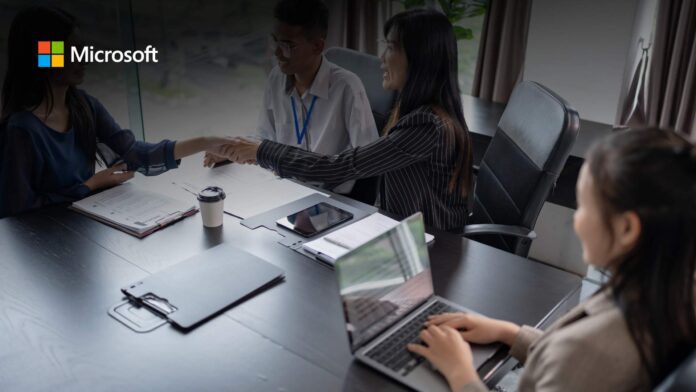

When most companies talk about AI-driven transformation, HR tends to be the last stop on the tour—after IT, engineering, sales, and anyone else who might get their hands on the “real” tech first. At Microsoft, however, HR isn’t waiting for permission or prototypes. It’s actively leading the company’s shift toward an AI-first operating model.
That was the headline message from Lesley Gong, HR Director for Microsoft Hong Kong and Taiwan, during a recent Asia HR Leaders Live Series discussion hosted by AsiaHRM Founder Rita Tsui. In a world where HR transformation is often reduced to buzzwords and pilot programs collecting dust, Gong’s perspective offered something rarer: a clear, operational blueprint for how AI is actually changing HR inside a company that’s building the tools driving the change.
And if you’re wondering whether this is just another “future of work” panel full of platitudes—consider this: 94% of Microsoft’s HR team are already monthly active Copilot users.
This isn’t a thought experiment. It’s a system-sized shift happening in real time.
HR as the First Mover, Not the Follower
Gong, whose background spans Amazon, Alstom, and nearly eight years at Microsoft, called the last chapter of her career “the most transformative.” That’s not surprising; the company has moved from digital to AI transformation at a speed very few enterprises can match.
But the point she repeatedly returned to was this: HR wants to be first.
“We stand in front of the trend,” she said. “We’re not only welcoming new technologies; we’re defining how HR should use them.”
If that sounds bold for a function historically bogged down in compliance and back-office tasks, the results back her up. Microsoft HR didn’t simply add AI to old workflows; it rebuilt the operating model around it.
Turning AI Into Measurable HR Value
Microsoft designed its HR AI strategy around a simple rule: focus only on initiatives that support core people priorities and are measurable from day one.
The result: not hypothetical value, but quantifiable impact.
Key AI Outcomes from Microsoft HR
-
20% increase in case management efficiency via Copilot-enabled workflows
-
22% faster case resolution
-
LinkedIn Recruiter’s AI boosted candidate response rates from 49% to 66%
-
94% of HR staff are monthly Copilot users
-
Real-time insights via D365 Copilot, from Outlook summaries to meeting intelligence
If you’ve been tracking enterprise adoption data—say, the 2025 McKinsey or MIT AI readiness reports—these stats are outliers. Most large organizations aren’t remotely close to Microsoft’s adoption levels. Many are still stuck at the “pilot” stage, and nearly two-thirds admit they haven’t scaled AI at all.
Microsoft is operating in a completely different lane.
And yet, Gong’s framing was notably human:
“At the core, AI is about being more human.”
AI isn’t here to replace people—it’s here to give them time back, reduce admin burdens, and allow HR to focus on organizational design, leadership, and culture.
“What If?” The Culture Driving HR’s AI Leap
Microsoft’s internal culture, famously reshaped under CEO Satya Nadella, is built on curiosity and experimentation.
For HR, that means asking—and acting on—a deceptively powerful question:
What if?
-
What if AI could replace a legacy workflow?
-
What if AI could solve your biggest HR bottleneck?
-
What if HR could shift from admin-heavy to strategic overnight?
This mindset isn’t a “soft skill” at Microsoft; it’s operationalized.
HR teams are encouraged to test, pilot, break, rebuild—and mainstream what works. Gong noted that the teams most successful with AI are those that challenge entrenched routines and are willing to unlearn.
Responsible AI: Table Stakes for HR
Plenty of companies talk about Responsible AI. Microsoft operationalizes it.
Every HR employee is trained not just in using AI but in:
-
data governance
-
permissions
-
enterprise security
-
privacy
-
risk mitigation
-
responsible use frameworks
In a function managing compensation data, performance files, employee relations cases, and sensitive personal information, this isn’t optional—it’s existential.
A Three-Layer Model for Rapid, Scalable HR Adoption
One reason Microsoft can move faster than most large enterprises is its structured adoption model. Gong’s breakdown offers a blueprint other HR leaders could steal tomorrow.
1. Subject Matter Experts (SMEs)
Volunteer experts embedded in every HR team collaborate with engineering and test new AI scenarios. They’re the bridge between product and people.
2. Early Adopters
Passionate HR staff test prototypes, run community channels, and build grassroots momentum—critical for de-risking and accelerating rollout.
3. Managers & Leaders
The top-down force ensuring adoption isn’t optional. Leaders set expectations, reward innovation, and remove barriers.
This structure creates distributed ownership—no one is waiting for HQ or IT to hand them a roadmap.
Gong put it simply:
“High-touch engagement is key.”
The Hard Truth: Employees Fear AI—But HR Must Lead Through It
Workers worry about losing jobs, falling behind, or being unable to keep up with new tools.
Gong didn’t sugarcoat it. Yes, some roles will change. Yes, the workload will shift. But avoiding innovation won’t protect jobs.
Instead, the goal is to evolve roles—like Microsoft did this year when HR stepped out of the annual rewards process for all employees below the GM level. Business leaders now take full responsibility, and HR focuses on strategic priorities.
“This is how AI helps people thrive. We release HR from routine tasks and move them toward impactful, strategic contributions.”
The Leadership Blueprint: Adaptive, Experimental, Uncertain—By Design
One of Microsoft’s most underrated strengths is leadership development. Gong highlighted its adaptive leadership training, which teaches leaders how to operate when they don’t have the right answer—because in AI transformation, no one does.
Adaptive leadership encourages:
-
rapid testing
-
learning through ambiguity
-
collaborative problem solving
-
innovation instead of perfection
It’s a skill, not a personality trait—and Microsoft is training leaders across functions to master it.
Why Microsoft’s HR Transformation Matters for Every Company
For years, HR has talked about digital transformation without ever being centered in the strategy. AI changes that, but only if HR grabs the wheel.
Microsoft’s example shows that:
-
AI in HR is not a tech project
-
HR can be a corporate innovation engine
-
transformation requires cultural change, not just tools
-
a structured adoption model drives sustainable scaling
-
responsible AI is essential for HR credibility
And most importantly, HR doesn’t have to wait for the business to move first.
As Gong put it,
“This time, HR wants to be the first group to adopt AI.”
For once, HR isn’t catching up. It’s setting the pace.




