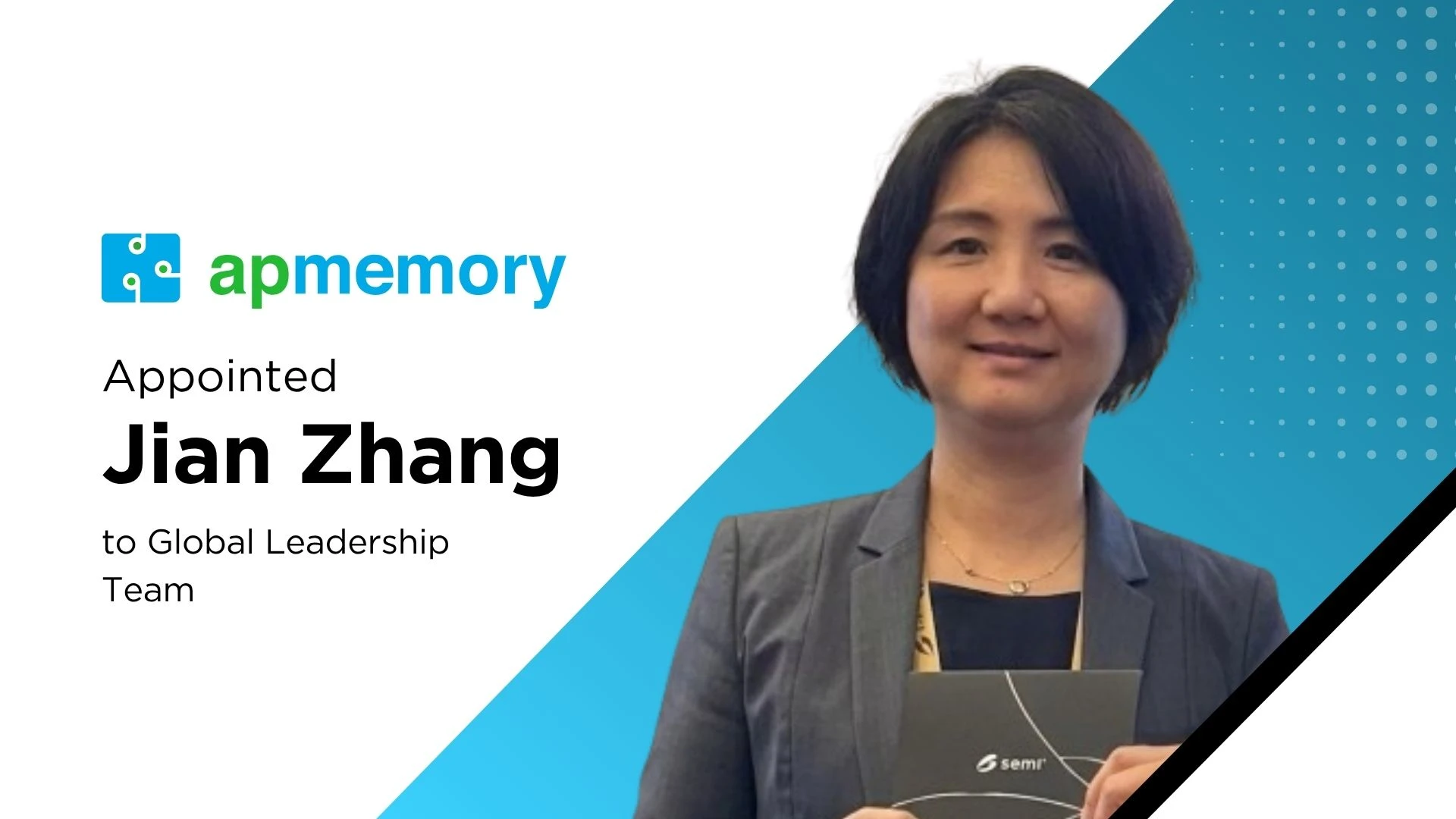
The semiconductor industry’s race to support artificial intelligence, high-performance computing and edge applications is creating demand not only for advanced memory technologies but also for specialised engineering talent. AP Memory has appointed semiconductor veteran Jian Zhang to its leadership team, bringing more than 30 years of experience spanning product development, test engineering, foundry operations, supply chains and global engineering organisations.
The semiconductor industry’s talent challenge is becoming increasingly complex as demand for AI infrastructure, high-performance computing and edge devices pushes companies to develop new technologies while operating across increasingly global supply chains.
AP Memory is responding by adding an experienced engineering and operations leader to its management team.
The company has appointed Jian Zhang, a semiconductor executive with more than three decades of global industry experience, to help strengthen technology development, product engineering, operations management and customer collaboration as AP Memory expands internationally.
Zhang joins AP Memory after serving as Vice President of Product Development and Test Engineering at Qualcomm, where she led engineering teams across Taiwan, Singapore and China.
Her responsibilities included post-silicon validation, production-test development, yield improvement, product-quality initiatives and customer failure analysis. She also established Qualcomm’s Product Development and Test Engineering team in Taiwan and helped create the company’s first advanced diagnostic laboratory there.
One aspect of Zhang’s background is particularly relevant to the industry’s current direction: her experience applying artificial intelligence and machine learning to engineering operations.
At Qualcomm, she introduced AI and ML technologies to improve engineering efficiency, test analytics and system-level debugging. Those applications illustrate how AI is moving beyond chip design and into the engineering processes used to develop, validate and manufacture semiconductor products.
For semiconductor companies, that transition has workforce implications.
Engineering teams are increasingly expected to combine traditional domain expertise with data science, automation and AI capabilities. Product development and testing generate enormous amounts of data, and AI can potentially help engineers identify anomalies, analyse failure patterns and accelerate debugging.
The value, however, depends on having engineers who understand both the underlying semiconductor systems and the AI tools being applied to them.
Zhang’s career spans that intersection.
Before Qualcomm, she was Vice President of Front-End Innovation and Foundry Operations at NXP Semiconductors, where she managed teams across Europe, the United States and Asia. Her responsibilities included technology roadmaps, new technology and product introductions, foundry strategy, cost management and capacity planning.
She also managed NXP’s global foundry strategy, coordinating internal wafer fabrication facilities with external foundry partners based on technology capabilities, cost and capacity.
That experience is significant because semiconductor organisations increasingly operate as global ecosystems rather than isolated companies. Chip development can involve teams in multiple countries, specialised manufacturing partners, outsourced testing and customers distributed across several markets.
Managing those operations requires more than technical expertise. It requires leaders capable of coordinating teams across cultures, time zones and organisational boundaries.
For HR and workforce leaders, semiconductor companies offer a useful example of how the definition of technical talent is changing.
The most valuable engineering leaders increasingly combine deep technical knowledge with experience in global operations, supply-chain management, customer collaboration and organisational development. At the same time, companies need specialists in areas such as AI, machine learning, semiconductor process technology, verification, testing and advanced manufacturing.
The competition for those skills is intensifying as AI infrastructure expands.
AP Memory’s focus on customised memory solutions places it within a market benefiting from increased demand for memory performance, power efficiency and system integration. AI workloads, high-performance computing and edge applications all place different demands on memory architectures and system design.
That market opportunity creates a corresponding workforce requirement.
Companies need engineers who can develop new technologies while also improving manufacturing yields, reducing costs and maintaining product quality. They also need leaders who can translate technical capabilities into customer requirements and coordinate execution across global operations.
AP Memory CEO and CTO Wen Chen said Zhang’s experience would help strengthen technology management, cross-regional collaboration and organisational capabilities as the company expands its customer footprint.
The appointment also highlights the importance of leadership development in a sector where organisational complexity can increase as quickly as technical complexity.
For growing semiconductor companies, adding senior executives with experience managing multinational engineering teams can provide access to established processes for product development, manufacturing strategy and talent coordination. It can also help companies build the organisational infrastructure required to scale without losing engineering discipline.
Zhang’s experience establishing engineering organisations at Qualcomm offers one example of that capability.
Her work in Taiwan involved building a Product Development and Test Engineering team and an advanced diagnostic laboratory. Such initiatives require hiring specialised talent, creating technical processes, defining team structures and developing collaboration models between engineering functions.
Those organisational skills can be as important to a technology company’s growth as individual technical breakthroughs.
AP Memory said the appointment forms part of its longer-term commitment to technology investment and organisational development. The company also plans to continue attracting global talent and expanding its international organisation and customer collaboration network.
For the semiconductor workforce, the direction is clear. As AI and edge computing create new technical requirements, companies will need leaders who can connect advanced engineering with global execution.
The next competitive advantage may therefore come not only from better memory technology, but from the ability to assemble and coordinate the specialised talent required to develop it.
Market Landscape
The semiconductor industry is experiencing a convergence of AI, advanced computing, edge devices and increasingly complex manufacturing ecosystems. This is putting pressure on companies to recruit engineers with hybrid capabilities across semiconductor technology, software, AI and data analytics.
The workforce challenge extends beyond hiring. Semiconductor companies also need to retain experienced engineers, transfer institutional knowledge and build leadership pipelines capable of managing globally distributed teams.
AI is adding another layer. Engineering organisations are using machine learning for testing, anomaly detection, yield analysis, debugging and optimisation, creating demand for professionals who understand both semiconductor engineering and AI-enabled workflows.
For AP Memory and its peers, global talent strategy is therefore becoming part of technology strategy. The ability to recruit and coordinate specialised engineering teams across regions can directly influence how quickly companies develop products and respond to customer requirements.
Top Insights
- AP Memory has appointed Jian Zhang, a 30-year semiconductor veteran, to strengthen technology development, engineering, operations and global customer collaboration.
- Zhang’s Qualcomm experience includes deploying AI and machine learning for test analytics, engineering efficiency and system-level debugging, highlighting AI’s expanding role in semiconductor workflows.
- Her NXP experience managing global foundry operations demonstrates the leadership capabilities required to coordinate complex semiconductor teams, suppliers and manufacturing networks.
- Growing AI and edge-computing demand is increasing the need for engineers who combine semiconductor expertise with AI, analytics and global operational skills.
Join thousands of HR leaders who rely on HRTechEdge for the latest in workforce technology, AI-driven HR solutions, and strategic insights