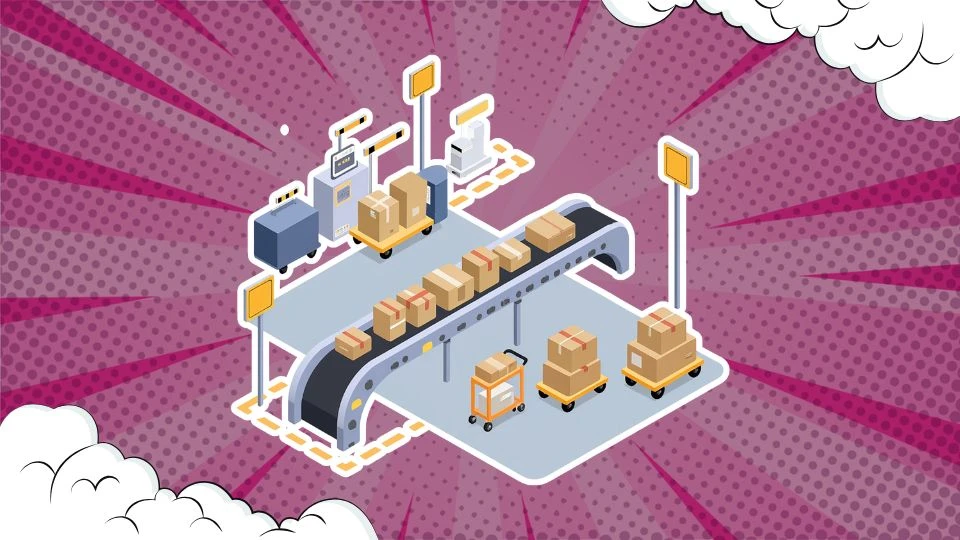
Warehouse operations are often taught as a series of individual processes—receiving, storage, picking and shipping. James Goldman’s new book, How a Warehouse Really Works, takes a systems-level approach, showing students and professionals how inventory, labor, technology, equipment and operational decisions interact across the entire warehouse.
Warehouse management has become increasingly dependent on software, automation, data and tightly coordinated processes, but understanding how those technologies fit into the physical operation remains a challenge for students entering supply chain careers.
That is the focus of James Goldman’s new book, How a Warehouse Really Works: The Essential Guide to Understanding and Improving Warehouse Operations, published by Dirigold Publishing.
The book is designed for educators, students, warehouse practitioners and workforce-development programs seeking a practical explanation of how modern warehouse operations function as an interconnected system.
Rather than treating receiving, storage, inventory management, picking and shipping as independent activities, Goldman follows the movement of inventory across the operation and examines the dependencies between each stage.
That approach is increasingly relevant as warehouses become more technologically sophisticated.
A modern distribution center can combine a warehouse management system (WMS), barcode scanning, robotics, automated storage and retrieval systems, labor-management tools, inventory analytics and increasingly AI-enabled software. Yet technology does not eliminate the need to understand the underlying processes.
If receiving information is inaccurate, inventory records can become unreliable. If replenishment fails, pickers may encounter empty locations. If picking priorities are poorly configured, packing and shipping can become bottlenecks.
The warehouse works as a system.
From receiving to reverse logistics
Goldman’s book maps that system from beginning to end.
The physical flow covered in the book includes receiving, verification, putaway, storage, inventory control, replenishment, picking, packing, staging, shipping and returns.
That sequence provides a foundation for understanding why warehouse performance cannot be measured by a single metric.
Inventory accuracy affects picking. Picking performance affects packing. Packing affects shipping throughput. Returns feed information back into inventory and operational processes.
The book also addresses cycle counting and exception management, areas that can become increasingly important as organizations seek accurate real-time inventory information across warehouses and fulfillment networks.
For students, the end-to-end approach provides context that can be difficult to gain from studying individual logistics functions in isolation.
For working professionals, it offers a framework for examining how decisions made in one part of a facility affect downstream performance.
Warehouse technology is part of the system
The role of technology is another important dimension.
Warehouse operations have evolved from largely manual environments into increasingly digitized systems. Amazon has demonstrated the scale of robotics and software-driven fulfillment, while companies such as Microsoft, SAP and Oracle provide enterprise platforms that connect supply chain, inventory and operational data.
Specialized warehouse technology vendors also provide WMS platforms, automation controls, robotics and analytics.
But implementing technology does not automatically improve warehouse performance.
A WMS depends on accurate master data and disciplined processes. Automation depends on appropriate workflows and equipment integration. Analytics are only useful when organizations understand what the underlying measurements represent.
That makes operational knowledge increasingly valuable rather than obsolete.
Goldman draws on nearly three decades of experience in warehouse operations, logistics and warehouse management systems. He is also COO and founder of JGA Warehouse Systems Advisory Group.
The book attempts to translate that experience into language accessible to newcomers while retaining practical value for warehouse leaders.
Bridging classroom theory and warehouse reality
One of the book’s primary audiences is education.
Supply chain and logistics programs can teach inventory management, transportation, procurement and distribution without necessarily giving students a detailed understanding of how those functions operate together inside a warehouse.
That creates a gap between academic concepts and operational execution.
Goldman argues that warehouse education is most valuable when students can connect theoretical concepts to what happens on the warehouse floor.
That is particularly relevant as the logistics sector faces a growing need for workers who understand both physical operations and digital systems.
The World Economic Forum’s Future of Jobs Report 2025 identifies supply chain and logistics-related roles among occupations being reshaped by technology, while also highlighting the growing importance of analytical thinking, technological literacy and other skills.
For workforce-development organizations, this combination is significant.
The warehouse employee of the future may need to understand not only how to move inventory safely, but also how to interact with scanners, automated equipment, WMS interfaces, data dashboards and increasingly intelligent decision-support systems.
Why warehouse systems knowledge matters
The book’s timing also reflects a broader transformation in supply chain technology.
E-commerce has increased expectations around inventory visibility, order accuracy and fulfillment speed. Supply chain disruptions have pushed companies to reconsider resilience and inventory strategies. Automation is changing how facilities allocate labor and equipment.
At the same time, AI is beginning to influence demand forecasting, inventory optimization, computer vision, warehouse robotics and workforce planning.
Those developments increase the importance of understanding the underlying operating model.
An organization cannot effectively optimize a process it does not understand.
For employers, that means training programs need to develop systems thinking alongside technical skills. For educators, it means helping students understand why warehouse functions depend on each other.
Goldman’s book is positioned around that intersection.
A practical resource for the next generation of supply chain workers
The broader value of How a Warehouse Really Works is therefore not simply its description of warehouse processes.
It treats the warehouse as a connected operating environment in which people, inventory, equipment, information and technology interact continuously.
That perspective could become increasingly important as logistics organizations deploy more automation and AI.
The technology may handle more individual tasks, but people will still need to understand how those tasks fit into the larger system—and what happens when something goes wrong.
For educators, that makes warehouse systems a useful bridge between classroom theory and real-world supply chain execution.
For professionals, it provides a structured way to examine operational dependencies.
And for employers investing in workforce development, it highlights a fundamental principle of modern logistics: digital transformation works best when technology is built on a strong understanding of the operation it is designed to improve.
How a Warehouse Really Works is now available in print and digital formats through Amazon, while educators and training organizations can contact Goldman regarding evaluation copies, classroom adoption and bulk orders.
Market Landscape
Warehouse technology is moving toward increasingly connected operations.
Warehouse management systems, robotics, computer vision, automated material handling, IoT sensors and AI are becoming part of the modern distribution environment. The result is a warehouse where physical inventory flows are increasingly coordinated through software.
Research from Gartner and other supply-chain analysts has consistently identified warehouse automation, digitalization and AI as important areas of investment as organizations pursue greater productivity and resilience.
The challenge is that technology adds complexity as well as capability.
A warehouse can have sophisticated automation and still struggle with inaccurate inventory, poor process design or inadequate employee training. That is why warehouse education increasingly needs to cover both operational fundamentals and technology literacy.
Goldman’s systems-oriented approach fits that requirement by connecting individual warehouse functions to the broader performance of the operation.
Top Insights
- James Goldman’s new warehouse operations book maps inventory from receiving through returns, helping students and professionals understand interconnected logistics processes.
- The book combines warehouse labor, equipment, safety, technology and performance measurement, reflecting the increasingly digital nature of modern distribution operations.
- Its systems-based approach addresses a common training challenge: explaining how decisions in receiving, inventory or replenishment affect downstream warehouse performance.
- Warehouse automation and AI increase demand for workers who understand both physical logistics processes and digital systems such as WMS platforms.
- The book targets educators, employers and workforce-development organizations preparing the next generation of supply chain and warehouse professionals.
Join thousands of HR leaders who rely on HRTechEdge for the latest in workforce technology, AI-driven HR solutions, and strategic insights