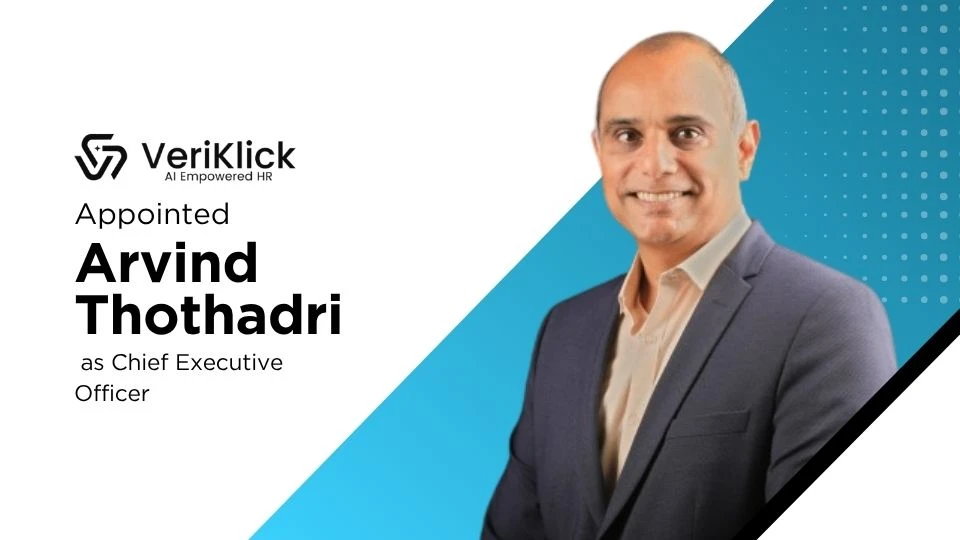
AI is reshaping how employers source, assess and authenticate candidates, and HR technology providers are expanding leadership teams to capture that shift. VeriKlick has appointed veteran HRTech executive Arvind Thothadri as CEO of VeriKlick India, giving the company’s India operation a leader with more than three decades of business experience and over two decades in technology-led candidate assessment and HR technology.
Recruitment technology is moving beyond applicant tracking and résumé screening. Employers increasingly want systems that can evaluate skills, authenticate candidates and use artificial intelligence to make hiring workflows faster and more reliable.
VeriKlick is strengthening its position in that market with the appointment of Arvind Thothadri as CEO of VeriKlick India.
Thothadri brings more than 30 years of global business leadership experience and more than 20 years working in technology-led businesses spanning candidate assessment and HRTech, according to the company. He is also an alumnus of IIM Lucknow.
The appointment gives Thothadri responsibility for VeriKlick India’s strategic direction, talent growth and operational expansion as the company develops AI-powered recruitment assessment and candidate authentication technologies.
The timing is notable.
Artificial intelligence is changing both sides of the hiring process. Employers are using AI to identify candidates, evaluate applications and automate administrative work, while applicants increasingly have access to generative AI tools that can help produce résumés, cover letters and interview responses.
That creates a new problem for HR teams: how can employers distinguish between a candidate’s demonstrated ability and content generated or assisted by AI?
Candidate assessment and authentication platforms are emerging as one answer.
AI Moves Deeper Into Talent Assessment
VeriKlick positions its technology around intelligent recruitment, candidate authentication and talent assessment.
Rather than treating hiring as a sequence that ends with résumé screening, this category of HR technology attempts to generate additional evidence about candidates through structured assessments and verification mechanisms.
For enterprise employers, the potential benefit is a richer view of candidate capability before a hiring decision is made.
That is especially relevant for Global Capability Centers (GCCs), which have become major hubs for technology, engineering, finance, analytics and other specialized roles.
GCC hiring frequently involves large candidate pools and specialized skill requirements. Assessment technology can potentially help employers standardize parts of that process while allowing recruiters to concentrate on higher-value evaluation and engagement.
VeriKlick says Thothadri will focus on expanding the company’s support for GCCs and global enterprises seeking to modernize their hiring infrastructure.
An Executive With HRTech Experience
Thothadri’s background is closely aligned with the company’s current direction.
The company describes him as having experience building businesses from the ground up and scaling them toward long-term profitability, alongside leadership roles involving large multinational organizations and high-growth technology businesses.
His more than two decades of experience in candidate assessment and HR technology could be particularly relevant as recruitment platforms increasingly converge with AI and talent intelligence.
Komal Dangi, CEO of VeriKlick, said Thothadri’s understanding of the HRTech ecosystem and experience scaling AI talent platforms would support the company’s next phase of expansion.
The appointment also highlights how specialized knowledge is becoming increasingly important in AI recruitment.
AI expertise alone does not necessarily translate into effective HR technology. Hiring systems operate in a sensitive environment involving employment decisions, candidate privacy, bias, explainability and regulatory considerations.
Executives working at the intersection of technology and talent therefore need to understand both the underlying technology and the operational realities of recruitment.
India Becomes a Strategic AI Hiring Market
India is an increasingly important market for enterprise HR technology, both as a large talent market and as a base for global technology operations.
GCCs have expanded beyond traditional back-office functions, with many now involved in engineering, product development, artificial intelligence, cybersecurity and advanced analytics.
That creates demand for recruitment systems capable of identifying specialized technical and professional skills at scale.
It also creates a competitive environment for HRTech providers.
Platforms such as Workday, SAP SuccessFactors, Oracle, LinkedIn and Eightfold AI are building increasingly sophisticated talent intelligence and AI capabilities. Specialist providers are competing through assessment, interviewing, verification and skills intelligence.
VeriKlick’s focus on candidate authentication and assessment places it in a narrower part of that ecosystem.
The differentiation will ultimately depend on whether its technology can produce reliable candidate signals while fitting into the existing workflows used by recruiters and enterprise HR teams.
The Authentication Challenge
Candidate authenticity is becoming a more important consideration as AI becomes commonplace in recruiting.
A candidate can now use generative AI to improve written applications or prepare highly polished interview responses with relatively little effort. While these tools can help legitimate candidates communicate their experience, they can also make it harder for employers to determine whether an applicant’s submitted work reflects their own capabilities.
That is pushing HR technology toward more direct measurement.
Skills assessments, structured interviews, identity verification, behavioral signals and work simulations can provide additional evidence beyond what a résumé says.
The challenge is avoiding an arms race in which employers add increasingly intrusive technology to counter increasingly sophisticated AI assistance.
Enterprise buyers will therefore need to evaluate assessment systems not just on automation and detection claims, but also on candidate experience, data protection, explainability and the validity of the underlying assessments.
Building a Modular Talent Ecosystem
Thothadri described the intersection of AI and talent intelligence as an opportunity to build a large, modular talent ecosystem.
That vision reflects where HR technology is heading.
Recruitment is becoming less dependent on isolated tools and more connected across sourcing, assessment, verification, interviewing, onboarding and workforce intelligence.
For VeriKlick, the India leadership appointment provides an opportunity to build that ecosystem in a market with a large technology workforce and a growing enterprise demand for specialized talent.
Whether the company can translate its AI and authentication capabilities into measurable improvements in hiring quality will determine the next stage of its growth.
For now, Thothadri’s appointment signals that VeriKlick intends to compete not simply as an assessment provider, but as part of the emerging infrastructure for AI-enabled, skills-based and authenticated hiring.
Market Landscape
The HRTech market is shifting toward skills-based hiring, talent intelligence and AI-assisted recruitment.
The World Economic Forum’s Future of Jobs Report 2025 found that skills gaps remain one of the biggest barriers to business transformation, with 63% of employers identifying them as a major challenge. The report also projects significant changes to the skills required by workers through 2030.
That pressure is driving investment in technologies that can identify and evaluate skills more effectively.
The competitive landscape includes broad HCM platforms such as Workday, Oracle and SAP SuccessFactors, talent intelligence providers such as Eightfold AI, professional talent networks such as LinkedIn, and specialist assessment and verification companies.
The next competitive frontier may be candidate authenticity.
As generative AI makes conventional application materials easier to produce, employers have greater incentive to validate skills through assessments and structured evaluation. That creates an expanding market for technologies capable of generating trustworthy evidence without adding excessive friction to the hiring process.
For GCCs and large enterprises, the ability to combine assessment, authentication and AI-powered talent intelligence could become particularly valuable when recruiting at scale.
Top Insights
- VeriKlick appointed Arvind Thothadri CEO of India, bringing decades of business leadership and more than 20 years of HRTech and candidate assessment experience.
- Thothadri will lead India’s strategic expansion as VeriKlick develops AI-powered recruitment assessment and candidate authentication capabilities for global enterprises.
- Candidate authentication is becoming more important as generative AI makes résumés, applications and interview preparation easier to automate and personalize.
- GCCs could become an important customer segment as enterprises seek scalable systems for assessing specialized technology and professional talent.
- VeriKlick faces competition from Workday, SAP, Oracle, LinkedIn and specialist talent intelligence platforms as HR technology becomes increasingly AI-driven.
Join thousands of HR leaders who rely on HRTechEdge for the latest in workforce technology, AI-driven HR solutions, and strategic insights