1. “Systemic” improvement of work is a harder thing to build, sell, and measure than task acceleration. How do you define the outcome when the thing you’re improving is the system rather than the individual task inside it?
We look at before and after, and define the outcome as a visible shift to new ways of working, with real time and money savings. Our platform understands how teams are working today from an organizational perspective. That shows us the key parts of the system that need to change.
It’s also about time and money. We know the blended cost rate for different departments and teams, so we can see the value being wasted on manual tasks. When we build workflows, the platform understands the time, steps and pain points each team is dealing with. From there we reclaim that time and redirect it toward the company’s OKRs, so it isn’t just time saved but value created.
Mostly, the benefit is visibility. Teams don’t know how they work or how they interact with other teams. Each one sits inside its own system. We show everyone what’s actually happening. In our data, people complain about not being able to see where work is 4.5 times more often than they complain about speed. That visibility is the eye-opening moment that gets teams to lean into new ways of working.
2. The shift from specialist acceleration to systemic improvement requires organizations to think about work differently before they can buy technology. How many of the organizations you talk to have made that cognitive shift?
Not many. Most companies have bought AI, but they aren’t seeing the value because they don’t have a single source of truth for their data. Out-of-the-box frontier models are entirely dependent on the quality of data you give them. The majority of companies we work with haven’t built that single source of truth. They need to gather their data first, so the models have the context and information about that specific company, team and individual. That’s why we’ve focused development on unifying the data view.
3. Nearly half of all handoffs between tools still involve a human. That means the integration problem isn’t being solved by the tools themselves, people are the integration layer. What does that cost an organization, and how are you measuring it?
For years we’ve used humans as software. Go do this, go do that, talk to this person. In our data, 48.9% of handoffs between tools still involve a person. The median for companies we work with is 52 tools, and every one of those handoffs is someone copying, checking, chasing or re-entering something.
We measure it by timing the actual workflows. Across the companies we timed, the average company spends 424 hours a week on documented processes, and 110 of those hours are recoverable. At $100 an hour that’s about $510,000 a year. Two thirds of that recoverable time sits in the top 10% of processes, so most companies don’t need to fix everything. They need to fix the right few things.
The big unlock now is that we have software that can act like humans. The trick is creating the environment for these AI tools to do that work well.
4. The organizations most affected by AI gaps tend to be the ones that moved fastest on AI adoption. Is that pattern consistent with what your data shows, and what does it say about how organizations should have been sequencing their AI investments?
I’d be careful saying that’s universal. There are so many factors in AI adoption: organizational, technical, governance and agency.
If a business has a culture where people lack agency, being told to hand that agency over to AI, or being seen to hand it over, is even more disruptive and less effective. You can have two teams in the same company moving at completely different speeds.
Setting up an environment for AI-native work is the single biggest thing an organization can do. It gives teams the right frameworks to succeed, whatever speed they started at.
5. The technology industry has a structural incentive to sell more tools. Is the AI gap problem solvable within the current vendor model or does fixing it require a fundamental change in how enterprise software is built and sold?
We believe SaaS is both the key to this work and the single biggest risk to it. A lot of the SaaS companies use is becoming worthless because it only does one narrow thing from one point of view. We do a lot of work removing software from organizations.
Many people are rushing to vibe code their own solutions. That has its place. But for governance, security and maintenance, you can get the same results by configuring SaaS, without any of those hangovers.
The sustainable path is to, build highly customized business workflows and systems by configuring existing SaaS. I think that’s the unlock a lot of people are missing.
6. The conversation in boardrooms right now is about AI ROI. How do you make that argument land with a CEO who is being told by their technology vendors that more AI is the answer?
I don’t think those two things are connected. ROI is only ROI if it exists.
From our experience, nine times out of ten the ideas and projects the C-suite wants to sponsor are the wrong things to work on. There’s a lot of emphasis on big, complex AI projects. Meanwhile the team doing the actual work is drowning in spreadsheets and multiple logins just to get through the simplest daily task.
Once a CEO sees that two thirds of the waste sits in a handful of processes, the question stops being “how much AI?” It becomes “fix those five things first.”
7. If the problem is systemic then the solution has to be systemic too. What does that look like as a product or a platform, and why hasn’t it existed before?
A systemic solution has to do four things:
Find the broken work
Design the new work
Help with change management
Track the changes, so you understand their impact and how they’re affecting the teamsWe’ve flipped the consulting model on its head. Traditional consulting is a window in time. Consultants are there for a week or a month to understand how the teams work, then they leave behind a static work map that’s already obsolete. Companies are organisms. If you make a bunch of changes on one side, it affects the other side of the business; and everything is always in motion.
Now that AI can interview the whole team in parallel and keep the picture current, we can provide real-time, always-on consulting. It helps leaders understand the true status of their teams, departments and individuals, so they can value work accurately.
8. Changing how work flows through an organization is a change problem. The tools can be connected but the processes, accountability, and the habits still have to change. How does your solution account for the human and organizational layer?
We’re doing a lot more work to understand the human layer. That includes how people engage with the software and tools they’re asked to use, whether teams have enough agency to make decisions, and whether they have the right leadership structure.
Because people are in every step of the work, we need to understand how teams operate at that human level. We’re working with a number of teams on this now, including figuring out whether the right people are in the right roles.
We can already see the organizational layer, because we map every individual workflow that’s happening across the business.
A big part of this work is making sure the team is part of the change. The people doing the work tell us how it runs today, and their managers decide what changes and how fast. Then the team needs to own the new way of working, so it sticks.
9. The data you’re citing is coming from somewhere. How did you gather it, and how confident are you that it reflects the state of operations rather than a sample that confirms the thesis you already had?
The numbers we’ve published come from our own client work: 680 processes across 128 companies in 10 sector groups, captured in AI-led interviews and recorded working sessions. The time data comes from 187 processes at 6 companies where we timed the work, covering 2,546 hours a week. Those times are what people stated in those sessions, not tool logs.
There are real limits. These are companies that came to us, so they already suspected they had a problem. The timed set is small, and self-reported time can be off in either direction. So I’d treat the numbers as a strong signal from the field, not a census of every company. We publish how we measure on our site so people can check our method.
We know collectively how teams are working, where their workflows are broken, and where a new workflow is causing more pain than the old one. We can also see how people work inside tools like Slack and Airtable. All of that data gets crunched and filtered so that the Ace brain we create for every client is based on the most relevant information.
A workflow change someone talked about nine months ago is less important than a conversation that happened yesterday, so our system is designed to filter for that. It also dreams at night, reprocessing the data to come up with clear recommendations for our clients to act on.
The numbers we’ve published come from our own client work: 680 processes across 128 companies in 10 sector groups, captured in AI-led interviews and recorded working sessions. The time data comes from 187 processes at 6 companies where we timed the work, covering 2,546 hours a week. Those times are what people stated in those sessions, not tool logs.
There are real limits. These are companies that came to us, so they already suspected they had a problem. The timed set is small, and self-reported time can be off in either direction. So I’d treat the numbers as a strong signal from the field, not a census of every company. We publish how we measure on our site so people can check our method.
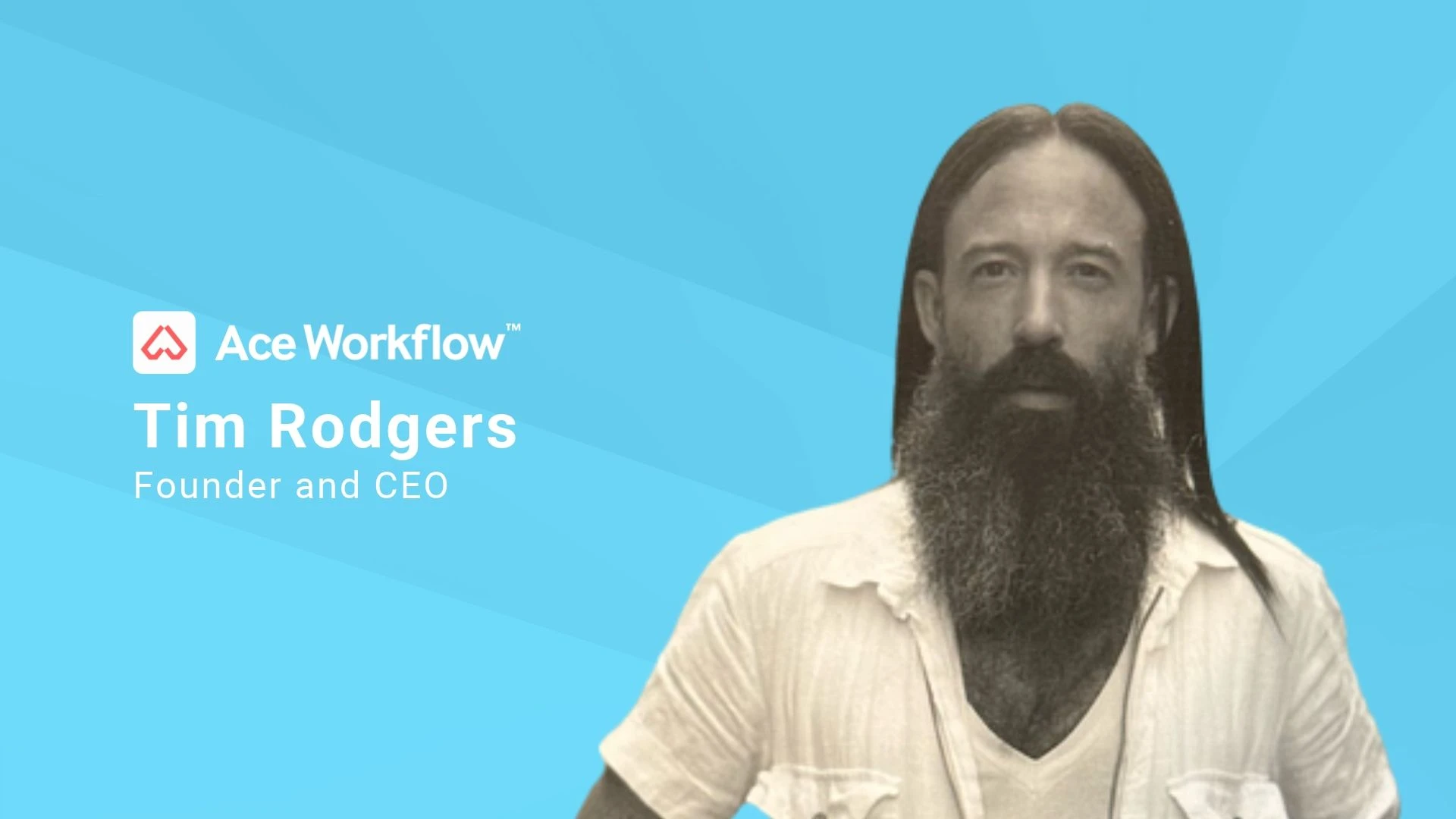
Tim Rodgers Bio
New York City.
Founder, Ace Workflow™
Tim Rodgers is an Emmy and Cannes Lions winning creative technologist and the founder of Ace Workflow, an operational intelligence company.
Ace finds the manual work draining a team, rebuilds it inside the tools that team already pays for, and then runs it. Four stages: Discover, Design, Build, Run. A team of 50+ forward deployed experts has delivered 311+ projects across more than 100 companies, including MasterClass, Warner, and Bessemer Venture Partners. As an Airtable Gold Partner, Ace builds human and AI workflows that cut errors by up to 95%, pay for themselves in weeks, and give people back 20+ hours a week for the work they were actually hired to do.
Before Ace, Tim led Rehab, the award-winning creative technology company, for two decades, building it into one of the world’s most respected creative tech studios. His team created interactive and voice experiences for Disney, Google, Nike, Meta, HBO, and the Getty Museum, including the Emmy-winning Westworld interactive campaign and the AI-powered Stress Tester that predicted public reactions to Apple’s “Crush” ad.
Recognized by Forbes, TechCrunch, AdAge, and ADWEEK, Tim is a frequent speaker and judge at Cannes Lions, D&AD, The One Show, and the Scandinavian AI Summit.
From his startup roots in Belfast to his base in New York, the mission stays the same: fix work, and build systems that make work feel human again.