Almost all firms have employed AI in some form or another, but only around one out of every five gained any value out of it, per a recent poll of 110 HR managers from Gartner conducted in July 2026.
Roles are changing faster than titles. The activities that once defined early-career roles are now being reduced. The career path that used to be offered to employees no longer matches how the work is actually done. According to Gartner HR research from May 2026, CHROs should move away from experience-based career advancement toward skills-based career advancement systems. Not only is the career ladder unstable, but it no longer exists for most people.
What Are Traditional Career Ladders?
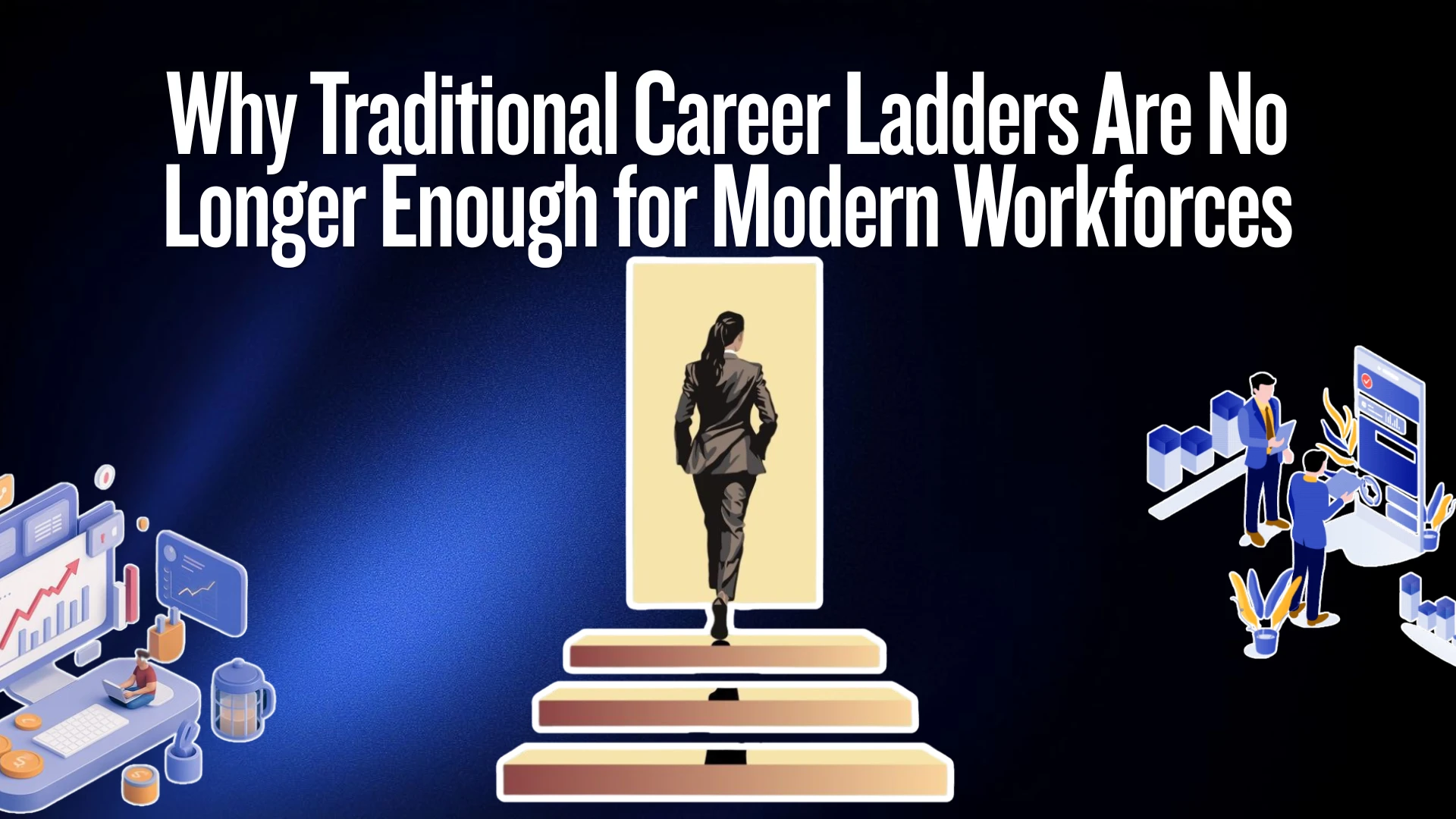
The classical career ladder can be referred to as a stiff and linear structure. Progression through the career requires strict ascent through predetermined levels within a particular department. It is characterized by a strong emphasis on tenure, experience, and competencies. Due to this vertical structure, the career of talented individuals can force them to adopt management positions that they are not interested in.
This situation pertains to a pre-existing Talent Management Suite system that was designed to enforce the stringent career path for sales roles. As per this setup, a worker starts out as a BDR and gets promoted to an Account Executive (AE) after 24 months from the start of work. Moving forward, the only means of earning the next pay grade would be by being elevated to the regional sales manager position. No lateral role switch is allowed through this system at all unless the HR overrides the move.
Why Transferable Skills Matter in Modern Career Development
- Skills persist after job titles. Since jobs will continue changing, the skills behind the job title are what truly last. According to Gartner from September 2026, being ready for AI means focusing on evergreen skills
- Adaptability pays off. According to Gartner’s survey of 3,086 employees, those who developed their adaptable skills were 3.8 times more likely to rate their skills readiness as high.
- Look for potential in addition to skills. According to Gartner, potential is the ability and willingness to learn new skills. However, 51% of managers asked their recruiters to only hire candidates who already had all the desired skills. This approach is expensive.
- Intentions remain ahead of actions. According to a Gartner survey, 74% of HR leaders believed most companies were shifting to skills-based talent management, but only 41% of them actually had some skills-based processes. Belief is an important component, but it is the easier one.
Integrating Career Development with Strategic Workforce Planning
When career development relates to strategic workforce planning, then it means it is shifting from rigid job titles to skill-driven systems. They use AI technologies to analysist skills, workforce gaps and match employees to critical business projects. Career growth should not be treated as an individual opportunity. Platforms now use personalized upskilling and internal mobility as the primary tool to fill enterprise talent shortage in real time.
This integration depends on the data provided by HR, finance, and operations that connects all the learning platforms, talent intelligence, and headcount budget. When the continuous skill development is directly connected to the operational needs. Then companies can shift their current employees instead of relying on the expensive external hiring. This results in a workplace where individual career growth directly drives long-term organizational capacity and financial ROI.
How AI Will Personalize Employee Career Development
From your work history, projects, and learning activity, AI can suggest your next steps or mentor your personalized talent chart. HCM suites often capture skills data manually rather than continuously, so the real value comes from systems that keep profiles live is seen as one of the current capability gaps.
According to Gartner research, companies still have problems getting benefit from AI in HR. When personalization is built on data or unclear logic, it creates a lack of trust. Employees will ask why they were not recommended for a role, and HR needs an answer. It is best to keep a manager in the loop for decisions that affect pay and progression.
How HR Leaders Can Move Beyond Traditional Career Ladders
HR leaders are shifting from traditional models and adapting smart skills architectures and internal talent marketplaces. Rather than moving step-by-step through job titles, employees now use modern HR tools to shape a career path that fits them. This helps them match with upskilling opportunities directly linked to functional projects and the real-time needs of the business.
Rethink Career Growth—Build a Future-Ready Workforce with Flexible Career Pathways!