
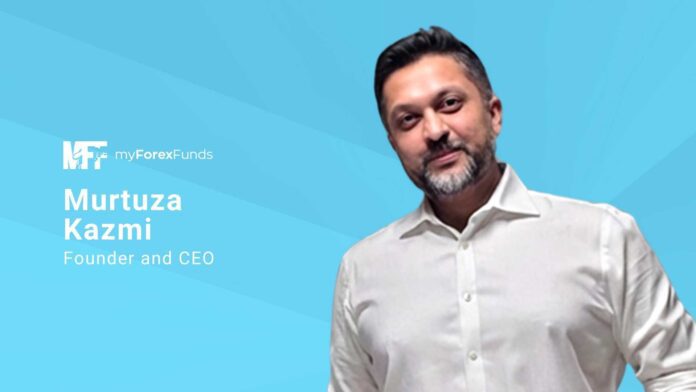

Responses by Murtuza Kazmi, Founder and CEO of MyForexFunds
.
1. Why is building a global workforce more complex than simply hiring remotely?
Hiring remotely is the easy part. Building a company that can actually function as one unit across continents is where the real work begins.
A lot of businesses assume global hiring is simply about finding talented people in different countries and giving them the right tools. In reality, that is only the starting point. The real challenge is creating alignment, accountability, and operational continuity across a workforce that spans multiple jurisdictions, time zones, and operating realities.
At MyForexFunds, we built a global workforce across three continents. Canada anchors executive leadership, finance, tax, compliance, and strategic direction. Greece became a major hub for trade operations, risk management, and platform technology. Pakistan and Dubai play important roles in operations, while customer service and broader support functions are extended across roughly 20 other countries, including the UK, Spain, the Netherlands, Turkey, Venezuela, and others.
What makes that work is not remote access. It is structure. Once a company reaches scale, global workforce management becomes an operating model, not a hiring strategy.
2. What is the difference between remote teams and truly global organizations?
A remote team is distributed. A true global organization is integrated.
You can have people working from many different countries and still not be operating as a single company. The difference comes down to whether the business has clear ownership, role specialization, and coordinated execution across regions.
We did not build around the idea of everyone doing everything from everywhere. We built around regional strengths. That created a real global operating model rather than a loose collection of remote workers. The company is not simply spread out geographically. It is structured to move together.
3. What are the operational realities of coordinating teams across multiple countries and time zones?
The biggest operational reality is that you cannot run a global company through meetings alone.
When your workforce stretches across continents, you have to design for continuity. Work needs to move without waiting for everyone to be online at the same time. That means decisions need to be documented clearly, responsibilities need to be explicit, and handoffs need to be well designed.
At MyForexFunds, this matters every day. A strategic, legal, or compliance matter might begin in Canada, trade operations or risk review might take place in Greece, and customer or procedural follow-through could happen through Pakistan, Dubai, or our broader international support structure. That only works if the organization is designed to operate as a connected system.
Time zones are not the problem. Poor design is the problem. If the operating model is strong enough, time zones become an advantage.
4. What must leaders do differently when workforce members and contractors operate across multiple jurisdictions?
Leaders have to stop thinking in terms of presence and start thinking in terms of system design.
Once a company operates across multiple jurisdictions, leadership becomes less about direct supervision and more about clarity, standards, and trust. Different countries bring different legal realities, cultural expectations, and ways of working. If leadership is not intentional, that complexity can easily fragment the business.
What worked best for us was establishing a strong global core—clear expectations, clear reporting, clear decision rights, and consistent standards—while allowing regional teams enough flexibility to execute well in their own environment.
A leader in a global organization cannot manage everything personally. The job becomes building a company that can operate properly even when you are not in the room.
5. What do companies often underestimate when scaling international teams?
They underestimate how quickly complexity compounds.
What feels manageable at 20 people becomes something very different at 160. A small communication gap becomes a service issue. An unclear handoff becomes an operational delay. One weak manager can create a bottleneck across multiple countries.
From my experience, one of the biggest lessons was that global growth is not mostly a talent challenge. It is a management and operating system challenge. Hiring is only one piece. The harder part is preserving alignment, quality, accountability, and execution as the organization expands across regions.
Companies often underestimate how much discipline global scale requires. Documentation, role clarity, onboarding, scorecards, manager quality, and cross-functional coordination all become far more important than people expect.
6. What infrastructure and support systems are required when digital platforms experience rapid global growth?
You need both technical infrastructure and human infrastructure, and both have to scale together.
On the technical side, that means reliable systems, strong platform architecture, internal tooling, secure access management, and clear ownership over uptime and incidents. But technical growth alone is not enough. You also need strong support systems around it: knowledge management, workflow design, service metrics, escalation structures, training systems, and cross-functional operating discipline.
Our structure made that very clear, in which Greece, Canada, Pakistan and Dubai, and the wider international workforce have different functions.
We are also seeing a major shift with AI. Our AI team in Canada now works across departments globally to improve support automation, knowledge systems, workflow routing, and internal decision support. Used properly, AI does not replace strong teams. It removes friction and helps those teams operate better at scale.
7. How can companies maintain alignment, accountability, and culture across distributed teams?
Alignment, accountability, and culture do not happen by accident in a distributed company. They have to be built deliberately.
Alignment comes from making priorities visible. Accountability comes from assigning clear ownership and measuring outcomes. Culture comes from consistency in how leaders behave, how decisions are made, and how people are treated across the company.
At MyForexFunds, we learned that culture could not depend on geography. It had to travel. That means building common standards across teams, creating visibility into goals and expectations, and making sure people understand how their work connects to the bigger system.
What I have found is that people do not need to sit in the same office to feel connected. But they do need to feel that they are part of something organized, fair, and moving in the same direction. Once that is in place, culture becomes much stronger than location.
.
.
About Murtuza Kazmi
Murtuza Kazmi is the Founder and CEO of MyForexFunds, one of the world’s most widely recognized prop trading platforms. A trader himself for most of his adult life, Murtuza founded MyForexFunds to remove barriers to capital access for skilled traders around the world. Under his leadership, the company grew rapidly into a global trading community, paying out hundreds of millions of dollars to traders and earning industry-wide recognition for transparency, speed of payouts, and community engagement. Following a prolonged legal battle with the Commodity Futures Trading Commission (CFTC), a U.S. court dismissed the CFTC’s case against MyForexFunds with prejudice, sanctioned the regulator, and awarded MyForexFunds its legal fees. Murtuza is now focused on rebuilding trust, restoring transparency, and shaping the future of the prop trading industry.




