
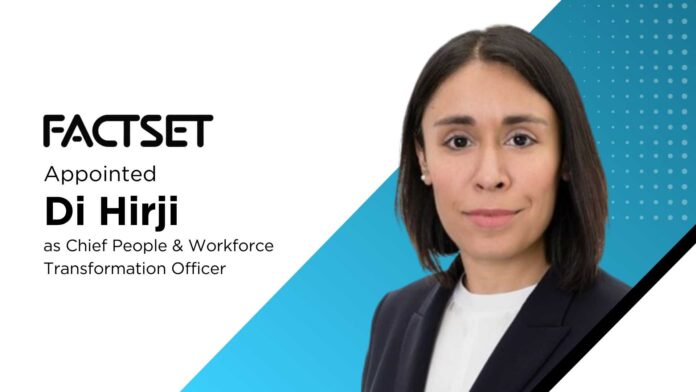

FactSet has appointed former S&P Global executive Di Hirji as its new Chief People & Workforce Transformation Officer, signalling that workforce transformation is becoming a strategic pillar of the financial data provider’s broader AI ambitions. The leadership change comes as enterprise technology companies increasingly reshape organisational structures, workforce skills, and operating models to support the transition toward AI-native businesses.
FactSet has named Di Hirji as its next Chief People & Workforce Transformation Officer, with the appointment taking effect on 3 August 2026. She succeeds Catrina Harding, who will remain with the company in an advisory capacity during the leadership transition after serving three years as the company’s senior human resources executive.
The appointment arrives at a pivotal moment for FactSet as the financial data and analytics provider expands its investment in artificial intelligence across its products, operations, and workforce. Rather than positioning HR as a traditional support function, the company is aligning its people strategy with its wider transformation agenda, reflecting a growing trend among enterprise technology organisations.
Chief Executive Officer Sanoke Viswanathan described workforce transformation as a critical component of FactSet’s evolution into an AI-native company. The executive’s comments highlight an emerging reality across enterprise software and financial technology markets: AI adoption increasingly depends not only on technology deployment but also on organisational redesign, workforce planning, and employee capability development.
Hirji brings more than two decades of international human resources and organisational transformation experience to the role. Most recently, she served as Chief People Officer for S&P Global Market Intelligence and S&P Dow Jones Indices, overseeing people strategy within one of the financial information industry’s largest organisations.
Before joining S&P Global, Hirji held senior HR leadership roles at Thomson Reuters and spent eight years at Accenture, where she advised Fortune 500 and FTSE 100 organisations on organisational change, leadership development, and workforce transformation initiatives. Her experience spans Europe, Asia, and the Americas, giving her exposure to multinational workforce strategies across highly regulated industries.
The appointment reflects a broader shift occurring across enterprise technology companies as artificial intelligence reshapes how work is organised. Rather than viewing AI solely as a productivity tool, organisations are increasingly integrating human resources leadership into enterprise transformation programmes that encompass skills development, organisational design, talent acquisition, and workforce planning.
FactSet’s emphasis on combining human expertise with “agentic” AI capabilities mirrors a wider industry movement. Enterprise software vendors, including Microsoft, Google, and Salesforce, have introduced AI assistants and autonomous agents designed to augment knowledge workers rather than simply automate isolated tasks. As these technologies mature, HR leaders are being tasked with helping organisations redesign workflows, establish governance frameworks, and prepare employees for increasingly collaborative human-AI environments.
Hirji echoed this perspective, describing FactSet’s transformation as “as much a people story as a technology one.” Her comments reinforce a growing consensus among HR technology leaders that successful AI adoption depends on workforce readiness, continuous learning, and organisational adaptability as much as software implementation.
The leadership transition also reflects the expanding strategic role of chief people officers within enterprise technology businesses. Increasingly, HR executives are responsible not only for recruitment and employee engagement but also for enterprise change management, digital transformation, workforce analytics, and leadership development.
Research supports the importance of this shift. McKinsey & Company has reported that organisations achieving the greatest value from generative AI combine technology investments with significant organisational and workforce transformation initiatives. Meanwhile, Gartner has forecast that AI will substantially reshape knowledge work and HR operating models over the coming years, increasing demand for skills-based workforce planning and continuous employee development.
For enterprise HR leaders, FactSet’s appointment underscores how workforce transformation is becoming a board-level priority rather than an operational function. As organisations accelerate AI adoption, leadership teams are increasingly recognising that technology investments require corresponding investments in people, culture, governance, and organisational capability.
The move may also influence the broader financial services technology sector, where firms are balancing regulatory requirements, specialised knowledge work, and rapid advances in AI-driven analytics. Companies operating in capital markets face unique challenges in integrating AI while maintaining data quality, compliance, and human oversight—making workforce transformation an essential complement to technology modernisation.
FactSet’s transition also acknowledges the contributions of outgoing executive Catrina Harding, who strengthened the company’s people organisation during a period marked by hybrid work, digital transformation, and evolving employee expectations. Her advisory role is intended to provide continuity as Hirji assumes responsibility for the company’s next phase of organisational development.
As enterprise organisations increasingly position HR leaders at the centre of AI transformation programmes, appointments such as Hirji’s illustrate how the future of work is becoming inseparable from broader digital strategy. For technology providers serving knowledge-intensive industries, competitive advantage may depend as much on workforce adaptability as on advances in AI itself.
Market Landscape
The appointment reflects one of the defining trends in enterprise HR technology: the convergence of AI strategy and workforce transformation. Organisations are moving beyond AI experimentation toward enterprise-wide adoption that requires new operating models, reskilling initiatives, and human-AI collaboration frameworks.
HR technology vendors are responding by embedding generative AI, workforce intelligence, and skills-based talent management into their platforms. At the same time, enterprises are increasingly elevating Chief People Officers as strategic partners responsible for enabling digital transformation rather than managing HR operations alone.
As AI adoption accelerates across financial services and enterprise software, workforce transformation is emerging as a competitive differentiator alongside cloud infrastructure, data platforms, and analytics capabilities.
Top Insights
- FactSet has appointed Di Hirji as Chief People & Workforce Transformation Officer to lead organisational change as the company advances its AI-native business strategy and workforce evolution.
- Hirji’s experience across S&P Global, Thomson Reuters, and Accenture positions her to oversee enterprise workforce transformation spanning organisational design, leadership development, and digital HR initiatives.
- The appointment reflects an industry-wide trend in which HR leaders play a central role in enterprise AI adoption, workforce planning, and human-AI collaboration strategies.
- Research from Gartner and McKinsey indicates that successful AI transformation increasingly depends on workforce capability development alongside technology investment and organisational redesign.
- Financial technology companies are placing greater emphasis on people strategy as AI reshapes knowledge work, governance, skills development, and employee experience across global enterprises.





