
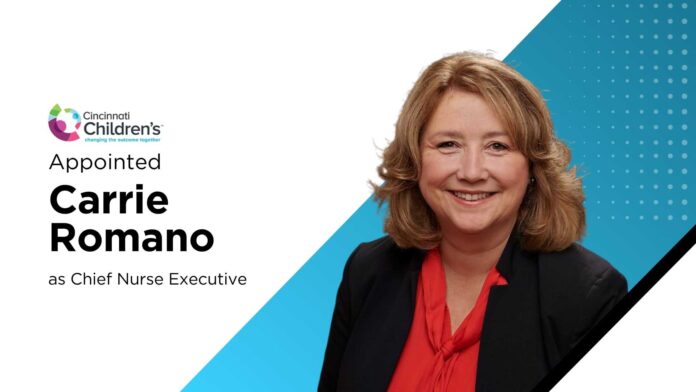

Cincinnati Children’s has appointed longtime nursing leader Dr. Carrie Romano as its next Chief Nurse Executive (CNE), expanding the scope of its senior nursing leadership role to reflect the growing strategic influence of nursing across enterprise healthcare operations. The leadership transition highlights an industry-wide evolution where nurse executives are increasingly responsible for workforce development, digital health transformation, care innovation, and organizational strategy alongside clinical excellence.
Healthcare organizations continue to elevate nursing leadership as workforce transformation, digital health, and patient-centered care reshape the future of clinical operations. Reflecting that shift, Cincinnati Children’s has named Carrie Romano, DNP, RN, as its next Chief Nurse Executive, following a national executive search.
Romano will assume the role on September 6, succeeding Barb Tofani, who will retire in November after leading Cincinnati Children’s nursing organization through years of nationally recognized clinical excellence.
Beyond a leadership transition, the appointment introduces a notable organizational change. The health system has renamed the role from Chief Nursing Officer (CNO) to Chief Nurse Executive (CNE), signaling broader executive responsibilities that extend beyond nursing operations into enterprise strategy, workforce leadership, innovation, and organizational transformation.
The title change reflects an increasingly common trend among major healthcare systems, where nursing executives are becoming central contributors to long-term business planning, digital transformation, workforce resilience, and patient experience initiatives.
A nursing leader with decades of experience
Romano brings more than 36 years of nursing leadership experience, including her entire professional career at Cincinnati Children’s.
She joined the organization in 1989 as a staff nurse and progressed through leadership positions before most recently serving as Vice President of Patient Services. In that role, she provided executive oversight for Ambulatory Services, Care Management, and Home Care Services, while helping guide operational strategy across multiple care settings.
Throughout her career, Romano has led initiatives focused on healthcare quality, patient safety, care access, digital health, telehealth expansion, workforce development, leadership cultivation, and enterprise growth.
Her appointment reflects a broader emphasis across healthcare organizations on developing internal leadership pipelines while preserving institutional knowledge during executive succession.
Nursing leadership expands beyond clinical operations
The transition illustrates how nursing leadership continues evolving alongside healthcare modernization.
Today’s chief nurse executives increasingly oversee workforce planning, leadership development, employee engagement, digital health implementation, operational performance, and interdisciplinary collaboration in addition to traditional clinical responsibilities.
Healthcare systems are also relying on nursing executives to support AI adoption, telehealth expansion, workforce retention, and care delivery redesign as organizations respond to staffing shortages and rising patient expectations.
For HR leaders in healthcare, these expanded executive responsibilities reinforce the importance of integrated workforce strategies that combine talent development, succession planning, digital skills, and employee wellbeing.
HR technology supports healthcare workforce transformation
Modern healthcare workforce management depends increasingly on cloud-based HR technology and workforce analytics.
Platforms such as Workday, Oracle Health, SAP SuccessFactors, ADP, and Microsoft help healthcare organizations manage recruitment, scheduling, credentialing, learning and development, workforce planning, payroll, employee engagement, and succession planning across large clinical teams.
Artificial intelligence is also becoming more deeply embedded within healthcare HR operations, supporting predictive staffing models, skills intelligence, workforce forecasting, onboarding automation, and personalized employee learning.
For nurse executives, these technologies provide greater visibility into workforce capacity while supporting data-driven decisions that improve both employee experience and patient care delivery.
Leadership development remains a strategic priority
Romano’s appointment also underscores the growing importance of leadership development within healthcare organizations.
Health systems continue investing in structured leadership pathways to prepare clinicians for executive responsibilities while addressing long-term workforce sustainability. Internal promotion strategies often strengthen organizational continuity, accelerate leadership transitions, and reinforce institutional culture.
Cincinnati Children’s also recognized the contributions of outgoing nursing leader Barb Tofani, whose tenure included achieving four consecutive Magnet® designations from the American Nurses Credentialing Center (ANCC)—one of healthcare’s highest recognitions for nursing excellence.
Magnet recognition is widely associated with high standards in nursing practice, workforce engagement, professional development, patient outcomes, and organizational quality.
According to Gartner, workforce resilience and leadership development remain strategic priorities as healthcare organizations modernize operations through digital transformation. McKinsey & Company has similarly reported that organizations investing in leadership capability and workforce engagement are better positioned to improve employee retention, innovation, and long-term organizational performance.
For healthcare HR leaders, the appointment reflects a broader evolution in executive nursing leadership. As healthcare systems continue integrating digital technologies, expanding care models, and responding to workforce challenges, chief nurse executives are increasingly expected to lead organizational transformation as well as clinical excellence.
Market Landscape
Healthcare organizations are accelerating investments in HR technology, workforce management platforms, and digital health infrastructure to address staffing shortages, improve employee engagement, and strengthen patient outcomes. Enterprise solutions from Workday, Oracle Health, SAP SuccessFactors, ADP, and Microsoft increasingly integrate workforce analytics, AI-powered scheduling, learning management, credential tracking, and succession planning. These capabilities enable healthcare leaders to align workforce strategy with operational performance and long-term care delivery transformation.
Top Insights
- Cincinnati Children’s has appointed Carrie Romano as Chief Nurse Executive, expanding the strategic scope of senior nursing leadership beyond traditional clinical operations.
- The organization has renamed its Chief Nursing Officer role, reflecting growing enterprise responsibilities in workforce strategy, innovation, and healthcare transformation.
- Romano brings more than three decades of leadership experience, including oversight of ambulatory services, care management, digital health, and workforce development.
- Healthcare organizations continue elevating nursing executives as strategic leaders, responsible for talent development, workforce planning, digital transformation, and patient experience.
- HR technology and workforce analytics are becoming increasingly important, helping healthcare leaders optimize staffing, employee engagement, succession planning, and operational performance.
Join thousands of HR leaders who rely on HRTechEdge for the latest in workforce technology, AI-driven HR solutions, and strategic insights





