
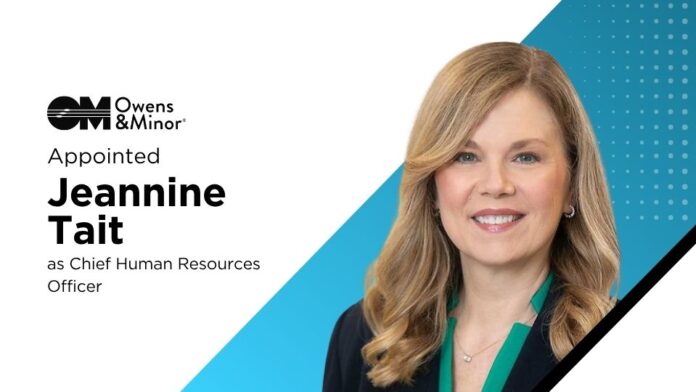

Owens & Minor is putting a veteran HR executive at the center of its next phase of organizational change. The healthcare supply chain company has appointed Jeannine Tait as chief human resources officer, giving her responsibility for talent development, culture, performance management and employee engagement across a workforce of more than 14,000. The appointment comes months after Tait joined the company as interim CHRO and as Owens & Minor operates under new ownership following the separation of its Products & Healthcare Services business.
The appointment of a permanent CHRO can look routine on an executive roster. At Owens & Minor, the timing makes it more consequential.
The healthcare solutions company is rebuilding its leadership structure after a major strategic separation and a change in ownership. In December 2025, its Products & Healthcare Services business became part of the Platinum Equity portfolio, leaving Owens & Minor as a privately held standalone company.
Jeannine Tait, who joined Owens & Minor as interim CHRO in February 2026, will now lead the company’s global people strategy. Her remit includes talent development, organizational culture, performance management and engagement.
The move also arrives after a broader leadership reset. Owens & Minor appointed Jim Marshall as CEO in May 2026, describing his mandate around strategic transformation, operating-model modernization and building high-performing teams.
Taken together, the executive changes suggest that workforce strategy is being treated as part of the company’s operating transformation rather than as a supporting HR function.
A CHRO role shaped by organizational transformation
Tait brings more than three decades of HR experience across multiple industries. Before Owens & Minor, she served as chief human resources and communications officer at McGraw Hill, where she helped transform the HR organization in support of the company’s digital enterprise strategy ahead of its IPO.
Earlier, she was vice president of total rewards and HR operations at Solenis, where she worked on HR integrations and workforce growth.
That background is relevant to Owens & Minor’s current situation. The company is not simply replacing an executive; it is managing a workforce strategy around a materially different corporate structure.
The separation of the Products & Healthcare Services business was designed to simplify Owens & Minor’s business model and sharpen its focus on home-based care. The transaction was announced in October 2025 for $375 million in cash, alongside a retained equity stake, and closed at the end of that year.
For HR leadership, a transaction of that scale can change everything from organizational design and workforce planning to leadership development and employee communications.
Tait’s permanent appointment therefore gives Owens & Minor a dedicated executive owner for the people side of that transition.
Healthcare makes workforce strategy particularly important
The broader healthcare labor market adds another layer of pressure.
McKinsey estimates that the world could face a shortage of at least 10 million healthcare workers by 2030. Its research argues that addressing the gap will require not only expanding the talent pipeline but also improving retention and changing how healthcare work is delivered.
Although Owens & Minor is a healthcare supply chain and solutions company rather than a hospital operator, it operates inside that same labor ecosystem. Its workforce supports medical distribution, products, technology and services used by hospitals, health systems and research facilities.
That makes employee capability and retention operational issues, not simply HR metrics.
The company’s own reporting shows the scale of its workforce. Owens & Minor says it has more than 14,000 teammates globally, while its current careers materials emphasize learning, career development and a culture intended to support employee growth.
The challenge for Tait will be translating those priorities into measurable workforce outcomes as the company evolves.
From employee engagement to workforce performance
The modern CHRO role is increasingly tied to business performance.
That means overseeing conventional HR responsibilities—such as talent acquisition, compensation and performance management—while also helping companies redesign jobs, develop new skills and create management systems suited to changing operating models.
McKinsey’s 2025 HR Monitor found that employee development remains fragmented at many organizations: 26% of surveyed employees said they received no feedback during the previous year, while only about one-third of critical roles were supported by succession plans.
Those findings are relevant beyond traditional office environments. Healthcare companies have to manage a mix of corporate employees, operational teams, technical specialists and supply-chain professionals, each with different skills and workforce requirements.
A CHRO leading through transformation therefore needs more than an employee-engagement strategy. The function has to connect skills, leadership pipelines, performance systems and business priorities.
That is especially important as technology changes healthcare supply chains.
Owens & Minor describes itself as a technology-enabled healthcare solutions company, and its operations increasingly depend on digital systems, supply-chain optimization and technology-supported services. Its recent leadership appointments have also emphasized modernization and operational transformation. For example, new COO Marc Rottink was brought in with experience spanning global supply chains, systems implementation and cross-functional operating alignment.
That creates a natural intersection between HRTech and operational technology: new systems only create value when employees have the skills and organizational support to use them effectively.
The enterprise HRTech implications
Tait’s appointment also illustrates how the CHRO role is evolving within large enterprises.
HR leaders are increasingly expected to own workforce data, succession planning, employee experience and skills development while working closely with technology and operations executives. In digitally transforming companies, that can make HR one of the key mechanisms for translating corporate strategy into workforce capability.
For Owens & Minor, the immediate priorities are likely to include maintaining organizational continuity after the portfolio separation, aligning leadership teams under Marshall and ensuring employees understand the company’s direction.
The longer-term question is whether the company can build a workforce model that supports growth while preserving the operational expertise required by healthcare customers.
That is where HR technology can become more than administrative infrastructure. Workforce analytics, learning platforms, performance-management systems and skills intelligence can help HR teams identify capability gaps and monitor whether organizational changes are producing the intended results.
The technology itself, however, is only one part of the equation.
Tait’s appointment signals that Owens & Minor is placing executive-level accountability behind the workforce strategy required to use those tools effectively. In a healthcare market facing persistent labor constraints and rapid operational change, that may prove as important as the technology investments themselves.
Market Landscape
Owens & Minor’s leadership transition reflects a wider shift in healthcare HR: workforce strategy is increasingly being integrated with operational transformation.
The company’s move into private ownership under Platinum Equity and its sharpened focus following the Products & Healthcare Services separation create a different organizational context from the one that existed before 2026.
At the same time, healthcare employers face a structural workforce challenge. McKinsey’s estimate of a potential 10-million-worker global shortage by 2030 underscores why retention, workforce development and productivity are becoming strategic priorities.
For HR technology vendors, this environment creates demand for systems that can connect employee data with skills, performance, learning and workforce planning. The strongest platforms increasingly compete not simply on automation, but on whether they can help HR leaders make better decisions about where talent is needed and how organizations should evolve.
Top Insights
- Owens & Minor appointed Jeannine Tait CHRO, placing talent development, culture and workforce performance at the center of its post-separation transformation.
- Tait’s appointment follows Jim Marshall’s CEO arrival, giving Owens & Minor a leadership team focused on operational transformation, workforce capability and sustainable growth.
- The healthcare workforce faces structural shortages, increasing pressure on employers to improve retention, leadership development, skills planning and employee experience.
- Owens & Minor’s 14,000-person workforce spans healthcare supply chain, products and technology, making workforce capability closely linked to operational performance.
- The CHRO role increasingly connects HR technology, organizational design and talent strategy as enterprises modernize operations and introduce new digital capabilities.
Join thousands of HR leaders who rely on HRTechEdge for the latest in workforce technology, AI-driven HR solutions, and strategic insights





