
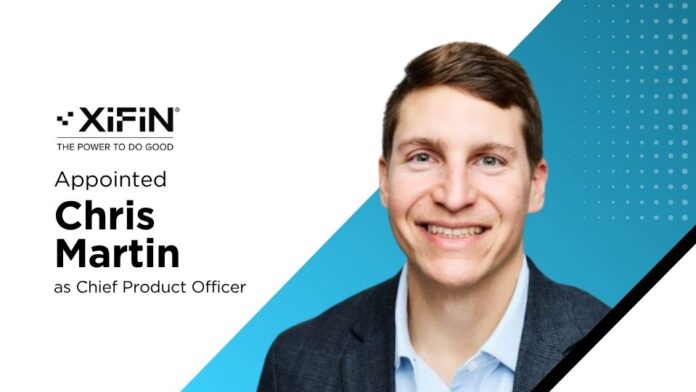

XiFin is putting product leadership at the center of its next phase of healthcare revenue cycle modernization, appointing Chris Martin as chief product officer as the company expands its AI-enabled XiFin Empower ecosystem. Martin will oversee product strategy, management and modularity as XiFin looks to make data- and AI-driven revenue cycle management more accessible across healthcare segments.
Artificial intelligence is moving from isolated automation projects into the core infrastructure of healthcare revenue cycle management, where providers are under constant pressure to improve reimbursement, manage increasingly complex payer rules and reduce administrative work.
XiFin’s latest executive appointment reflects that shift.
The healthcare technology company has named Chris Martin chief product officer, giving him responsibility for product strategy and management as XiFin expands its AI-enabled Empower ecosystem. Martin will also focus on making the company’s revenue cycle management capabilities more modular and accessible to customers across additional healthcare markets.
The appointment comes several months after XiFin named Sanjay Kumar chief technology officer in February 2026. Taken together, the two appointments suggest the company is building a leadership structure around the convergence of AI infrastructure and product execution rather than treating artificial intelligence as a standalone technology initiative.
That distinction is important in healthcare RCM.
Revenue cycle management encompasses everything from patient and insurance information through claims processing, reimbursement, denial management and payment. The underlying workflows are highly data-intensive and shaped by complex payer policies, regulations and clinical billing requirements.
AI can potentially automate parts of that process, identify patterns in claims and reimbursement data, prioritize work for revenue-cycle teams and surface opportunities for financial improvement. But turning those capabilities into enterprise products requires more than machine-learning models. Healthcare organizations need systems that integrate with existing workflows and can explain or operationalize recommendations.
Martin’s background is heavily focused on product development in complex industries. Before joining XiFin, he was senior vice president and head of consumer products at Axos Financial, where he led product strategy and execution and developed AI-enabled products. He also established a client advisory board designed to connect product development directly with financial advisors.
Earlier roles at Deloitte Consulting and IBM involved technology, consulting and enterprise transformation.
That experience could be relevant to XiFin’s effort to make its AI capabilities available through more modular products. Healthcare organizations rarely replace revenue-cycle infrastructure wholesale. They often have existing electronic health record systems, practice-management platforms, laboratory information systems and specialized billing applications that must continue operating alongside new technology.
A modular architecture can therefore be more practical than an all-or-nothing transformation.
XiFin says Martin will work with CTO Sanjay Kumar and the broader leadership team to translate technical innovation into customer value and increase adoption across additional healthcare segments.
The company is already reporting growth in its Empower platform. XiFin says Empower RCM volume increased 21.1%, while its molecular diagnostics, hospital outreach and ancillary-services segments recorded double-digit growth.
Those are company-reported figures, however, and do not by themselves demonstrate that AI is producing better financial or operational outcomes for customers.
The broader market is moving in the same direction. Healthcare organizations are adopting automation and AI to tackle administrative complexity, while major technology vendors are embedding AI into healthcare financial and operational workflows.
Competitors and adjacent platforms include Waystar, R1 RCM, Experian Health and Optum, alongside broader healthcare IT providers such as Oracle Health and Microsoft, which increasingly provide AI and data infrastructure used by healthcare organizations.
XiFin’s positioning is more specialized. Rather than competing as a general-purpose enterprise AI provider, it is applying data science and automation to revenue-cycle workflows, with particular exposure to laboratory, diagnostic and other specialized healthcare organizations.
That specialization can be an advantage because RCM problems vary considerably by healthcare segment. Molecular diagnostics laboratories, hospital outreach programs, pharmacies and specialty providers face different reimbursement models, payer relationships and regulatory requirements.
The challenge is making AI useful without making the technology another layer of complexity.
For healthcare finance and operations executives, the relevant questions will include how easily XiFin’s modules integrate with existing systems, how much human intervention is required, how AI recommendations are validated and how the platform performs across different payer and reimbursement environments.
Data governance will also become increasingly important. AI-driven RCM depends on sensitive financial, insurance and healthcare data, meaning security, privacy, model governance and auditability are critical considerations for enterprise buyers.
Martin’s appointment arrives as healthcare organizations are under pressure to do more with increasingly constrained administrative resources. Automating repetitive RCM processes is attractive, but the most valuable systems will likely be those that combine automation with specialized domain knowledge and clear human oversight.
XiFin appears to be betting on that model.
The company says Martin will focus on flexibility and meeting customers “where they are,” a strategy that aligns with the realities of healthcare IT adoption. Providers and diagnostic organizations often have years of investment in existing infrastructure, making incremental modernization more achievable than wholesale replacement.
The leadership changes also indicate that XiFin sees product strategy as a key component of its AI expansion. Kumar’s technology remit and Martin’s product mandate create a division between building AI capabilities and packaging them into products customers can adopt.
That could become increasingly important as healthcare AI moves from experimentation to operational deployment.
The company’s leadership team has also received several industry recognitions in 2026, including San Diego Business Journal recognition for CFO Erik Sallee and CTO Sanjay Kumar, as well as awards and finalist honors for executives leading specialty RCM, pharmacy and revenue-optimization initiatives.
Those accolades provide context around XiFin’s leadership bench, but the more consequential measure will be whether the company can translate its AI investment into measurable improvements in healthcare financial operations.
For now, Martin’s appointment signals a clear priority: XiFin wants AI-powered revenue cycle management to become a broader, more modular product category rather than a collection of isolated automation capabilities.
Market Landscape
Healthcare RCM is becoming an increasingly important application area for enterprise AI because it combines large volumes of structured data with repetitive, rules-based administrative processes.
Established companies including Waystar, R1 RCM, Experian Health and Optum compete across claims, payments, denial management, eligibility and broader financial workflows. Oracle Health and Microsoft are also expanding healthcare data and AI capabilities, creating additional pressure for specialized RCM vendors to differentiate through domain expertise.
XiFin’s focus on laboratories, diagnostics, hospital outreach, pharmacy and ancillary services gives it a more specialized position. Its challenge will be balancing that specialization with the interoperability and modularity enterprises require.
The next phase of competition is likely to center on measurable outcomes: cleaner claims, faster reimbursement, fewer avoidable denials, lower administrative costs and improved visibility into revenue performance.
Top Insights
- XiFin appointed Chris Martin chief product officer as it expands AI-driven revenue cycle management through the modular XiFin Empower ecosystem across healthcare markets.
- Martin’s product and financial-services technology background adds enterprise transformation experience as XiFin works to commercialize its data and AI capabilities.
- XiFin reported a 21.1% increase in Empower RCM volume, alongside double-digit growth in molecular diagnostics, hospital outreach and ancillary services.
- The company is competing with Waystar, R1 RCM, Experian Health and Optum as healthcare providers increasingly evaluate AI for revenue-cycle automation.
- Enterprise buyers will need to assess interoperability, AI governance, data security and measurable reimbursement outcomes before expanding AI-powered RCM deployments.
Join thousands of HR leaders who rely on HRTechEdge for the latest in workforce technology, AI-driven HR solutions, and strategic insights

Business Wire, a Berkshire Hathaway company, is the global leader in press release distribution and regulatory disclosure. Public relations, investor relations, public policy and marketing professionals rely on Business Wire for secure and accurate distribution of market-moving news and multimedia. Founded in 1961, Business Wire is a trusted source for news organizations, journalists, investment professionals and regulatory authorities, delivering news directly into editorial systems and leading online news sources via its multi-patented NX network. Business Wire’s global newsrooms are available to meet the needs of communications professionals and news media worldwide.




