
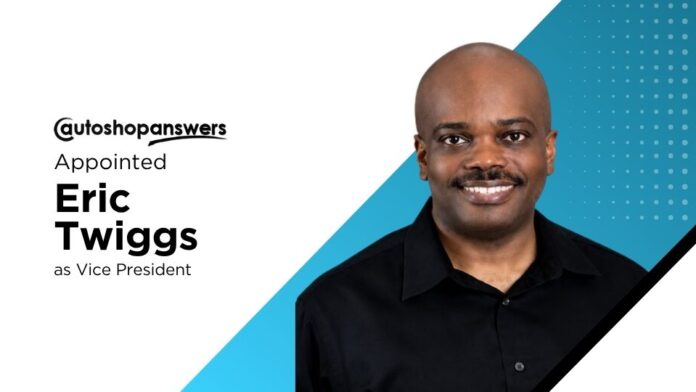

Professional associations and industry networks are increasingly using education, digital resources and member programs to help workers and business owners navigate changing industries. AutoShop Answers has appointed Eric Twiggs as Vice President of Member Services, with responsibility for strengthening member engagement, developing educational initiatives and expanding resources for automotive repair professionals.
For automotive repair businesses, keeping pace with technology is only one part of the challenge. Shop owners also have to manage hiring, employee development, changing customer expectations and the operational demands of running a modern service business.
AutoShop Answers is responding with a leadership change focused on the people and resources surrounding its professional membership.
The organization has appointed Eric Twiggs as Vice President of Member Services, a newly announced role centered on improving the member experience and developing programs designed to support automotive service professionals.
Twiggs will focus on identifying member needs, creating new initiatives and expanding opportunities for professionals to connect, learn and develop their businesses.
The appointment comes as the automotive service industry continues to undergo significant technological and workforce changes.
Modern repair shops increasingly depend on digital diagnostic systems, connected vehicles, advanced vehicle electronics and increasingly specialized technical skills. At the same time, shop owners face the broader workforce challenge of recruiting and retaining technicians with those capabilities.
That makes professional education and knowledge-sharing increasingly important.
Member Experience Becomes a Workforce Strategy
AutoShop Answers describes its approach as extending beyond providing basic membership resources.
The organization wants to develop programs that respond to the practical challenges facing repair businesses, with Twiggs expected to play a central role in that effort.
Todd Hayes, AutoShop Answers’ leadership, said Twiggs brings experience and knowledge of the automotive industry and understands the challenges facing shop owners.
For a membership organization, that understanding can influence how educational programs and services are designed.
A generic training library may provide information, but member-driven education can be more useful when it is built around specific operational problems.
That distinction is becoming increasingly relevant across professional industries.
Technology is changing the skills required by workers, while businesses are simultaneously expected to provide opportunities for employees to develop those skills. Industry associations, communities and professional networks can help fill some of that gap by providing specialized learning and peer-to-peer knowledge.
Automotive Repair Faces a Skills Challenge
The automotive service industry provides a particularly strong example.
Vehicles have evolved from predominantly mechanical systems into increasingly software-defined and electronically connected platforms.
Technicians may now need expertise spanning diagnostics, electronics, software, advanced driver-assistance systems and traditional mechanical repair.
For independent repair shops, keeping employees current can be difficult.
Large automotive manufacturers and dealership networks have access to structured training programs and manufacturer-specific resources. Independent shops often need to assemble training from multiple sources while continuing to serve customers.
That creates an opportunity for industry organizations to act as professional learning hubs.
AutoShop Answers says Twiggs will help identify opportunities to develop programs that address current challenges while preparing members for changes ahead.
From Resources to Professional Community
The other important component of the appointment is community.
Professional development is not limited to formal courses. Shop owners and technicians can also benefit from peer discussions, shared operational practices, industry events and access to people who have solved similar problems.
AutoShop Answers says its member strategy will focus on creating new ways for members to connect, learn and grow.
That puts the organization within a wider trend across workforce technology: professional communities are becoming part of the employee and business-development ecosystem.
Platforms such as LinkedIn combine professional networking with learning and career development, while specialized industry organizations provide deeper domain expertise.
For automotive professionals, a specialized network can potentially offer more relevant information than a general-purpose professional platform.
Technology Is Changing the Shop—and the Workforce
The workforce implications extend beyond training.
As automotive technology becomes more sophisticated, repair businesses need employees capable of working with new diagnostic tools and digital systems.
That creates pressure on employers to treat skills development as an ongoing process rather than a one-time onboarding activity.
The trend is consistent with broader labor-market research.
The World Economic Forum’s Future of Jobs Report 2025 identified skills gaps as one of the major barriers employers face as businesses transform, while forecasting significant changes in the skills workers will need through 2030.
For automotive service businesses, that transformation can be particularly visible.
A technician who learned primarily through mechanical experience may increasingly need digital and software-related capabilities. Service advisors and managers also need to understand increasingly complex vehicle technologies to communicate effectively with customers.
Training therefore becomes connected to business performance.
What Twiggs’ Role Could Mean
Twiggs said his objective is to listen to members, understand their needs and help create practical programs.
That member-first approach could be important as AutoShop Answers expands its services.
The success of the role will ultimately depend on whether new programs translate into measurable value for members—whether through stronger technical skills, improved management capabilities, better employee development or stronger connections across the industry.
For HR and workforce leaders, the development highlights a broader trend.
Industry-specific organizations are increasingly becoming part of the infrastructure through which workers and employers acquire knowledge, develop skills and adapt to technological change.
In automotive repair, where vehicle technology and technician requirements are changing rapidly, that role could become even more important.
AutoShop Answers’ leadership appointment signals an effort to build that support system around the needs of its members.
The next test will be whether the organization can turn that strategy into programs that help automotive professionals keep pace with the changing nature of work.
Market Landscape
The automotive service workforce sits at the intersection of technology adoption, skills development and talent shortages.
Connected vehicles, advanced electronics, software-defined systems and increasingly sophisticated diagnostic equipment are changing the capabilities required from technicians and service professionals.
The result is a growing need for continuous learning.
Professional associations and industry networks can complement formal education and employer training by offering specialized courses, peer communities, events and business resources.
For independent repair shops, these services can be particularly valuable because smaller employers may lack the dedicated learning and development teams available to larger enterprises.
The broader HRTech opportunity is therefore not limited to traditional corporate HR software. Workforce education, professional communities, skills platforms and industry-specific training are increasingly part of the technology ecosystem supporting workers throughout their careers.
Top Insights
- AutoShop Answers appointed Eric Twiggs VP of Member Services to expand member programs, education and resources for automotive service professionals.
- Twiggs will focus on member engagement and practical initiatives designed to help repair businesses address current workforce and operational challenges.
- Automotive technicians increasingly need digital, electronics and diagnostic skills as connected and software-intensive vehicles reshape repair work.
- Professional associations can supplement employer training by providing specialized education, peer communities and industry knowledge for smaller automotive businesses.
- The appointment reflects a broader workforce trend toward continuous learning as technology changes job requirements and skills gaps persist across industries.
Join thousands of HR leaders who rely on HRTechEdge for the latest in workforce technology, AI-driven HR solutions, and strategic insights





