
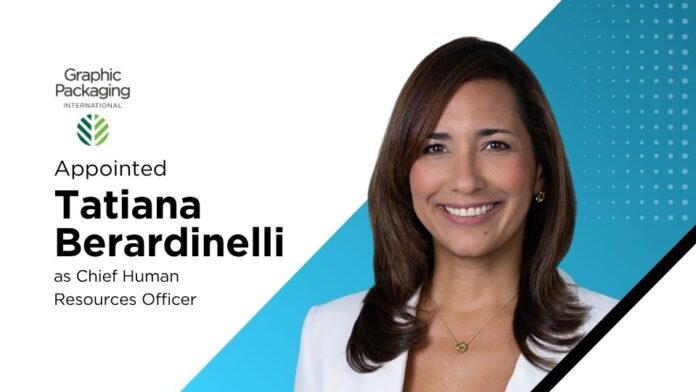

Graphic Packaging Holding Company is changing the leadership of its global people organization as manufacturers face growing pressure to improve productivity while competing for specialized talent. The packaging company has appointed Tatiana Berardinelli as Executive Vice President and Chief Human Resources Officer, effective September 8, bringing more than 25 years of international HR leadership across packaging, chemicals, coatings and advanced materials.
Graphic Packaging Taps Packaging HR Veteran to Lead Global Workforce Strategy
For industrial companies, the HR function is increasingly moving beyond traditional workforce administration. Productivity, skills development, leadership pipelines and organizational design are becoming closely tied to broader business transformation.
Graphic Packaging Holding Company is reflecting that shift with the appointment of Tatiana Berardinelli as executive vice president and chief human resources officer, effective September 8.
Berardinelli will report to President and CEO Robbert Rietbroek and join the company’s Executive Leadership Team. She arrives with 25 years of global human resources experience spanning packaging, specialty chemicals, coatings and advanced materials.
The appointment places a veteran of complex industrial transformations at the center of Graphic Packaging’s workforce strategy as the company looks to strengthen its performance culture and operational execution.
From HR administration to operational strategy
Berardinelli most recently served as chief human resources officer at Multi-Color Corporation (MCC), a global label and packaging solutions provider with more than 13,000 employees.
Her experience there is particularly relevant to Graphic Packaging because both organizations operate in workforce-intensive manufacturing environments where talent availability, productivity and operational consistency can directly affect business performance.
Graphic Packaging CEO Robbert Rietbroek said Berardinelli’s priorities will include employee empowerment, productivity and clearer execution metrics.
That combination illustrates how the modern CHRO role is evolving.
HR leaders at large manufacturers are increasingly expected to participate directly in business transformation rather than operate solely as owners of recruiting, compensation and employee relations. Workforce planning, organizational restructuring, leadership development and productivity programs are becoming part of the executive-level HR mandate.
Global experience could shape workforce transformation
Before MCC, Berardinelli was CHRO at Clariant, the Swiss-headquartered specialty chemicals company. She was involved in transformation initiatives covering organizational design, corporate culture, leadership, performance and employee engagement.
Earlier positions at PPG Industries, Eastman Chemical Company, Dow Chemical Company and Rohm and Haas gave her exposure to multinational industrial organizations.
Her career has also spanned North America, Latin America, Europe and Asia Pacific.
That geographic experience could be important for Graphic Packaging, which operates across international markets and must manage workforce policies within different labor environments, cultural expectations and regulatory frameworks.
For global HR organizations, consistency is difficult to achieve without creating overly centralized processes. Technology increasingly provides part of the answer.
HR technology becomes infrastructure for global workforces
Enterprise manufacturers are increasingly using human capital management (HCM) platforms, workforce analytics, talent management systems and learning technologies to create a common data layer across geographically dispersed workforces.
Platforms from companies such as Workday, SAP, Microsoft and Oracle compete in this broader enterprise HR technology ecosystem, while specialist vendors provide capabilities for skills intelligence, employee engagement, learning and frontline workforce management.
For a CHRO overseeing a multinational workforce, the challenge is not simply selecting technology. It is ensuring that systems provide reliable workforce data that can support decisions about skills, succession, performance and organizational design.
AI is adding another dimension.
Generative AI and predictive analytics can help HR organizations automate administrative work, identify workforce trends and provide managers with more timely information. But adoption also introduces questions around data governance, employee privacy and how automated recommendations are used in employment decisions.
For an industrial company, those considerations become particularly important when workforce technology needs to operate across large frontline and corporate populations.
The manufacturing talent challenge
Manufacturers face a workforce environment in which technological change is increasing demand for specialized skills while many companies continue to compete for experienced operational talent.
The World Economic Forum’s Future of Jobs Report 2025 estimates that 39% of workers’ existing skill sets could be transformed or become outdated between 2025 and 2030. It also identifies skills such as analytical thinking, resilience, flexibility and agility among the capabilities employers increasingly value.
That trend has implications for packaging manufacturers.
Automation, advanced manufacturing systems, data analytics and increasingly AI-enabled operations can change the skills required on production floors and in corporate functions. HR organizations consequently need to understand not only how many workers a business requires, but which capabilities those workers will need.
Berardinelli’s background in organizational transformation and performance management aligns with that broader challenge.
Building a performance culture with measurable outcomes
Graphic Packaging says the new CHRO will help strengthen its performance culture and operational excellence.
The emphasis on measurable execution is notable because performance management is itself undergoing a technology shift.
Traditional annual reviews are increasingly being supplemented by continuous feedback, real-time workforce analytics, skills assessments and manager dashboards. The goal is to connect individual development with broader organizational priorities.
For HR leaders, the difficult part is designing metrics that encourage the right behavior.
Overemphasizing productivity measurements can create unintended pressure on employees, particularly in manufacturing environments where safety, quality and employee wellbeing need to be considered alongside output.
The more mature approach is to treat workforce metrics as a balanced system rather than a single productivity score.
What the appointment signals for Graphic Packaging
Berardinelli’s appointment is ultimately a leadership change, but it also offers a window into how industrial companies are redefining the CHRO role.
Her remit combines talent attraction and development with productivity, organizational transformation, employee empowerment and execution.
That places HR closer to the company’s operating strategy.
As manufacturing becomes more technology-intensive, the companies that can connect workforce planning with automation, skills development and employee experience will have an advantage in managing the transition.
For Graphic Packaging, the next phase will be measured not simply by the technology it deploys, but by how effectively its workforce can adapt to changing operational requirements.
Market Landscape
The industrial HRTech market is shifting toward skills-based workforce planning, frontline employee experience, workforce analytics and AI-enabled HR operations.
Manufacturers increasingly need systems that can connect corporate HR data with the realities of geographically distributed and frontline workforces.
Berardinelli’s background is particularly aligned with this environment because her experience spans multiple industrial sectors and international markets.
For enterprise HR leaders, several areas are becoming strategic priorities:
- Skills intelligence: identifying current and future workforce capabilities.
- Workforce analytics: connecting employee data with productivity, retention and organizational performance.
- Learning technology: reskilling employees as automation changes operational roles.
- Performance management: linking individual goals with measurable business outcomes.
- Employee experience: improving communication and engagement across frontline and corporate populations.
- AI in HR: automating administrative processes while maintaining appropriate governance.
The broader labor market reinforces the need for this shift. The World Economic Forum expects significant changes in workforce skills through 2030, making reskilling and organizational adaptability increasingly important to enterprise planning.
Top Insights
- Graphic Packaging appoints Tatiana Berardinelli as CHRO, bringing 25 years of global HR leadership to a workforce strategy focused on transformation and productivity.
- Her experience at MCC and Clariant gives Graphic Packaging an executive with extensive exposure to industrial organizational design, culture and performance transformation.
- Manufacturing HR teams increasingly need skills intelligence, workforce analytics and learning technology as automation changes operational roles and talent requirements.
- Berardinelli’s international background could support workforce standardization across North America, Latin America, Europe and Asia Pacific while accommodating regional employment requirements.
- The appointment highlights the expanding CHRO mandate, connecting employee development and engagement with productivity, operational excellence and enterprise transformation.
Join thousands of HR leaders who rely on HRTechEdge for the latest in workforce technology, AI-driven HR solutions, and strategic insights





