
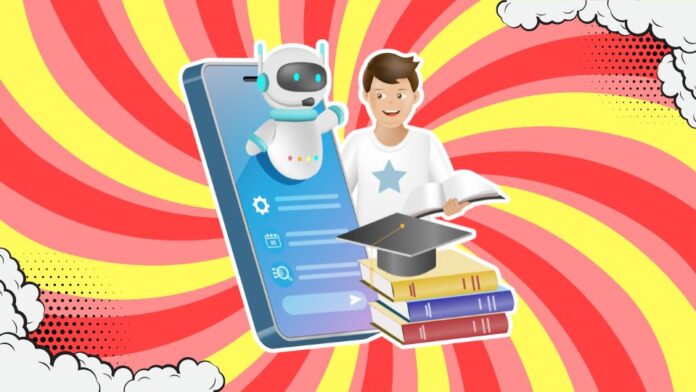

Aristotle, a voice-first AI tutoring platform, has raised $5 million in seed funding as it launches nationwide with an approach designed to make AI tutoring feel less like a chatbot and more like a persistent one-to-one learning relationship.
The round was led by True Ventures, with participation from Wicklow Capital and angel investors from companies including Anthropic, OpenAI, Sierra, Ramp and Cognition. Aristotle says more than 1,000 students participated in its closed beta, completing more than 1,500 hours of individual tutoring.
The company was founded by Stanford alumni Shan Reddy, Jaiden Reddy and Vivek Vajipey, who collectively bring experience from human tutoring and AI research. Their central argument is that conventional AI assistants are optimized to provide answers, while effective tutoring requires something different: understanding when a student needs an explanation, when they need a hint and when they need time to work through a problem independently.
Building AI Around How Students Learn
Aristotle’s product is designed around voice interaction, giving students an experience intended to resemble a live tutoring session.
The system remembers previous sessions and adapts its interactions to individual students. Rather than simply responding to questions, the platform aims to determine how much guidance a learner needs and when to challenge them further.
That distinction is important as generative AI becomes increasingly common in education.
A conventional chatbot can solve a mathematics problem or explain a historical concept within seconds. But getting the correct answer is not necessarily equivalent to learning how to reach that answer independently.
Aristotle’s founders describe this as keeping students in the “productive struggle” between understanding and frustration. The platform is consequently being designed around guided interaction rather than answer delivery.
From Human Tutoring to AI-Powered Personalization
The company’s approach grew from its founders’ own experience tutoring students through services such as Wyzant and Varsity Tutors.
That background gives Aristotle a different starting point from many general-purpose AI products. Instead of adapting an existing chatbot to education, the founders are attempting to encode elements of the human tutoring process into an AI-native product.
Voice is a central part of that strategy.
Conversational tutoring can allow students to ask follow-up questions naturally, interrupt explanations and work through problems interactively. The persistent context between sessions is equally important because an effective tutor needs to understand not only the current question but also the student’s history.
For education technology, that creates a model closer to a continuously adapting learning companion than a conventional question-and-answer assistant.
The Economics of One-to-One Tutoring
Personal tutoring has traditionally been constrained by cost and availability. A student can receive highly individualized instruction, but access depends heavily on the supply of qualified tutors and what families or institutions can afford.
Aristotle is attempting to change that equation through software.
The company says its closed beta generated more than 1,500 hours of one-on-one tutoring across more than 1,000 students. It is now using the $5 million investment to expand the product, grow its team and support general availability.
The company also cites feedback from parents who have compared Aristotle directly with human tutoring. One parent quoted by the company said their 13-year-old son preferred Aristotle to a human tutor who charged $250 per hour. That is an individual customer account, rather than evidence of broader product performance, but it illustrates the economic proposition Aristotle is targeting.
AI Tutors Enter a Crowded EdTech Market
Aristotle is entering an increasingly competitive market that includes AI tutoring startups, adaptive learning platforms and established education companies integrating generative AI into their products.
The technical challenge is not simply producing fluent explanations. AI tutors need to maintain context, identify misconceptions, adjust difficulty and avoid giving students shortcuts that undermine learning.
That puts tutoring AI closer to an adaptive decision-making system than a conventional chatbot.
It also creates an important role for human oversight. Schools and families adopting AI tutoring will need to consider accuracy, age-appropriate interactions, student privacy and how AI-generated guidance fits alongside teachers and existing curricula.
Why Voice Matters for Learning Technology
Voice could become one of the more consequential interfaces for AI tutoring because it removes some of the friction associated with typing questions and navigating educational software.
For younger learners in particular, a conversational interface can make interaction feel closer to asking a teacher for help than querying a search engine.
The larger technology trend extends beyond education. AI systems are increasingly moving from tools that retrieve information toward systems that maintain context, personalize interactions and guide users through complex tasks.
Aristotle is applying that model to learning, where the quality of the interaction may matter as much as the information being delivered.
If the platform can demonstrate that persistent, adaptive conversations improve learning outcomes rather than simply making homework easier, it could help establish a new category of AI-enabled tutoring.
Market Landscape
AI is reshaping education technology around personalization, conversational interfaces and adaptive learning. General-purpose LLMs have made on-demand explanations widely accessible, while specialized platforms are attempting to build stronger instructional behavior around those underlying models.
Aristotle’s differentiation is its focus on voice-first tutoring and persistent student context. Instead of positioning AI primarily as a homework assistant, the company is attempting to reproduce the interaction model of a dedicated tutor through software.
The next stage will be determining how effectively that model translates into measurable learning outcomes at scale.
For education providers, the development is part of a broader shift from static digital learning content toward AI systems capable of adapting instruction to individual learners in real time.
Top Insights
- Aristotle raised $5 million and launched nationwide with a voice-first AI tutor designed around personalized, persistent student interactions.
- More than 1,000 students participated in its closed beta, completing over 1,500 hours of one-on-one AI tutoring.
- The platform aims to guide students through problems rather than simply provide answers, emphasizing adaptive instruction and productive struggle.
- Voice interaction and persistent session memory position Aristotle as an AI learning companion rather than a conventional educational chatbot.
- The company’s longer-term proposition is to make individualized tutoring more scalable through AI while preserving elements of human tutoring behavior.
Join thousands of HR leaders who rely on HRTechEdge for the latest in workforce technology, AI-driven HR solutions, and strategic insights





