
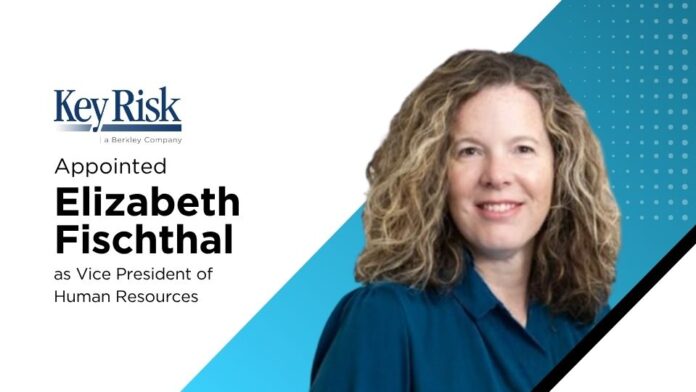

Key Risk has appointed Elizabeth Fischthal as vice president of human resources, adding an HR leader with more than two decades of experience as the workers compensation provider focuses on talent, leadership development and organizational culture.
Key Risk has appointed Elizabeth Fischthal as its new Vice President of Human Resources, bringing a veteran HR executive into a leadership role focused on talent strategy, organizational effectiveness and culture.
Fischthal joins Key Risk with more than 20 years of human resources leadership experience. Her background includes talent management, organizational effectiveness, leadership development, talent acquisition and culture transformation—areas that have become increasingly interconnected as employers rethink how they attract, develop and retain employees.
The appointment is particularly relevant in the workers compensation sector, where workforce capabilities are closely tied to operational performance. Insurers and claims organizations rely on specialized employees across underwriting, claims management, risk assessment, customer service and technology. Building and retaining that talent can have a direct effect on how efficiently organizations serve employers and injured workers.
Fischthal’s role will place those workforce priorities within Key Risk’s broader business strategy.
HR Leadership Moves Beyond Traditional Administration
The appointment reflects the expanding role of HR leadership inside businesses where workforce decisions increasingly influence operational outcomes.
Rather than focusing solely on recruiting and employee administration, modern HR functions are being asked to build leadership pipelines, identify critical skills, improve employee experiences and connect workforce investments to measurable business objectives.
Fischthal’s experience spans several of those areas. According to Key Risk, she has worked with senior executives as a strategic HR adviser, helping organizations strengthen leadership pipelines and align people strategies with broader business goals.
That approach mirrors the direction of the wider HR technology market, where platforms for workforce analytics, talent management and employee experience are giving HR teams more data to support strategic decisions.
Technology has also changed how those functions operate. Workday, Microsoft, Salesforce and SAP have expanded enterprise HR and workforce capabilities, while specialized platforms increasingly use artificial intelligence to support recruiting, skills analysis, employee development and workforce planning.
For HR executives, the challenge is no longer simply implementing these systems. It is translating the data they produce into decisions about organizational structure, skills and leadership.
Talent Strategy Becomes a Business Issue
Key Risk’s announcement does not disclose specific technology initiatives associated with Fischthal’s appointment. But her areas of expertise suggest that talent strategy and organizational development will be important parts of the HR agenda.
Talent acquisition is one component. Leadership development and succession planning are another.
For companies operating in specialized industries, replacing experienced employees can be difficult because institutional knowledge is often accumulated over years. A leadership pipeline can therefore reduce dependence on external hiring while creating clearer development paths for existing employees.
Culture transformation is another increasingly important component of the HR function. Organizations competing for skilled employees need more than compensation and job openings to differentiate themselves. Employee development, leadership quality and workplace experience can all affect whether people remain with an organization.
This is where HRTech platforms can support—but not replace—HR leadership. Workforce analytics can identify patterns in turnover, engagement or skills gaps, but executives still need to determine what those patterns mean and what interventions are appropriate.
AI Is Changing the HR Technology Landscape
The timing of Fischthal’s appointment also comes as artificial intelligence becomes more deeply embedded in human resources technology.
AI recruiting tools can automate aspects of candidate sourcing and screening. Workforce analytics platforms can help identify skills gaps and workforce trends. Generative AI is also beginning to assist with job descriptions, employee communications, learning content and HR service delivery.
Large technology companies including Microsoft, Google and Salesforce are incorporating AI into workplace and business software, while dedicated HRTech vendors are developing tools for talent intelligence and employee experience.
For HR leaders, that creates both an opportunity and a governance challenge. Automation can reduce repetitive work, but decisions involving hiring, promotion and employee performance require careful oversight because algorithmic recommendations can introduce bias or obscure accountability.
That makes experienced HR leadership increasingly important as organizations determine where automation belongs and where human judgment must remain central.
What Fischthal’s Appointment Means for Key Risk
Key Risk’s announcement is ultimately a leadership change rather than a technology launch, but it highlights a broader shift in the role of HR inside modern enterprises.
Fischthal’s remit spans the workforce disciplines that increasingly define strategic HR: finding the right talent, developing leaders, improving organizational effectiveness and shaping culture.
For Key Risk, the immediate priority will be turning those capabilities into measurable business outcomes. That could include stronger leadership succession, improved talent retention, more effective recruiting or closer alignment between workforce planning and business growth.
The company has not outlined specific initiatives under Fischthal’s leadership, so the impact of the appointment will become clearer as Key Risk defines its workforce priorities.
What is already clear is that HR leadership is increasingly being positioned as part of the operating strategy—not simply as a support function.
Market Landscape
The HRTech market is increasingly centered on strategic workforce management rather than basic HR administration. Talent intelligence, workforce analytics, employee experience and AI-assisted recruiting are becoming important parts of enterprise HR technology stacks.
For specialized employers such as insurance and workers compensation providers, the challenge is particularly pronounced because domain expertise can take years to develop. Leadership development and internal mobility can therefore become important components of workforce planning.
AI is adding another layer. Technology can help HR teams analyze workforce data and automate repetitive processes, but strategic decisions around culture, leadership and organizational design remain heavily dependent on human judgment.
Fischthal’s appointment fits that environment: her stated areas of expertise cover several functions that technology can support, but that ultimately require executive-level direction.
Top Insights
- Key Risk appointed Elizabeth Fischthal as VP of HR, adding more than 20 years of experience across talent and organizational leadership.
- Fischthal’s expertise spans talent acquisition, leadership development and culture transformation, areas increasingly connected to strategic workforce planning.
- The appointment comes as HRTech platforms use AI and workforce analytics to help organizations manage recruiting, skills and employee development.
- Key Risk has not announced specific technology initiatives under Fischthal, leaving the appointment’s measurable workforce impact to emerge over time.
Join thousands of HR leaders who rely on HRTechEdge for the latest in workforce technology, AI-driven HR solutions, and strategic insights

Business Wire, a Berkshire Hathaway company, is the global leader in press release distribution and regulatory disclosure. Public relations, investor relations, public policy and marketing professionals rely on Business Wire for secure and accurate distribution of market-moving news and multimedia. Founded in 1961, Business Wire is a trusted source for news organizations, journalists, investment professionals and regulatory authorities, delivering news directly into editorial systems and leading online news sources via its multi-patented NX network. Business Wire’s global newsrooms are available to meet the needs of communications professionals and news media worldwide.




