
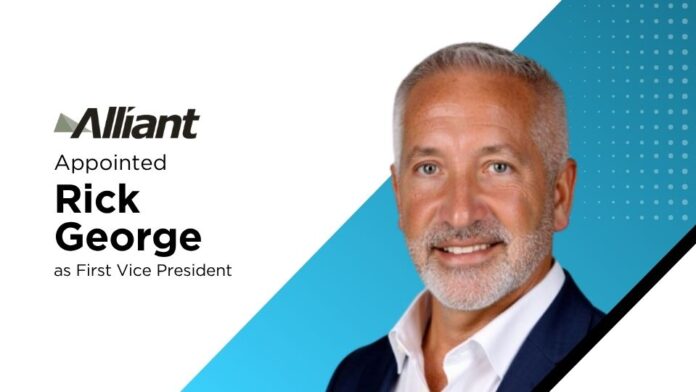

As employers rethink how they manage employee benefits amid rising healthcare costs, Alliant Insurance Services has brought in Rick George as first vice president within its Employee Benefits Group. Based in Fayetteville, Arkansas, George will advise employers nationwide on benefits strategy, employee experience, workplace culture and healthcare cost management, with a career spanning more than three decades in benefits, wellness and technology-enabled transformation.
Employee benefits technology is increasingly becoming an operational issue for HR teams, not simply an insurance administration function. Employers are being asked to improve the employee experience while dealing with higher healthcare spending, fragmented benefits data and growing pressure to demonstrate that benefits programs deliver measurable value.
That backdrop gives Alliant Insurance Services’ latest hiring move broader significance.
The insurance brokerage and employee benefits provider has appointed Rick George as a first vice president within its Employee Benefits Group. From Fayetteville, Arkansas, George will work with employers across the U.S. on employee benefits strategies designed to connect workforce needs with business objectives.
According to Alliant, George has more than 35 years of experience spanning employee benefits, total rewards, healthcare strategy and employee well-being. His background also includes technology-enabled benefits transformation, including efforts to improve benefits processes, operational efficiency, data integrity and reporting.
The appointment does not represent a new HR software product or benefits platform. Instead, it highlights a growing part of the HR technology ecosystem: the use of technology, data and process redesign to make complex employer-sponsored benefits easier to administer and easier for employees to navigate.
That distinction matters.
For HR and benefits leaders, the problem is often less about whether a digital benefits tool exists and more about whether disparate systems, data sources and workflows work together. Benefits administration can involve insurers, brokers, payroll systems, HR information systems, wellness providers, pharmacy programs and employee-facing enrollment platforms.
George’s previous experience, as described by Alliant, centers on connecting those operational pieces. Before joining the company, he served as Senior Director of Benefits and Wellness at a national transportation company, where he was involved in benefits and wellness programs as well as broader process and technology initiatives.
The timing is notable because employers are facing an increasingly difficult cost equation.
Mercer reported that average employer-sponsored health insurance costs reached $17,496 per employee in 2025, a 6% increase. The firm expects costs to rise another 6.7% in 2026, pushing the average above $18,500 per employee.
Those increases are changing the role of benefits technology. HR teams increasingly need accurate workforce and claims data, better reporting and more effective ways to guide employees toward appropriate benefits and healthcare choices.
WTW’s 2025 Benefits Trends Survey similarly found that rising benefit costs were the leading issue influencing U.S. employers’ benefits strategies, cited by 90% of respondents. The research also found that employers are increasingly looking to extract more value from existing programs rather than simply expanding their benefits portfolios.
That is where Alliant’s employee benefits consulting model intersects with the broader HRTech market.
Companies such as Microsoft, Salesforce and Workday have helped establish expectations for cloud-based HR infrastructure, while specialized providers focus on benefits administration, employee engagement, healthcare navigation and workforce analytics. The competitive landscape therefore extends beyond traditional insurance brokers. Modern benefits programs increasingly depend on how effectively data and digital workflows move between HR systems and specialized platforms.
For enterprise HR teams, the practical implication is that benefits transformation should be evaluated as an operating-model decision rather than a software purchase alone. A new employee benefits platform may improve enrollment, communication or analytics, but its effectiveness depends on data quality, integrations, governance and employee adoption.
George’s technology-oriented background fits that shift. Alliant says his previous work included redesigning benefits processes, improving reporting capabilities and creating more seamless experiences for employees, HR professionals and business leaders.
The broader direction of travel is clear: benefits teams are being pushed toward more measurable, data-driven decision-making.
Artificial intelligence could accelerate that transition, particularly in areas such as benefits communication, employee support, healthcare navigation and workforce analytics. WTW found that 80% of employers surveyed believe AI will fundamentally change how healthcare benefits are managed over the next three years.
But AI is unlikely to solve the underlying infrastructure problem by itself. Employers still need reliable data, integrated systems and clearly defined processes before advanced analytics or AI-based tools can produce useful results.
That makes experienced benefits leaders with technology and transformation backgrounds potentially valuable as organizations modernize their HR operations.
For Alliant, George’s appointment strengthens its employee benefits advisory capabilities at a time when employers are balancing three competing priorities: controlling healthcare expenditure, maintaining an attractive employee experience and simplifying increasingly complex benefits ecosystems.
The bigger HRTech story is not the appointment itself. It is the convergence of benefits consulting, workforce data and enterprise technology. As healthcare costs continue to rise, employers will have stronger incentives to treat benefits infrastructure as part of their broader digital workplace strategy rather than an isolated administrative function.
Market Landscape
The employee benefits technology market is moving toward data integration, personalization and measurable outcomes. Employers increasingly expect benefits systems to connect with HRIS, payroll, analytics, healthcare navigation and employee experience tools rather than operate as standalone enrollment systems.
Mercer’s latest research puts the pressure into perspective: employer-sponsored health benefit costs are expected to exceed $18,500 per employee in 2026, while WTW reports that 90% of U.S. employers identify rising benefit costs as a major influence on strategy.
For enterprise buyers, this favors platforms and advisory models that can combine benefits administration with analytics, reporting and employee engagement. Major enterprise technology ecosystems from Microsoft, Salesforce and other HR software vendors are also raising expectations around integrated data and digital employee experiences.
The competitive question for benefits providers is increasingly whether they can help employers turn fragmented workforce and healthcare information into actionable decisions.
Top Insights
- Alliant hired Rick George to advise employers on benefits strategy, employee experience and healthcare costs, strengthening its technology-enabled employee benefits capabilities.
- George brings more than 35 years of benefits, wellness and healthcare strategy experience, including large-scale process, systems, data and reporting transformation.
- Employer health benefit costs are projected to exceed $18,500 per employee in 2026, increasing demand for analytics-driven cost management and benefits optimization.
- WTW says 90% of U.S. employers identify rising benefit costs as a key strategic concern, putting pressure on HR leaders to improve existing programs.
- AI, workforce analytics and integrated HR platforms are reshaping benefits management, but enterprise adoption still depends on clean data, integrations and effective employee engagement.
Join thousands of HR leaders who rely on HRTechEdge for the latest in workforce technology, AI-driven HR solutions, and strategic insights

Business Wire, a Berkshire Hathaway company, is the global leader in press release distribution and regulatory disclosure. Public relations, investor relations, public policy and marketing professionals rely on Business Wire for secure and accurate distribution of market-moving news and multimedia. Founded in 1961, Business Wire is a trusted source for news organizations, journalists, investment professionals and regulatory authorities, delivering news directly into editorial systems and leading online news sources via its multi-patented NX network. Business Wire’s global newsrooms are available to meet the needs of communications professionals and news media worldwide.




