

A multinational firm trains its employees in leadership training, certification courses, and compliance. The simple question that senior executives pose – What value did the above programs add to the business? leaves little data for the L&D department aside from completion and satisfaction surveys.
The use of AI has hastened the process of transformation within an organization and raised expectations from the HR. The HR managers should prove their relevance in contributions towards productivity, skills development, talent retention, and performance.
This article shows how AI analytics helps measure learning ROI.
Learning ROI Issue & How AI Is Transforming It
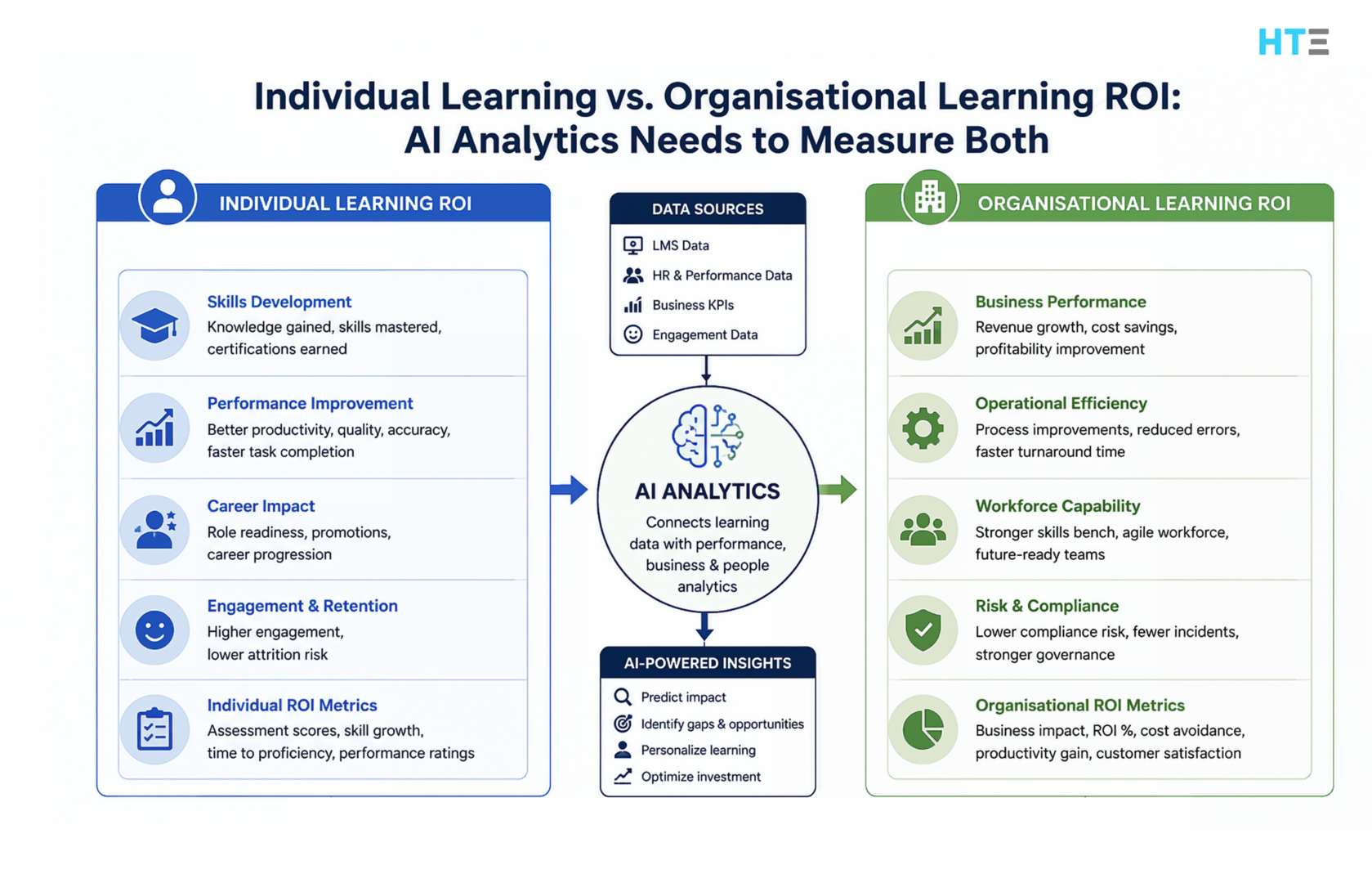
Organizations are moving ahead in AI adoption, and hence it is important for HR leaders to measure training returns through results like productivity gains, skills development, and talent retention. The emphasis has moved from measuring learning engagement to measuring the impact.
Advanced AI Analytics can identify the courses that improve job performance, shorten onboarding, or strengthen capabilities while predicting future skill requirements. Instead of relying on periodic reports, organizations can evaluate the effectiveness and maximize the return on their learning investments.
How AI Analytics Is Replacing Metrics with Learning Intelligence
- Measures Knowledge Retention Over Time
Rather than assessing learners after a course, Learning Analytics tracks how well employees retain and apply new skills over time. This helps organizations identify programs that create impact.
- Recommends Interventions Before Learning Outcomes Decline
As AI Adoption increases, organizations can use AI models to detect employees who are falling behind or disengaging from learning. HR can intervene before performance is affected.
- Benchmarks Learning Effectiveness Across Teams
AI Analytics compares learning outcomes across departments, locations, and job roles to identify which teams achieve business results and which require additional support.
The analytics in use for organization manufacturing goods are referred to as AI Analytics. Learning Analytics proves that employees completing equipment training make fewer mistakes and have fewer safety incidences. HR uses these insights to expand simulation training across all production sites.
Building the AI Learning Analytics Business Case
- Address Existing Measurement Gaps
Before investing in AI Analytics, organizations should identify where current reporting falls short. Understanding the limitations is vital in determining the areas that can be solved using AI.
- Aligning Cross-functional Stakeholders
An effective business case will involve HR, business, finance, and IT. By working together, they ensure that AI Analytics captures results that matter to people and the business.
- Demonstrate Value
The investment should show how Learning Analytics can support future workforce needs, adapt to evolving skill requirements, and scale across business units without increasing operations.
- Establisha Framework for Optimization
The business case should emphasize that AI Analytics is not a one-time reporting tool. Continuous analysis enables organizations to refine learning content and improve employee experience.
A retail organization implements AI Analytics to evaluate the effectiveness of customer service training. Through Learning Analytics combined with customer satisfaction ratings, average time to resolve issues, and employee performance data, it becomes evident that associates who follow AI learning have higher customer satisfaction and resolution rates.
The Future of L&D via AI Analytics
The future of Learning Analytics involves moving beyond mere reporting. Those organizations that use the AI insights in their L&D strategy will have successful learning programs, fastest closing of skill gaps, and superior workforce performance. The learning ROI will be measured by the contributions of learning to the organization’s growth.

Paramita Patra is a content writer and strategist with over five years of experience in crafting articles, social media, and thought leadership content. Before content, she spent five years across BFSI and marketing agencies, giving her a blend of industry knowledge and audience-centric storytelling.
When she’s not researching market trends , you’ll find her travelling or reading a good book with strong coffee. She believes the best insights often come from stepping out, whether that’s 10,000 kilometers away or between the pages of a novel.




