
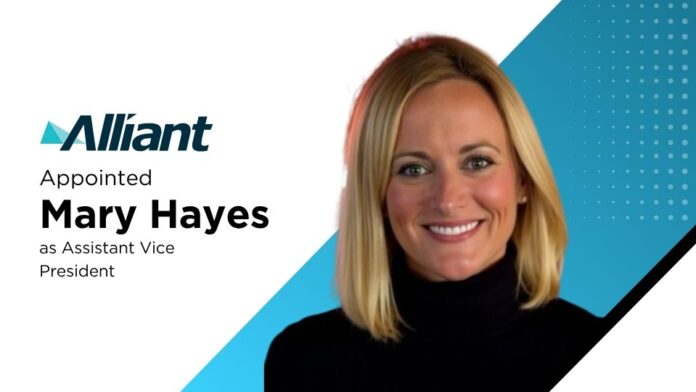

Alliant Insurance Services has appointed Mary Hayes as Assistant Vice President within its Employee Benefits Group, adding expertise spanning PEO solutions, employee benefits, payroll, workers’ compensation and compliance. The Florida-based advisor will help employers evaluate workforce strategies designed to simplify operations, manage risk and control costs.
The boundaries between employee benefits, payroll, HR administration and workforce risk management continue to blur as employers look for more integrated ways to manage their workforce. Alliant Insurance Services is expanding its advisory capabilities in that environment with the appointment of Mary Hayes as Assistant Vice President within its Employee Benefits Group.
Hayes will work with employers in Florida on workforce strategies that encompass employee benefits, HR operations, payroll, workers’ compensation and compliance. Her background includes PEO solutions, employee benefits and property and casualty insurance, giving her experience across several functions that increasingly intersect in enterprise workforce management.
The appointment is notable because employers are under pressure to manage more workforce processes while controlling administrative complexity and employment-related costs.
A professional employer organization, or PEO, can provide businesses with access to services such as payroll administration, employee benefits, workers’ compensation and HR support. Rather than treating these functions as isolated processes, PEO arrangements can consolidate elements of workforce administration under a broader operating model.
That model has become increasingly relevant as companies assess how much HR infrastructure they should operate internally and which processes can be supported by external providers.
Hayes’ role will include helping businesses determine whether a PEO structure is appropriate for their needs. That decision can involve more than comparing service fees. Employers may need to consider workforce size, benefits requirements, compliance responsibilities, risk exposure, payroll complexity and the level of HR expertise available internally.
The shift toward integrated workforce management is also reflected in the broader HR technology market.
Modern HR platforms increasingly connect traditionally separate systems for human resources, payroll, benefits, time and attendance, workforce analytics and employee experience. Providers such as Workday, UKG and ADP have built platforms around this convergence, while specialized vendors continue to target individual components of the HR technology stack.
For employers, integration can reduce the number of systems and manual processes required to manage employee data. It can also create a more consistent source of workforce information, potentially improving reporting and decision-making.
But technology alone does not resolve every workforce challenge.
Benefits selection, PEO evaluation and insurance risk decisions can involve organizational circumstances that are difficult to capture in software workflows. Employers may need guidance on how different operating models affect compliance, costs, employee experience and risk.
That is where advisory services remain relevant alongside HR SaaS and automation.
Hayes joins Alliant after serving as Vice President of Sales at a national HR services company. She holds property and casualty and life and health insurance licenses, adding insurance expertise to her HR services background.
Alliant said her work will focus on helping employers improve operational efficiency, manage costs, mitigate risk and enhance employee experience. Those objectives reflect a broader shift in HR from administrative service delivery toward workforce strategy.
The employee benefits function itself has become increasingly connected to employee experience. Benefits administration is no longer simply an annual enrollment exercise. Employers use benefits to support recruitment, retention and workforce wellbeing, while employees increasingly expect digital access to benefits information and streamlined administrative experiences.
For HR teams, this creates a technology and governance challenge. Employee data may sit across HRIS, payroll, benefits, insurance and workforce management systems, creating opportunities for integration but also introducing data-quality, privacy and compliance considerations.
The PEO market sits at the intersection of these issues. PEO providers can centralize multiple employment-related services, while HR technology vendors increasingly offer APIs and integrations that allow employers to connect specialized applications without completely replacing existing systems.
The competitive landscape therefore extends beyond traditional insurance consulting.
Companies such as ADP, Paychex and TriNet operate across portions of the HR services and PEO ecosystem, while Workday, UKG and other enterprise HR technology providers compete around workforce-management platforms. Benefits technology companies, payroll providers and insurance brokers can also occupy overlapping parts of the employer technology stack.
For employers, the question is increasingly less about choosing a single HR system and more about determining how different services should fit together.
Hayes’ appointment reflects that broader market dynamic. Her combined experience in PEO services, benefits and insurance gives Alliant another advisor capable of addressing workforce administration and risk as connected business issues rather than separate functions.
That approach may become more important as HR leaders attempt to simplify technology environments while maintaining compliance and delivering competitive employee benefits.
AI is also beginning to influence this landscape. Automated payroll processes, benefits decision support, workforce analytics and HR service delivery can reduce administrative workloads. Yet decisions involving insurance risk, employment structures and organizational priorities still require context and accountability.
The result is a hybrid model in which technology handles more repetitive workforce administration while advisors and HR leaders focus on higher-value decisions.
Alliant’s addition of Hayes is therefore more than a personnel announcement. It illustrates how HR services are converging around a broader workforce-management model that combines benefits, payroll, compliance, insurance and employee experience.
For employers evaluating PEO arrangements or redesigning their HR operating models, that convergence creates both an opportunity and a challenge: simplify the infrastructure without losing the specialized expertise needed to manage increasingly complex workforce requirements.
Market Landscape
The HR services market is increasingly converging around integrated workforce management. PEOs, benefits providers, payroll platforms, HR SaaS companies and insurance advisors increasingly overlap as employers seek fewer administrative silos.
Technology providers such as ADP, UKG and Workday have expanded integrations across HR and workforce functions, while PEO providers compete by combining HR administration, payroll, benefits and risk-related services.
The emerging model combines HR automation and connected workforce data with specialized human advice for complex decisions involving benefits, compliance, insurance and employment structures.
Top Insights
- PEOs increasingly sit at the intersection of HR administration, payroll, benefits, compliance and workforce risk management.
- Integrated HR technology can reduce administrative silos, but employers still need specialized expertise for complex workforce decisions.
- Benefits and workforce strategy are becoming increasingly connected as employers use benefits to support employee experience and retention.
- HR leaders are balancing technology consolidation with the need for specialized advisory support across compliance and risk.
- AI and automation can handle repetitive HR administration while human advisors focus on contextual workforce and risk decisions.
Join thousands of HR leaders who rely on HRTechEdge for the latest in workforce technology, AI-driven HR solutions, and strategic insights

Business Wire, a Berkshire Hathaway company, is the global leader in press release distribution and regulatory disclosure. Public relations, investor relations, public policy and marketing professionals rely on Business Wire for secure and accurate distribution of market-moving news and multimedia. Founded in 1961, Business Wire is a trusted source for news organizations, journalists, investment professionals and regulatory authorities, delivering news directly into editorial systems and leading online news sources via its multi-patented NX network. Business Wire’s global newsrooms are available to meet the needs of communications professionals and news media worldwide.




