
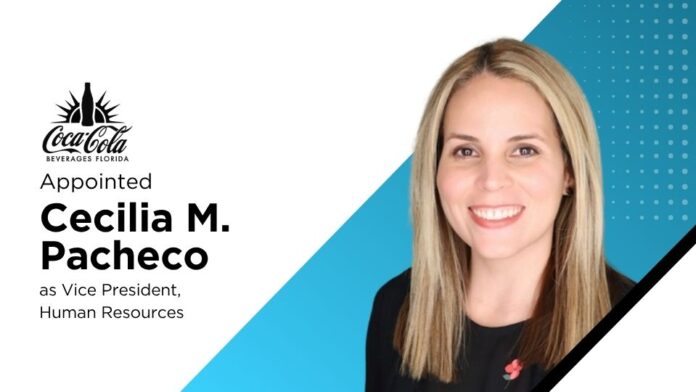

Human resources leadership is increasingly moving beyond recruiting and employee administration as companies focus on workforce planning, organizational transformation and building the skills needed for growth. Coca-Cola Beverages Florida is putting that broader mandate at the center of its HR strategy with the appointment of a new senior leader.
Coca-Cola Beverages Florida, LLC, known as Coke Florida, has appointed Cecilia M. Pacheco as Vice President of Human Resources, giving her responsibility for the company’s HR organization as it continues to expand and invest in workforce capabilities.
For large employers, the HR function has become increasingly intertwined with business strategy.
Hiring is only one part of the equation. Companies also need to retain critical talent, develop managers, improve employee experience, manage rewards and benefits, and ensure their workforce can adapt as business operations change.
Coke Florida’s appointment of Cecilia M. Pacheco reflects that broader definition of HR leadership.
Pacheco brings more than 15 years of human resources leadership experience, including work with Fortune 500 organizations. Her background spans talent strategy, organizational initiatives, workforce development and business transformation.
At Coke Florida, she will oversee the company’s Human Resources function across Talent Acquisition, Employee Relations, HR Operations, Learning and Development, and Total Rewards.
That scope puts the new HR leader at the center of several functions that increasingly need to operate as a connected system.
HR moves closer to business transformation
The appointment comes as employers face a workforce environment shaped by changing employee expectations, skills shortages, automation and pressure to improve productivity.
In that environment, talent acquisition cannot be separated easily from learning and development.
A company may hire employees for today’s skills but still need to reskill them as technology and operating models change. Compensation and benefits also play a role in retention, while employee relations and management practices influence whether newly hired talent remains productive.
The combination of responsibilities under Pacheco therefore gives the HR organization a broad mandate.
Coke Florida says her experience partnering with senior leaders, developing high-performing teams and leading organizational transformation will support the company’s continued growth.
That emphasis is consistent with the evolution of the strategic HR business partner model, in which HR leaders increasingly participate in decisions around workforce planning, organizational design and business performance rather than operating solely as an administrative function.
Learning becomes part of the growth strategy
One of the more significant responsibilities in Pacheco’s new role will be Learning and Development.
For employers operating in competitive labor markets, internal development has become an increasingly important complement to external hiring.
Training existing employees can help organizations address skills gaps while creating clearer career paths. It can also preserve institutional knowledge and reduce dependence on recruiting for every new capability.
Technology is changing how that development is delivered.
Modern learning-management and talent platforms increasingly use skills intelligence, AI recommendations and personalized learning pathways to connect employee development with organizational requirements. Platforms from Workday, SAP, Oracle, Cornerstone and LinkedIn are competing to make skills data a more central part of talent management.
For a consumer-goods and beverage company, workforce development also extends beyond corporate offices. Distribution, manufacturing, sales, logistics and field operations require different capabilities, meaning a single workforce strategy must accommodate employees working across very different environments.
That makes scalable learning and career development particularly relevant.
A broader talent-management mandate
Pacheco’s responsibility will also include Total Rewards, which covers the compensation and benefits strategies companies use to attract and retain employees.
That function has become more complex as workers evaluate employers based on a combination of pay, flexibility, career development, benefits and workplace experience.
HR leaders increasingly need workforce data to understand how these elements interact.
For example, compensation analysis can identify retention risks, while employee-engagement data can highlight management or organizational issues. Talent acquisition data can reveal where recruiting is becoming difficult, while learning data can show whether internal development is helping close capability gaps.
Connecting those signals is one of the central objectives of modern HR technology.
Coke Florida’s decision to place talent acquisition, employee relations, HR operations, learning and development and total rewards within Pacheco’s remit gives the role visibility across much of that employee lifecycle.
The technology layer behind modern HR
Although the announcement is primarily about leadership rather than a new technology deployment, it highlights a broader trend across enterprise HR.
The HR function is becoming increasingly data-driven.
Applicant tracking systems, human capital management platforms, workforce analytics, employee listening tools and learning platforms now generate information across nearly every stage of the employee lifecycle.
AI is adding another layer.
Recruiting platforms can help identify candidates, learning systems can recommend development opportunities and workforce analytics can identify patterns in retention or skills availability. At the same time, organizations must manage the risks associated with algorithmic decision-making, employee privacy and the use of sensitive workforce data.
That makes HR leadership increasingly important in determining not just which technology an organization adopts, but how that technology is governed and integrated into broader talent strategy.
Pacheco’s background in organizational transformation could therefore become particularly relevant as Coke Florida continues to modernize its workforce practices.
What the appointment signals
Executive HR appointments rarely generate the same attention as technology launches or major acquisitions, but they can provide clues about where an organization is placing strategic emphasis.
In this case, the breadth of Pacheco’s remit suggests that Coke Florida is treating human resources as a central component of its growth strategy.
The company is not framing the role solely around hiring. Instead, the mandate spans recruitment, employee relations, operations, development and rewards — the infrastructure needed to attract people, build their capabilities and retain them.
That reflects the direction of modern HR.
As automation changes individual tasks and technology reshapes business operations, organizations increasingly need HR leaders who can connect workforce strategy with organizational change.
For Coke Florida, Pacheco’s appointment puts that responsibility under a single leadership role. The next test will be how effectively the company translates that mandate into measurable improvements in hiring, employee development, retention and workforce productivity.
Market Landscape
The appointment reflects a broader shift in HR leadership from administrative management toward integrated talent and workforce strategy.
Today’s CHRO and VP-level HR roles increasingly span:
- Talent acquisition and employer branding
- Learning, upskilling and reskilling
- Employee experience and engagement
- Compensation and total rewards
- Workforce analytics and planning
- Organizational transformation
- HR technology and AI governance
The technology market is following the same direction. HCM providers such as Workday, SAP, Oracle and UKG, alongside specialist talent platforms, are increasingly connecting recruiting, skills, performance, learning and workforce data.
For companies with large frontline workforces, the challenge is particularly pronounced. HR technology needs to work across office-based employees as well as manufacturing, logistics, sales and field teams.
Top Insights
- Coke Florida appointed Cecilia Pacheco as VP of Human Resources, expanding leadership oversight across recruitment, employee relations, learning, HR operations and total rewards.
- Pacheco brings more than 15 years of HR leadership experience, including work with Fortune 500 organizations and business-transformation initiatives.
- The appointment reflects a wider shift toward HR leaders owning workforce capabilities rather than focusing primarily on administrative HR functions.
- Learning and development will remain important as employers increasingly use internal mobility and upskilling to address changing workforce requirements.
- The growing use of AI and workforce analytics is giving HR leaders more tools to connect recruiting, development, retention and organizational performance.
Join thousands of HR leaders who rely on HRTechEdge for the latest in workforce technology, AI-driven HR solutions, and strategic insights

Business Wire, a Berkshire Hathaway company, is the global leader in press release distribution and regulatory disclosure. Public relations, investor relations, public policy and marketing professionals rely on Business Wire for secure and accurate distribution of market-moving news and multimedia. Founded in 1961, Business Wire is a trusted source for news organizations, journalists, investment professionals and regulatory authorities, delivering news directly into editorial systems and leading online news sources via its multi-patented NX network. Business Wire’s global newsrooms are available to meet the needs of communications professionals and news media worldwide.




