
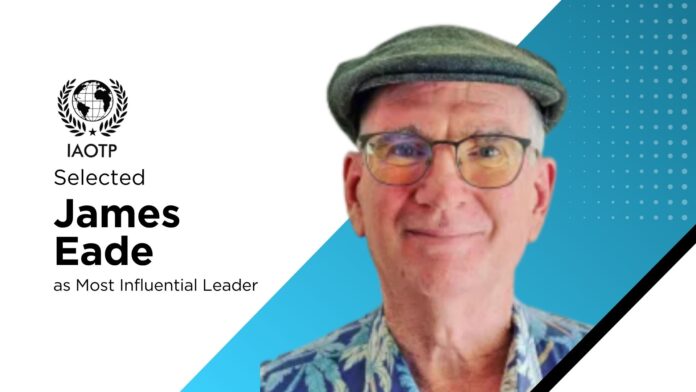

James Eade, a longtime chess educator, author, technology executive and addiction-recovery advocate, has been selected by the International Association of Top Professionals (IAOTP) as its Most Influential Leader in Addiction Recovery for 2026. The recognition adds a new dimension to a career spanning chess leadership, nonprofit work, technology and writing, with Eade expected to receive the award at IAOTP’s December 12, 2026, Annual Awards Gala at The Plaza Hotel in New York City.
James Eade’s professional career has rarely fit neatly into a single category. He has worked in technology, written extensively about chess, led nonprofit initiatives and spent recent years focusing publicly on addiction recovery. Now, the latter work is becoming a larger part of his professional profile.
IAOTP says it has selected Eade as its Most Influential Leader in Addiction Recovery for 2026, citing his advocacy, leadership and efforts to challenge the stigma surrounding addiction. The organization says Eade will be recognized during its annual awards gala at The Plaza Hotel in New York on December 12.
The award is notable less as a technology announcement than as an example of how digital publishing, community building and professional expertise increasingly intersect in the behavioral-health ecosystem.
Eade is the founder, president and CEO of the Eade Foundation, a nonprofit focused primarily on expanding access to chess and building communities through the game. His connection between chess and social development has been a recurring theme throughout his career.
The foundation was established following the death of Eade’s father and promotes chess literacy, notation and access to equipment. Its philosophy treats chess as a social activity as well as a competitive discipline, with an emphasis on encouraging players to improve rather than measuring themselves against an abstract standard of perfection.
That community-building experience now sits alongside Eade’s work in addiction recovery.
In 2023, he published Freedom: Your Path to Recovery, a book aimed at people dealing with addiction. His more recent book, No Blame, No Shame, continues that focus, emphasizing recovery, personal responsibility and the possibility of rebuilding one’s life after addiction.
That combination of advocacy and publishing reflects a broader shift in how people seek health and recovery information. Digital platforms, online communities, podcasts, books and peer-support networks have expanded the number of ways individuals can encounter recovery resources outside traditional clinical settings.
But the expansion of information also raises an important distinction: educational and motivational content is not a substitute for evidence-based treatment or professional medical care. Recovery journeys vary considerably, and people experiencing substance-use disorders may require clinical, psychological or emergency support.
Eade’s career before his recovery-focused writing provides another unusual dimension to the story.
He has held senior positions within the chess community, including leadership roles with the Chess Journalists of America, CalChess, the Kolty Chess for Youth Federation and the U.S. Chess Trust. He also served as American Zone President of FIDE and as a delegate for the United States Chess Federation.
His connection to the chess world extends to publishing. Eade has authored books including Chess for Dummies, The Chess Player’s Bible: Illustrated Strategies for Staying Ahead of the Game and Chess Openings for Dummies.
The breadth of that experience gives Eade an established platform from which to communicate his recovery message. His work also illustrates an increasingly common model for professional advocacy: combining subject-matter expertise, personal communication, community engagement and digital publishing to reach audiences directly.
Outside chess and nonprofit work, Eade spent part of his career in technology. He worked as a director-level and senior systems programmer for Charles Schwab and as a freelance producer for IBMTV. His academic background includes a bachelor’s degree in history from the University of Massachusetts Amherst and a master’s degree in human resource management from the University of San Francisco.
Those experiences provide a bridge between traditional professional leadership and his current advocacy work. They also help explain the emphasis on discipline, focus and resilience that appears throughout his public biography.
IAOTP describes itself as a selective, New York-based professional organization that recognizes accomplished professionals through awards, media exposure, networking and its annual gala. Its website says membership is nomination- or invitation-based and subject to committee review.
The organization has scheduled its 2026 gala for December 12 at The Plaza Hotel.
Eade is also slated to receive several other IAOTP distinctions this year, according to the supplied announcement, including Top 50 Fearless Leaders, Top Author of the Decade, Top Global Icon and Top 25 Global Impact Leaders.
The accumulation of awards is less important to the recovery field than what Eade does with the visibility they create. Addiction remains an area where stigma can discourage people from seeking help, making accessible and responsible communication an important part of public education.
For Eade, the next phase appears to be about maintaining that message across multiple channels — books, nonprofit work, speaking, chess communities and broader advocacy.
His story ultimately illustrates a less conventional path into recovery advocacy. Rather than emerging exclusively from healthcare or behavioral-health institutions, Eade brings decades of experience in technology, publishing, education and community leadership to the conversation.
That does not replace clinical expertise. It does, however, demonstrate how lived experience, communication and community-building can complement the wider recovery ecosystem.
Market Landscape
The addiction-recovery ecosystem increasingly spans behavioral-health providers, telehealth, digital therapeutics, peer-support communities, educational content and nonprofit organizations.
Technology has lowered barriers to accessing information and connecting with support networks, while employers and healthcare organizations are paying greater attention to behavioral health as part of broader wellbeing strategies.
The challenge is separating credible recovery information from unverified online advice. For technology platforms and content creators, responsible communication, clear sourcing and appropriate signposting toward professional care are increasingly important.
Eade’s work sits primarily on the education and advocacy side of that ecosystem rather than clinical treatment. His use of books and community-oriented initiatives demonstrates how nonclinical voices can contribute to awareness while remaining distinct from licensed healthcare services.
Top Insights
- James Eade has been selected as IAOTP’s 2026 Most Influential Leader in Addiction Recovery, expanding recognition of his work beyond his decades in chess and technology.
- Eade’s recovery advocacy includes books such as Freedom: Your Path to Recovery and No Blame, No Shame, aimed at reducing stigma and encouraging personal responsibility.
- His Eade Foundation uses chess as a community-building tool, reflecting a broader philosophy of education, inclusion, mentorship and social connection.
- Eade’s technology background includes senior systems programming at Charles Schwab, adding an unusual technology and business dimension to his advocacy career.
- The recognition highlights the growing role of publishing, digital communities and nonprofit organizations alongside traditional healthcare providers in the wider recovery ecosystem.
Join thousands of HR leaders who rely on HRTechEdge for the latest in workforce technology, AI-driven HR solutions, and strategic insights





