
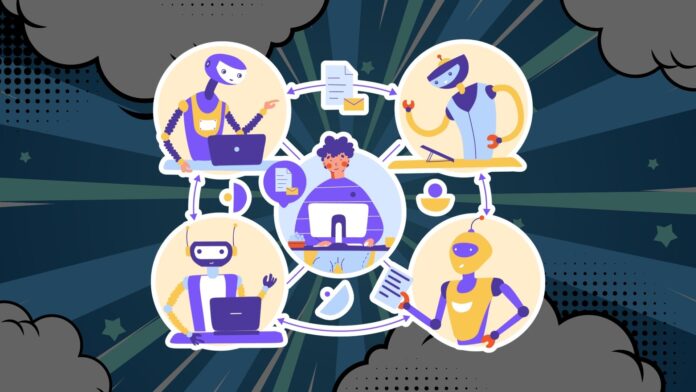

Enterprise HR teams are moving from isolated workflow automation toward systems that can coordinate entire employee processes. Newgen Software has been named a “Notable Vendor” in Forrester’s The Digital Process Automation Software Landscape, Q3 2026, putting the company in a market increasingly shaped by AI agents, end-to-end automation and the challenge of connecting fragmented enterprise systems.
The next phase of HR automation may look less like a collection of automated tasks and more like an intelligent operating layer connecting employees, applications, documents and business processes.
That shift is reflected in the latest digital process automation (DPA) market assessment from Forrester, which identifies Newgen Software among its “Notable Vendors” in The Digital Process Automation Software Landscape, Q3 2026. The report, authored by Forrester Vice President and Principal Analyst Craig Le Clair, examines 39 vendors in the DPA market.
Forrester defines DPA platforms as technologies that develop process applications using advanced programming principles including modeling, orchestration, dynamic case management and AI-led support. The category is particularly relevant to HR because employee processes rarely remain confined to a single application.
Hiring, onboarding, employee service requests, document processing, benefits administration and workforce compliance can involve HR systems, identity platforms, finance applications, document repositories and service-management tools. Automating one step does little if employees still have to move information manually between those systems.
That is where end-to-end process orchestration becomes more important.
According to the information supplied by Newgen about the Forrester report, 54% of automation decision-makers say their organisations need to focus more on end-to-end automation rather than workflow and task automation alone. The finding reflects a broader enterprise shift from automating individual activities toward coordinating processes across applications and departments.
For HR leaders, the distinction matters. An employee-support chatbot may answer a question, for example, but a genuinely automated HR service could interpret a request, retrieve relevant employee information, trigger the appropriate workflow, generate or process documentation and route exceptions to a human specialist.
That model is beginning to intersect with agentic AI.
Forrester identifies agentic execution as a major trend in DPA: AI agents can build work patterns based on context and changing conditions rather than simply following a fixed sequence of instructions. The research firm has separately highlighted the broader transition from deterministic automation toward contextual reasoning and adaptive decision-making.
For enterprise HR departments, this could eventually change how employee service operations are designed.
Traditional HR automation generally works from predefined rules. Agentic systems introduce a layer capable of interpreting context and determining which actions should happen next. That could prove useful for complex employee cases where the correct process depends on multiple variables rather than a simple yes-or-no decision.
But the technology also introduces new risks.
Forrester’s assessment points to a central enterprise challenge: scaling AI-enabled automation from pilots into production without encountering integration gaps, breakdowns in human interaction or regulatory and compliance problems. That concern is particularly relevant to HR, where automation frequently operates on sensitive employee information and decisions can have significant consequences.
Newgen’s positioning in the landscape spans North America, EMEA and APAC, with a stated focus on financial services and insurance, government and public sector, and healthcare. These are highly regulated industries where long-running cases, documentation and compliance requirements can make conventional workflow automation difficult to scale.
The company also reports supporting three deployment models tracked by Forrester: hosted/private SaaS, multitenant SaaS and on-premises. Deployment flexibility can be significant for organisations with strict data, security or regulatory requirements.
Newgen’s three highlighted extended use cases are AI agent industry outcomes, customer self-service and document automation. While these applications extend beyond HR, each has a workforce-technology connection.
Document automation, for instance, can reduce manual handling of employee records and forms. Self-service can shift routine HR interactions away from service desks. AI agents could potentially coordinate multi-step employee processes, provided organisations establish appropriate controls and escalation paths.
The competitive landscape is also becoming less straightforward.
Forrester describes adaptive process orchestration (APO) as DPA’s “top disruptor,” with the emerging category moving toward process definitions expressed through plain-language agent instructions rather than conventional workflow design. The research firm expects increasing feature overlap between DPA and APO as the markets develop.
That convergence could make platform selection more complicated for HR technology leaders. Buyers will need to look beyond whether a vendor offers workflow automation and assess integration architecture, AI governance, case management, deployment options, human-in-the-loop controls and the ability to support changing processes.
Newgen CMO Runki Goswami said the company’s view is that AI is shifting enterprise automation from individual tasks toward orchestration across processes, content, communications and AI.
That argument reflects a wider direction in enterprise software. Forrester expects enterprise applications to increasingly accommodate AI agents as a form of digital workforce, pushing technology leaders to reconsider how far business processes should be automated and orchestrated independently of human workers.
For HR teams, however, automation should not be confused with removing people from every process. The more realistic near-term model is likely to combine AI-driven execution with human oversight for exceptions, sensitive decisions and cases requiring judgment.
The Newgen recognition therefore matters less as a vendor accolade than as a signal of where enterprise automation is heading: from isolated workflow tools toward intelligent systems capable of coordinating work across people, applications and increasingly autonomous software agents.
Market Landscape
The DPA market is moving into a more complicated phase as AI agents, intelligent document processing, case management and adaptive orchestration converge.
For HR technology buyers, this creates both opportunity and selection risk. Modern platforms can potentially automate employee service, document-heavy processes and cross-system workflows, but AI-enabled automation also increases the importance of governance, security and human oversight.
Forrester’s broader 2026 research reinforces that caution. Its automation predictions argue that enterprises are moving toward cognitive and agentic automation, while ROI and governance challenges are likely to keep many organisations anchored to deterministic automation during 2026.
The market is also moving toward greater scrutiny of AI’s actual business value. Forrester reported in 2026 that only 15% of AI decision-makers said AI was positively affecting their firm’s earnings, highlighting the gap between experimentation and measurable enterprise outcomes.
For HR leaders, that means automation investments should be evaluated against measurable outcomes such as employee-service resolution times, administrative workload, process compliance, case-cycle times and employee experience—not simply the number of tasks an AI system can perform.
Top Insights
- Newgen’s Forrester recognition highlights the shift from isolated HR workflows toward end-to-end automation connecting employees, applications, documents and AI-driven process orchestration.
- Agentic execution could reshape employee service by allowing AI systems to adapt processes to context, while sensitive HR decisions still require human oversight.
- Newgen supports SaaS and on-premises deployment models, an important consideration for regulated enterprises managing employee data, compliance requirements and complex legacy systems.
- Adaptive process orchestration is emerging alongside DPA, giving HR technology buyers another architectural model to evaluate as agentic automation matures.
Join thousands of HR leaders who rely on HRTechEdge for the latest in workforce technology, AI-driven HR solutions, and strategic insights





