
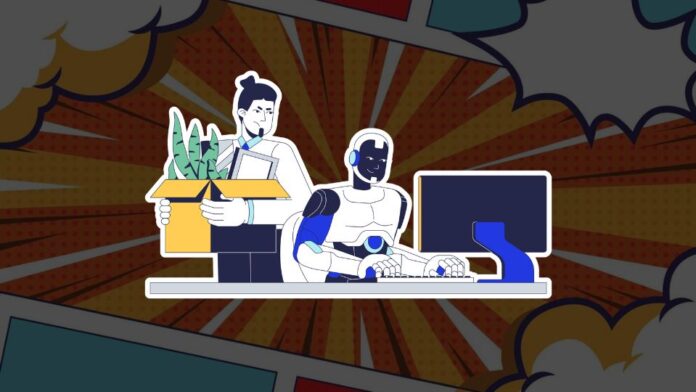

As companies move from experimenting with generative AI to embedding it into everyday work, a different problem is becoming harder to ignore: employees need the skills to build, govern and safely work alongside AI systems. TheNewPush LLC CEO Balázs Nagy is pursuing that challenge through Project NoéMI, a workforce accelerator developed through a strategic partnership with George Mason University and focused on practical AI skills, security and enterprise adoption.
The next phase of enterprise AI adoption may depend less on which model a company buys and more on whether its workforce knows what to do with it.
That is the problem Balázs Nagy, CEO of TheNewPush LLC, is attempting to address with Project NoéMI, a workforce accelerator developed through a strategic partnership between NewPush and George Mason University.
Nagy has spent more than two decades working in technology and security, including as NewPush’s chief technology officer. His latest initiative is aimed at helping organizations develop practical capabilities for deploying AI while maintaining security and governance controls.
The program is positioned as a response to the widening AI skills gap. Rather than treating AI as a plug-and-play productivity application, Project NoéMI is designed around the idea that companies will need employees who can build, supervise and govern AI-enabled systems.
That distinction is becoming increasingly important as organizations move beyond pilots.
The AI workforce problem is bigger than training
Companies can purchase access to foundation models, copilots and AI development platforms relatively quickly. Developing the workforce capable of deploying those technologies responsibly is harder.
IDC research has found that AI adoption is already influencing HR use cases including recruitment, performance management, employee assistants, job descriptions and skills management. The research also points to skills gaps as an important constraint on organizations trying to capture value from AI.
The challenge extends beyond technical employees.
Business leaders need to understand where AI should be deployed. Employees need to know how to collaborate with AI systems. Security teams need to assess new risks. HR leaders need to rethink job design and skills development. Governance teams need mechanisms for evaluating how AI decisions are made.
That creates demand for a workforce model that combines technical literacy with organizational judgment.
Project NoéMI is being designed around that intersection.
From AI users to AI builders
Nagy describes the program as a “high-intensity, semi-vocational accelerator” intended to give professionals practical AI capabilities.
The distinction between AI users and AI practitioners is central to the concept.
Most employees interacting with generative AI do not need to become machine-learning engineers. But organizations deploying AI at scale need people who can translate business requirements into working systems, understand how models behave, manage data and establish appropriate controls.
Those roles could become increasingly important as businesses introduce what Nagy calls “virtual coworkers.”
The term reflects a broader industry movement toward AI agents that can perform multistep tasks, interact with enterprise systems and operate with greater autonomy than conventional chatbots.
That evolution changes the skills equation.
An organization deploying an AI agent into finance, HR, customer service or operations needs more than prompt-writing expertise. It needs people who can define responsibilities, test outputs, monitor behavior, manage permissions and establish escalation paths when an automated system reaches its limits.
Security is positioned as a starting point
Project NoéMI places security at the beginning of the AI implementation process through what NewPush calls “Phase 0 Security.”
The stated objective is to prevent proprietary corporate information from leaking into public AI models.
That concern is already familiar to enterprise IT and security leaders. Employees using consumer AI tools can potentially expose confidential information when organizational controls are weak. Enterprises therefore increasingly need policies, technical safeguards and governance frameworks that distinguish approved AI use from uncontrolled experimentation.
NewPush’s approach makes security part of the workforce accelerator rather than an afterthought.
The company says its NewPush Platform establishes controls around proprietary data, while the program incorporates AI governance concepts alongside technical training.
One of the external frameworks referenced by the program is AI TRiSM, Gartner’s framework for managing trust, risk and security in artificial intelligence.
The broader principle is sound: AI capability and AI governance have to develop together if enterprises are going to move from experimentation into production.
The 4D framework focuses on human judgment
Project NoéMI also incorporates a four-part framework described as delegation, description, discernment and diligence.
The structure is intended to address a problem that technical AI training alone cannot solve: deciding what should be delegated to an AI system and what still requires human judgment.
That becomes more important as AI systems become more capable.
Delegation requires understanding which tasks an AI system can safely perform. Description involves defining what the system is supposed to accomplish. Discernment requires evaluating its output. Diligence involves checking whether the result is accurate, appropriate and compliant.
These are essentially workforce capabilities.
The employee does not simply need to know how to operate an AI tool. They need to understand the boundaries of that tool.
Avoiding the “replacement trap”
One of Project NoéMI’s more distinctive positions is its rejection of what Nagy describes as the “replacement trap”—the idea that organizations can achieve transformation simply by substituting algorithms for human employees.
That position mirrors an increasingly important discussion in workforce strategy.
AI can automate tasks, but jobs frequently contain combinations of routine work, judgment, relationship management and contextual knowledge. Replacing one task with software does not necessarily eliminate the broader role.
A more complicated transition involves redesigning jobs around what humans and AI systems do best.
For HR leaders, that means moving toward AI-enabled job design rather than treating automation purely as a headcount-reduction exercise.
It also creates a reskilling requirement.
Employees whose routine tasks become automated may need to develop new capabilities in analysis, oversight, customer interaction, process design or AI supervision.
Building an AI workforce at scale
Nagy’s longer-term vision extends beyond individual corporate training.
He argues that the AI economy will require millions of educators and certified AI architects capable of building and implementing AI systems, including what he calls a “Guardian Layer” focused on ethics and governance.
That ambition is considerably larger than the current Project NoéMI announcement and should be viewed as a forward-looking objective rather than an established market outcome.
Still, the underlying workforce issue is becoming harder for companies to avoid.
Gartner’s recent research has found that organizations are navigating significant changes in employee expectations and work design as AI adoption accelerates. IDC has similarly identified AI skills gaps as an important factor in enterprise transformation.
The implication is straightforward: AI investment without workforce investment can create a technology deployment problem rather than a productivity advantage.
Universities are becoming part of the AI skills pipeline
The partnership with George Mason University is also notable because universities are increasingly being pulled into the enterprise AI skills ecosystem.
Traditional computer science education cannot be expected to keep pace alone with every emerging AI role. Employers need professionals who understand technology but can also apply it to specific business contexts.
Accelerator models can fill part of that gap by combining academic frameworks with applied projects and enterprise case studies.
Project NoéMI is intended to follow that model, integrating university-validated curriculum with practical scenarios designed around secure AI implementation.
The value will ultimately depend on measurable outcomes: how many professionals complete the program, what capabilities they acquire, whether organizations deploy those capabilities successfully and whether the training produces durable improvements in AI governance and productivity.
AI adoption is becoming a people strategy
The most important part of Project NoéMI may therefore be its premise rather than its terminology.
The enterprise AI conversation is moving from “What can AI do?” toward “How should our workforce work with AI?”
That is a fundamentally different HR question.
It involves skills inventories, reskilling, job redesign, leadership development, governance and employee experience. It also requires HR and technology leaders to collaborate much more closely than they have traditionally done.
For companies still treating AI as another software procurement decision, that shift could be consequential.
The technology may be available. The workforce capable of deploying it safely and effectively is the harder asset to build.
Project NoéMI is one attempt to create that capability.
Its success will depend on whether it can turn the increasingly abstract discussion around AI readiness into practical skills that employees and organizations can actually use.
Market Landscape
The market for AI workforce development is expanding alongside enterprise AI adoption.
Traditional learning-management systems and corporate training providers are increasingly being supplemented by AI literacy programs, technical accelerators, skills platforms and specialized AI governance education.
Major technology ecosystems—including Microsoft, Google and Amazon—are investing heavily in AI training and certification, while consulting firms and universities are building their own enterprise AI education programs.
The emerging competitive question is therefore not whether companies can find AI courses. It is whether training can connect AI literacy, technical implementation, security, governance and job redesign into a single workforce strategy.
Project NoéMI is positioned in that gap.
Its emphasis on practical implementation and security differentiates it from basic AI-literacy programs, while its university partnership provides an academic component. Its longer-term challenge will be demonstrating that the model produces measurable enterprise outcomes rather than simply increasing AI awareness.
Top Insights
- Project NoéMI targets the AI skills gap by combining practical workforce training, enterprise security and AI governance through a partnership with George Mason University.
- The program is designed to move employees beyond basic AI usage toward building, supervising and governing AI-enabled business systems.
- Its Phase 0 Security concept puts protection of proprietary enterprise data at the beginning of AI implementation rather than treating security as an afterthought.
- The initiative reflects a broader workforce shift from AI replacement toward job redesign, where employees and intelligent systems divide responsibilities according to their capabilities.
- The program’s long-term test will be measurable outcomes: stronger AI skills, safer deployments, better governance and demonstrable business value for participating organizations.
Join thousands of HR leaders who rely on HRTechEdge for the latest in workforce technology, AI-driven HR solutions, and strategic insights





