
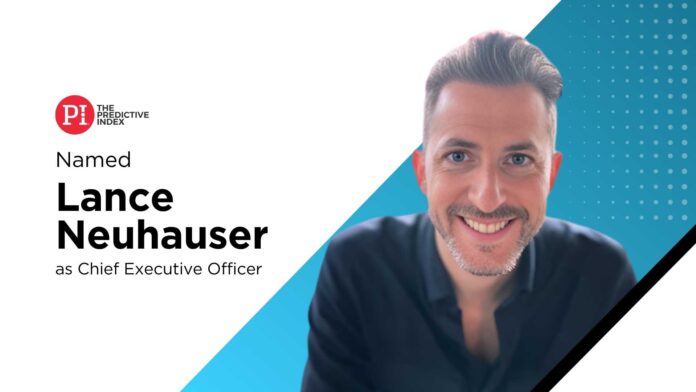

The Predictive Index is betting big on AI—and it’s bringing in seasoned tech leadership to make that bet count.
The talent optimization platform has named Lance Neuhauser as its new Chief Executive Officer, marking a strategic shift as the company looks to modernize its behavioral science foundation with AI-native capabilities. The move comes at a time when HR tech vendors are racing to embed artificial intelligence into everything from hiring to retention—often with mixed results.
Neuhauser steps in with a clear mandate: scale PI’s platform while bridging decades-old behavioral science with today’s AI-driven decision-making tools.
A leadership hire timed for AI’s HR moment
Neuhauser’s appointment isn’t just a routine executive reshuffle—it reflects a broader pivot across the HR tech landscape.
“AI is reshaping how companies hire, manage, and retain talent, and most organizations simply aren’t equipped for it,” Neuhauser said. His emphasis on combining validated science with modern tooling hints at a key tension in the market: the gap between flashy AI features and proven, reliable workforce insights.
That distinction could matter. As enterprises experiment with generative AI in HR workflows, concerns around accuracy, bias, and explainability are growing. Vendors that can ground AI outputs in established methodologies—like PI’s behavioral science models—may have an edge over newer entrants built primarily on large language models.
From adtech scale to HR tech reinvention
Neuhauser brings a resume shaped by multiple technology waves.
He co-founded Resolution Media, which grew into a global search marketing powerhouse before its acquisition by Omnicom. He later co-founded 4C Insights, a data platform focused on social and TV advertising, and went on to serve as president of Mediaocean following its acquisition.
More recently, his focus has shifted squarely to AI. Neuhauser has been building and advising AI-native startups, including serving as CEO of Wendy, an AI-powered platform for children, and working with companies like integrate.ai and Sonero.ai.
That blend of adtech scale and AI experimentation positions him well for PI’s next phase—particularly as HR platforms begin to resemble data platforms more than traditional software suites.
Why PI is leaning into its legacy
While many HR tech vendors are racing to rebrand themselves as AI-first companies, Predictive Index is taking a more measured approach: layering AI onto an existing foundation of behavioral science.
Neuhauser himself underscored that differentiator, pointing to PI’s 70+ years of validated research as a competitive moat.
In a market “flooded with new tools and bold claims,” he noted, that kind of credibility is difficult to replicate—especially as buyers grow more skeptical of AI-driven promises that lack transparency or proven outcomes.
That positioning could resonate with enterprise buyers who are increasingly cautious about adopting black-box AI systems in people-related decisions.
Board signals urgency—but not disruption
PI’s board appears aligned around a strategy of evolution rather than overhaul.
“Not by disrupting what works, but by building on it,” said board chair J. Puckett, emphasizing continuity alongside innovation.
That approach reflects a broader shift in enterprise tech, where companies are moving away from wholesale digital transformation toward incremental, value-driven upgrades—especially in sensitive areas like HR.
What this means for HR leaders
For HR teams, PI’s leadership change signals a familiar but important trend: the convergence of behavioral science and AI.
The promise is compelling—tools that don’t just automate HR processes, but actively improve decision-making around hiring, team dynamics, and employee engagement. The challenge, as always, lies in execution.
If Neuhauser can successfully integrate AI into PI’s platform without compromising its scientific rigor, the company could strengthen its position in a crowded HR tech market that includes players like Workday, SAP SuccessFactors, and newer AI-first startups.
If not, it risks blending into a sea of vendors making similar claims.
The bottom line
Predictive Index isn’t abandoning its roots—it’s trying to modernize them.
With Neuhauser at the helm, the company is signaling that the future of HR tech isn’t just AI-powered—it’s AI grounded in something more durable. Whether that balance holds could determine how much value organizations actually extract from the next wave of workforce technology.
Join thousands of HR leaders who rely on HRTechEdge for the latest in workforce technology, AI-driven HR solutions, and strategic insights





