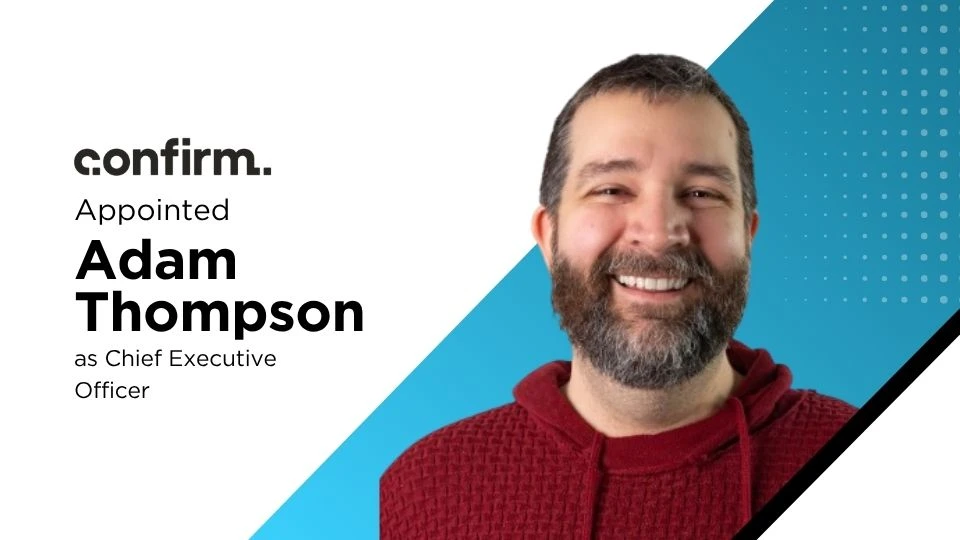
Confirm is changing CEOs at a pivotal point in its workforce technology strategy. Chief Product Officer Adam Thompson has been appointed CEO, succeeding Benoit de la Tour, who will move to a non-executive board role after leading a two-year transformation that repositioned the company around workforce enablement for frontline workers and scale-ups.
Leadership changes in HR technology can signal a shift in strategy. At Confirm, the latest move is intended to do almost the opposite: preserve a strategy that has already been substantially rebuilt while putting a product-focused executive in charge of its next stage.
Confirm announced that Chief Product Officer Adam Thompson will become CEO, replacing Benoit de la Tour after two years at the helm.
De la Tour will transition to a non-executive board position following a period that saw Confirm integrate four acquisitions, redefine its target market and product portfolio, and reposition the business around Workforce Enablement.
The company says that transformation has established Confirm as a provider focused on frontline workers and scale-ups. Thompson’s appointment is designed to carry that strategy forward rather than reset it.
That continuity is significant in a market where HR technology vendors are increasingly moving beyond traditional employee administration toward systems that help organizations develop skills, improve workforce performance and support employees throughout their careers.
From HR software to workforce enablement
Confirm’s repositioning reflects a broader change in how the HR technology market defines the employee experience.
For decades, enterprise HR software centered heavily on core administrative functions: employee records, payroll, benefits, recruiting and compliance.
Those systems remain essential, but frontline workforces often have different technology needs.
A frontline employee may have limited access to a corporate laptop, spend most of the working day away from a desk and interact with technology primarily through mobile devices or operational systems.
Learning opportunities, career progression, skills development and workforce communication therefore need to fit into the realities of frontline work rather than simply replicate office-based HR workflows.
Confirm is positioning its workforce enablement strategy around that gap.
Thompson described the opportunity in particularly large terms, pointing to an estimated 2.7 billion frontline workers worldwide who remain underserved by HR technology.
The underlying proposition is straightforward: frontline employees should have access to the same kinds of opportunities for learning, development and career growth that technology has increasingly made available to knowledge workers.
Why the CEO transition matters
Thompson arrives in the CEO role with direct responsibility for the product strategy that Confirm has been developing.
Over the past 12 months, he has helped shape both the company’s product direction and broader strategy. His previous experience as a founder and CEO in HR technology gives him another connection to the commercial and operational challenges involved in scaling a workforce software business.
That background could matter as Confirm moves from transformation into execution.
Integrating four acquisitions and rationalizing their products can create significant organizational complexity. The next challenge is turning that expanded portfolio into a coherent proposition that customers can understand, deploy and scale.
A product-led CEO can bring a different emphasis to that phase, particularly when the company’s growth strategy depends on solving specific workforce problems rather than simply expanding software functionality.
The frontline worker is becoming an HR technology battleground
Frontline employees account for a huge share of the global workforce, spanning industries such as retail, hospitality, healthcare, manufacturing, transportation, logistics and field services.
Yet much enterprise HR technology was designed around desk-based employees.
That mismatch has created an opportunity for vendors building more specialized workforce experiences.
The market includes established HR platforms such as Workday, SAP SuccessFactors and Oracle, alongside a growing collection of specialist vendors focused on employee engagement, skills, learning, scheduling, workforce management and frontline communications.
The competitive question is no longer simply whether frontline workers can access HR systems.
It is whether those systems can become useful enough to influence day-to-day development and long-term career progression.
That is a substantially higher bar.
AI raises the stakes for workforce enablement
Artificial intelligence is also changing the definition of workforce enablement.
AI can help organizations identify skills gaps, personalize learning recommendations, summarize workforce data and support employees with conversational interfaces.
But access to AI alone does not solve the underlying problem of workforce development.
Organizations still need reliable employee data, skills frameworks, learning content and mechanisms for turning recommendations into action.
That creates an opening for HR technology vendors that can connect workforce data with development workflows.
IDC’s research into HR transformation shows that AI and machine learning are already influencing areas including performance tracking and workforce planning, while inadequate technology remains a barrier for some HR leaders.
The implication is that the next generation of HR technology may be less about adding isolated AI features and more about creating connected systems that help organizations understand what employees can do, what they need to learn and where they can progress.
Scale-ups create a second market opportunity
Confirm is targeting not only frontline workers but also scale-ups.
That combination gives the company access to organizations at different stages of workforce maturity.
Large frontline employers may need technology that can operate across thousands of distributed employees. Scale-ups, meanwhile, often need to establish repeatable people processes while their workforce and organizational structure are changing rapidly.
The technology requirements differ, but both groups face a common problem: how to give employees clearer development opportunities while aligning workforce capabilities with business growth.
For scale-ups, that can mean moving beyond informal career conversations as headcount increases. For frontline-heavy enterprises, it can mean bringing development opportunities to workers who have historically had less access to corporate HR infrastructure.
The next test is execution
De la Tour’s tenure appears to have been focused on transformation. Thompson inherits a business that says it now has a new strategy, portfolio, market position and brand.
That changes the leadership challenge.
The question is no longer simply whether Confirm can define a compelling workforce-enablement category. It needs to demonstrate that the category translates into customer adoption, measurable workforce outcomes and sustainable growth.
That will require more than product development.
Confirm will need to show employers that workforce enablement can improve employee development while producing business value. It will also need to differentiate against large HCM vendors that increasingly incorporate skills, learning and AI capabilities into their broader platforms.
Thompson’s product background could prove useful in that contest, but the market will ultimately judge the company on execution.
For HR technology buyers, the more interesting development is the market direction Confirm represents. As organizations rethink skills, AI adoption and employee development, frontline workers are becoming an increasingly important part of the HR technology conversation.
Confirm’s leadership transition puts that underserved workforce at the center of its next growth phase.
Market Landscape
The HR technology market is moving toward skills, workforce enablement and employee development, while vendors increasingly use AI to connect workforce data with actionable recommendations.
Confirm’s strategy sits between traditional HCM and specialist workforce technology. Its emphasis on frontline employees differentiates it from broad platforms such as Workday, SAP SuccessFactors and Oracle, which serve much wider HR requirements.
The competitive opportunity is substantial, but so is the challenge. Established HCM vendors have significant customer relationships and are expanding their own skills and AI capabilities.
Confirm therefore needs to demonstrate why a workforce-enablement approach delivers better outcomes for frontline-heavy organizations and scale-ups than adding another feature to an existing HCM stack.
Its acquisition strategy also raises an important enterprise question: whether integrating multiple products can produce a simpler, more connected employee experience rather than another layer of HR technology complexity.
Top Insights
- Adam Thompson becomes Confirm CEO after leading product strategy, providing continuity as the company moves from portfolio transformation into its next growth phase.
- Confirm has repositioned around workforce enablement, targeting frontline employees and scale-ups that traditional HR technology has often underserved.
- The company’s strategy reflects a wider HR technology shift toward skills, learning, career development and workforce intelligence rather than administration alone.
- AI could strengthen workforce enablement by connecting employee data, skills gaps and personalized development, but technology must translate recommendations into measurable action.
- Confirm’s biggest challenge will be differentiating its frontline-focused strategy from major HCM platforms expanding into skills, learning and AI.
Join thousands of HR leaders who rely on HRTechEdge for the latest in workforce technology, AI-driven HR solutions, and strategic insights