
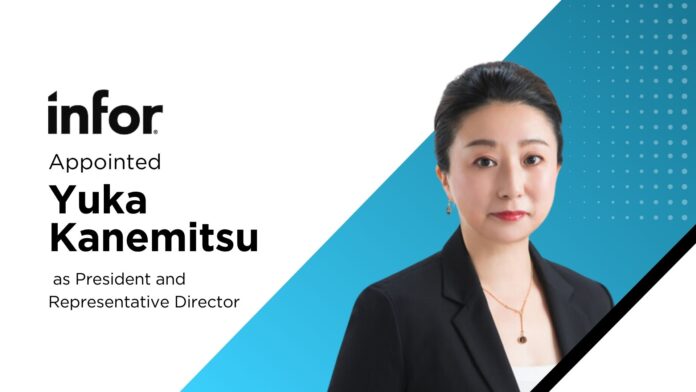

Infor is putting new leadership in place as Japanese enterprises accelerate investments in AI, cloud infrastructure and digital transformation. The industry cloud provider has appointed Yuka Kanemitsu as President and Representative Director of Infor Japan, giving her responsibility for business strategy, customer growth and strategic partnerships in one of the company’s key Asia-Pacific markets.
The appointment comes at a moment when Japanese companies are facing a combination of technology and workforce pressures. Aging demographics, persistent labor constraints, supply-chain volatility and the need to modernize legacy systems are pushing enterprises to look beyond standalone software tools toward platforms that can connect operational data, automation and artificial intelligence.
Infor says Kanemitsu will lead its Japan operations with a focus on customer success, strategic partnerships and expansion across sectors including automotive, industrial manufacturing, food and beverage, distribution and other asset-intensive industries.
Her remit places Infor’s Industry Cloud platform at the center of the company’s Japan strategy. The platform combines industry-specific enterprise applications with AI, automation and analytics, a positioning that reflects a growing shift in enterprise software away from generic AI features toward domain-specific applications.
That distinction is becoming increasingly important for enterprise technology buyers.
General-purpose generative AI can summarize documents, generate text and assist with knowledge work. But operational environments such as manufacturing, distribution and supply-chain management require systems that understand specialized workflows, regulatory requirements, production constraints and large volumes of structured enterprise data.
Infor is betting that AI becomes more valuable when embedded directly into those processes.
Geoff Thomas, Infor’s president of international operations, said Japan is one of the company’s most strategic markets and argued that customers increasingly want AI that understands their industries and improves business processes rather than generic AI capabilities.
Kanemitsu brings more than 25 years of enterprise-technology leadership experience to the role. Infor says her priorities will include expanding its presence in industries where operational complexity makes cloud modernization particularly consequential.
Japan’s enterprise software market is entering a new phase
Japan’s digital transformation market has been shaped by a combination of modernization pressure and demographic change. Many large organizations continue to operate complex legacy environments while simultaneously trying to introduce cloud computing, automation and AI.
The workforce dimension is particularly significant.
Japan’s working-age population has been shrinking for years, increasing pressure on employers to improve productivity and automate repetitive processes. That makes enterprise software increasingly relevant to workforce strategy even when the software itself is not categorized as HR technology.
For HR and operations leaders, AI-enabled ERP, supply-chain and workforce platforms can influence how organizations allocate employees, forecast demand, manage skills and redesign workflows.
This is where Infor’s industry-specific approach intersects with HRTech.
A manufacturer, for example, may need AI to support production planning and supply-chain decisions while also identifying workforce requirements. A distributor may need demand forecasting that feeds directly into staffing and logistics decisions. A food-and-beverage company may require specialized planning, compliance and inventory processes alongside workforce management.
The value proposition is therefore less about replacing workers with AI and more about giving organizations tools to make scarce human capacity more productive.
Industry cloud becomes the battleground
Infor is competing in a market that includes major enterprise software providers such as Microsoft, SAP, Oracle and Salesforce, all of which are embedding AI capabilities into their cloud platforms.
Infor’s differentiation is its emphasis on industry-specific software.
That strategy resembles a broader enterprise technology trend: rather than asking customers to assemble generic cloud infrastructure and AI tools themselves, vendors are packaging specialized functionality into industry-oriented platforms.
For enterprise buyers, that can reduce implementation complexity. It can also create stronger connections between AI models and operational data.
But industry cloud comes with a trade-off. Organizations need to assess whether a vendor’s industry specialization is deep enough to justify adopting another strategic platform. Integration with existing ERP systems, data governance, cybersecurity, interoperability and long-term vendor strategy remain critical considerations.
Infor’s Japan strategy therefore extends beyond simply selling cloud software. The company will need to demonstrate that its platform can deliver measurable improvements in areas such as productivity, supply-chain resilience, operational efficiency and decision-making.
What Kanemitsu’s appointment means for enterprises
Kanemitsu’s appointment is significant because Japan is not simply another regional expansion opportunity for enterprise software vendors. It is a market where demographic pressures and industrial complexity create a strong case for automation.
Her focus on automotive, manufacturing, food and beverage and distribution also places Infor close to some of Japan’s most operationally intensive industries.
For CIOs and HR leaders, the important question will be how those deployments affect the broader workforce.
AI-enabled enterprise applications can automate repetitive administrative tasks, provide employees with better operational information and help managers forecast labor requirements. They can also create new demands for data literacy, AI governance and workforce reskilling.
That makes enterprise AI adoption partly a people strategy.
Companies investing in Industry Cloud platforms will need to consider not only the technology stack but also how employees interact with AI, which decisions remain human-led and how organizations measure productivity improvements.
Infor’s leadership change suggests the company intends to make that industry-specific AI proposition a larger part of its Japan growth strategy.
The opportunity is substantial, but so is the competition. As Google, Microsoft, Amazon, SAP, Oracle and other technology companies push AI deeper into enterprise workflows, industry expertise may become one of the clearest ways vendors differentiate otherwise similar cloud and AI capabilities.
For Japanese enterprises, the next phase of digital transformation may therefore be defined less by whether they adopt AI and more by whether they can embed it effectively into the operational systems that run their businesses.
Market Landscape
Japan’s enterprise technology market is being shaped by three overlapping forces: cloud modernization, AI adoption and workforce constraints. These pressures are particularly visible in manufacturing, logistics, distribution and other industries with complex physical operations.
The competitive landscape includes global ERP and cloud providers such as Microsoft, SAP and Oracle, alongside specialized industry software companies. The strategic direction is increasingly toward industry cloud platforms that combine enterprise applications, analytics, automation and AI.
For HR and workforce leaders, this creates a convergence between HR technology and operational technology. Workforce planning increasingly depends on demand forecasts, production schedules, supply-chain conditions and skills data generated outside traditional HR systems.
The resulting enterprise architecture is likely to be more integrated, with AI acting as a layer across ERP, workforce management, analytics and collaboration applications.
Top Insights
- Infor appointed Yuka Kanemitsu to lead Japan, strengthening its focus on AI-enabled Industry Cloud adoption across manufacturing, distribution and other complex industries.
- Industry-specific AI is becoming a competitive differentiator, as enterprises seek technology that understands operational workflows rather than generic generative AI capabilities.
- Japan’s workforce constraints strengthen the automation case, pushing employers to use cloud software and AI to improve productivity and make better use of scarce talent.
- Infor faces major enterprise-cloud competition, with Microsoft, SAP and Oracle embedding AI deeper into ERP, analytics and business applications.
- HR and operations technology are converging, as workforce planning increasingly depends on supply-chain, production, demand and enterprise-data systems outside traditional HR platforms.
Join thousands of HR leaders who rely on HRTechEdge for the latest in workforce technology, AI-driven HR solutions, and strategic insights





