
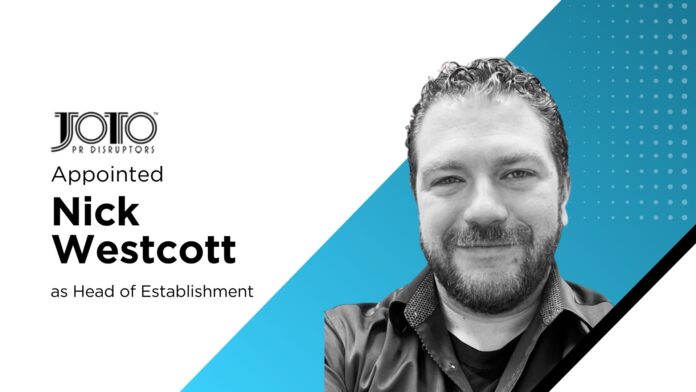

JOTO PR Disruptors is creating a new leadership role focused on the operational infrastructure behind growth, appointing Nick Westcott as Head of Establishment. The role brings together elements of human resources, training, marketing, sales alignment and client delivery as the agency looks to scale without allowing organizational complexity to slow execution.
Growth can expose weaknesses that are difficult to see when an organization is smaller. Hiring increases, teams become specialized, communication gets more complicated and processes that once worked informally begin to create bottlenecks.
JOTO PR Disruptors is addressing that challenge with a new executive-level role.
The public relations agency has appointed Nick Westcott as Head of Establishment, a position designed to strengthen the systems and organizational processes supporting its expansion.
According to JOTO CEO Karla Jo Helms, the role is intended to ensure that people, sales, marketing and client delivery move in the same direction as the organization grows.
That makes the appointment less about traditional PR and more about organizational infrastructure.
Westcott brings 12 years of experience spanning organizational training, supervision, human resources, marketing strategy, quality control and operations management. His background includes work with small and midsized organizations where process design and employee development had a direct effect on operational performance.
At Eyes On Litchfield, Westcott developed and standardized human resources, operations, training and quality-control processes. The company says those changes accompanied a doubling of patient volume and a 50% reduction in in-office physician hours.
Earlier, at Simon Eye Associates, he created a training program that reduced new-hire onboarding from six weeks to two and established a call-center structure that improved productivity by 15%.
Those experiences are relevant to a broader HR technology trend: organizations are increasingly treating workforce processes as systems that can be designed, measured and continuously improved.
HR infrastructure becomes a growth issue
For growing companies, HR is often viewed primarily through the lens of hiring and employee administration.
That model becomes less effective as organizations scale.
Recruiting employees is only the beginning. Companies also need standardized onboarding, role definitions, training, performance management, communication systems and processes that help employees understand how their work connects to broader business objectives.
The challenge is particularly visible in professional-services organizations, where employee knowledge and execution are closely tied to client outcomes.
JOTO’s new role sits at that intersection.
Westcott will work across functions that are often managed independently: HR develops workforce capabilities, marketing shapes the company’s external positioning, sales establishes expectations with prospective customers, and delivery teams ultimately have to meet those expectations.
If those systems are disconnected, growth can create friction.
A marketing team may promise a particular capability that delivery teams are not equipped to provide. Sales may establish expectations that operations cannot consistently support. Employees may lack the training or processes needed to execute.
Organizational alignment technology — from human capital management systems to workflow platforms and business intelligence tools — increasingly aims to reduce those gaps.
The rise of operational enablement
Westcott’s responsibilities also reflect the growing importance of what can broadly be described as operational enablement.
The concept goes beyond HR.
It involves making sure employees have the processes, information, training and technology required to perform their roles effectively. In knowledge-intensive companies, that can include learning-management systems, internal knowledge bases, employee communications platforms, workflow automation and performance analytics.
The underlying objective is simple: reduce the amount of organizational friction employees encounter when trying to do their jobs.
Westcott describes his role in similar terms, saying he will focus on understanding what different parts of the organization need and helping employees perform with greater confidence while maintaining business results.
For HR leaders, this reflects an increasingly important shift. Employee productivity is not determined solely by individual capability. It is also shaped by the systems surrounding employees.
A highly skilled employee can still underperform if onboarding is fragmented, responsibilities are unclear or information is difficult to access.
AI raises the stakes for organizational design
The rise of generative AI is making organizational infrastructure even more important.
Companies adopting tools from Microsoft, Google, Salesforce and other enterprise technology providers are increasingly automating parts of marketing, sales, customer service and administrative work.
But automation can amplify poorly designed processes as easily as it can improve good ones.
Organizations therefore need to understand how work moves between departments before deciding which tasks to automate.
That makes cross-functional process mapping, employee training and change management increasingly important components of enterprise AI adoption.
For a company such as JOTO, whose business depends heavily on communications and creative work, that question is particularly relevant. AI can accelerate research, content development, data analysis and other workflows, but human judgment, client relationships and strategic coordination remain central to professional services.
An operational leader connecting people, processes and technology can help determine where automation adds value and where human expertise should remain central.
What the appointment means for HR teams
JOTO’s creation of a Head of Establishment role is not evidence of a new standard corporate title. Its significance lies in the problem the position is designed to address.
As organizations grow, they need infrastructure that evolves at the same pace as their workforce.
That can mean implementing HR software, standardizing onboarding, documenting processes, building management capabilities and creating better connections between employee goals and business outcomes.
The most effective approach will vary by company size and industry. A 30-person agency does not need the same technology stack as a multinational enterprise.
But the underlying principle is similar: growth requires systems.
JOTO’s appointment illustrates how some organizations are responding by assigning explicit leadership responsibility for that infrastructure.
Whether the model produces sustained gains will ultimately depend on measurable outcomes — including employee productivity, onboarding time, retention, client delivery quality and the organization’s ability to scale without adding unnecessary layers of bureaucracy.
For HR and operations leaders, those are the metrics worth watching.
Market Landscape
Organizations are increasingly moving toward integrated people, process and technology management as workforce complexity grows. HR platforms are expanding beyond payroll and employee records into talent management, learning, analytics, workforce planning and employee experience.
At the same time, AI is changing how marketing, sales and professional-services teams work. That increases the importance of process governance and cross-functional coordination.
The emerging model is less about HR operating separately from the rest of the business and more about HR, operations, IT and business leaders jointly designing how work gets done.
JOTO’s new Head of Establishment role reflects that convergence at an agency level.
Top Insights
- JOTO created a Head of Establishment role for Nick Westcott, connecting HR, training, operations, marketing and sales as the agency prepares for growth.
- Westcott’s background centers on process improvement, including faster onboarding, workforce training, quality control and operational systems for healthcare organizations.
- Cross-functional alignment is becoming an HR priority, as disconnected sales, marketing and delivery processes can create friction during organizational expansion.
- AI adoption increases the need for process discipline, because automation can magnify inefficient workflows unless companies redesign work before deploying new tools.
- Operational enablement is becoming strategic, with employee training, workflow design, knowledge access and technology increasingly linked to productivity and client outcomes.
Join thousands of HR leaders who rely on HRTechEdge for the latest in workforce technology, AI-driven HR solutions, and strategic insights





