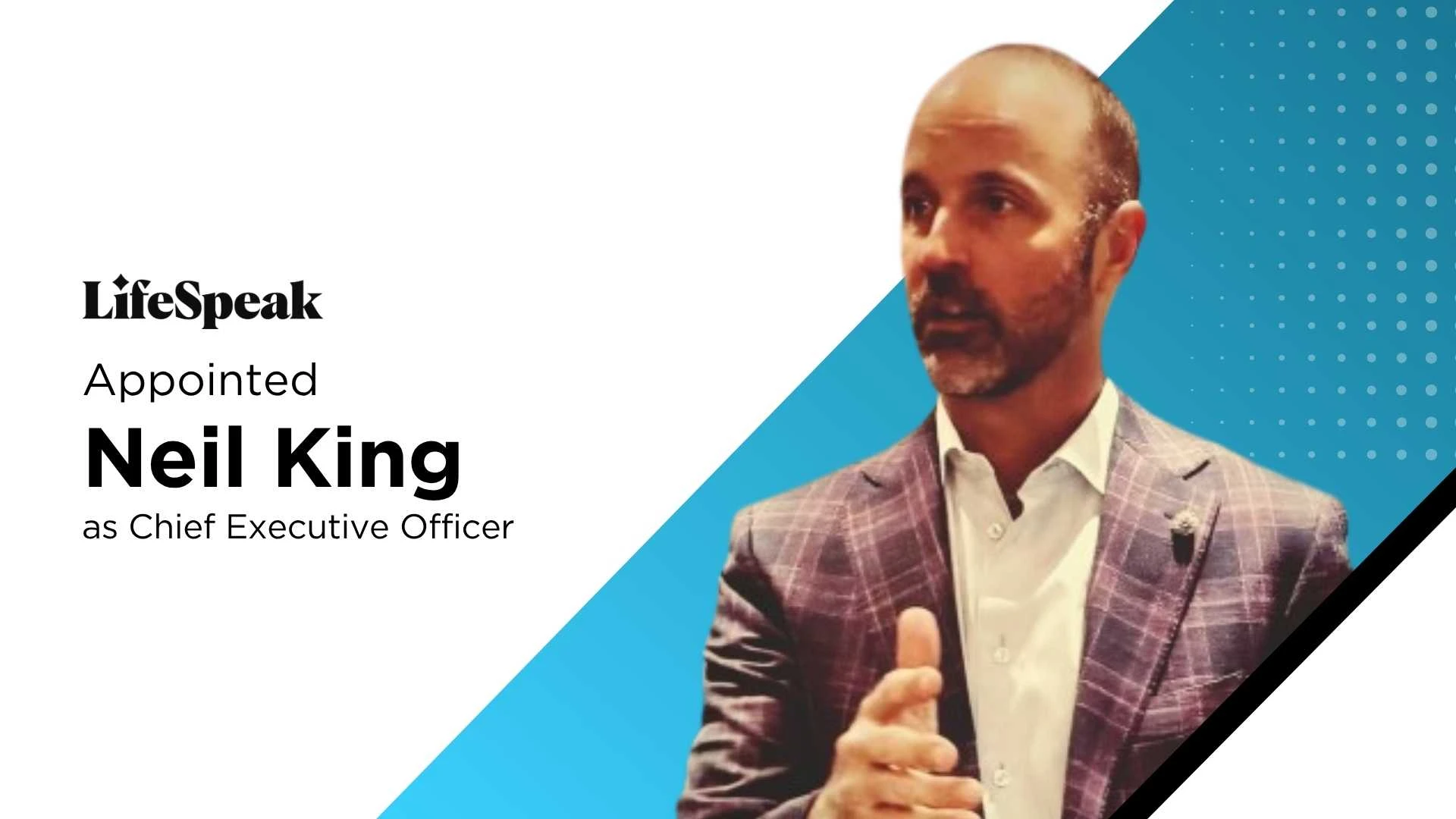
Enterprise employee wellbeing platform provider LifeSpeak Inc. has appointed healthcare executive Neil King as Chief Executive Officer, marking a leadership transition as the company prepares to launch the next generation of its workforce wellbeing platform in January 2027. The appointment signals LifeSpeak’s focus on measurable health outcomes and enterprise workforce health strategies as employers increasingly seek greater return on investment from employee wellbeing programs.
Employee wellbeing technology is evolving beyond engagement metrics toward measurable health outcomes, and LifeSpeak Inc. is positioning itself for that transition with a new chief executive.
The Toronto-based workforce wellbeing technology provider announced the appointment of Neil King as Chief Executive Officer, effective immediately. King succeeds Flint Brenton, who has served as Acting CEO since May 2026 and will continue as Chairman of the company’s Board of Directors.
The leadership change comes five months before LifeSpeak plans to introduce the next generation of its employee wellbeing platform, a move that reflects broader changes across the HR technology market as organizations demand stronger evidence that wellbeing investments contribute to workforce performance and business outcomes.
King brings more than 25 years of experience across healthcare delivery, employee wellbeing and enterprise benefits. Most recently, he served as President and Chief Operating Officer of CBI Home Health, where he led a national organization comprising more than 8,000 clinicians and caregivers.
Earlier in his career, King spent more than 15 years building employer-focused health solutions. At TELUS Health, he oversaw global employer solutions covering employee assistance programs, virtual care, disability management and workplace wellbeing services. Prior to that, he led global integrated health initiatives at LifeWorks, which was later acquired by TELUS Health.
His background gives LifeSpeak leadership experience spanning enterprise buyers, clinical service delivery and healthcare distribution channels—an increasingly valuable combination as employers seek integrated approaches to workforce health rather than disconnected wellbeing tools.
The appointment also aligns with a broader shift taking place across enterprise HR technology. Organizations are moving away from measuring employee wellbeing initiatives primarily through engagement statistics such as application downloads or login frequency. Instead, HR executives increasingly want measurable improvements in employee health, productivity, absenteeism and healthcare costs.
King acknowledged this shift, arguing that traditional utilization metrics fail to demonstrate whether wellbeing programs actually improve employee health. He emphasized that employers need evidence-based outcomes rather than activity metrics when evaluating workforce wellbeing investments.
Those priorities appear central to LifeSpeak’s upcoming platform launch, scheduled for January 1, 2027.
According to the company, the updated platform replaces large content libraries with structured, expert-developed care pathways designed around specific health objectives. Rather than requiring employees to navigate extensive collections of wellness content, the platform guides users through personalized programs targeting measurable outcomes.
LifeSpeak says progress will be tracked using validated clinical assessments integrated into the platform rather than relying on manual surveys or self-reported questionnaires. The platform is also designed to address several of the highest-cost areas affecting employer health plans, including musculoskeletal (MSK) conditions, GLP-1-related weight management, cardiometabolic health, mental health and caregiver support.
From an enterprise technology perspective, flexibility appears to be another priority. Organizations will be able to deploy the platform as a standalone employee experience, integrate it into existing benefits ecosystems or connect it through application programming interfaces (APIs), allowing compatibility with broader HR and health technology environments.
That interoperability reflects a growing expectation among enterprise buyers. Rather than replacing existing HR systems, modern wellbeing platforms increasingly function as components within larger digital workplace ecosystems that may include platforms from Microsoft, Salesforce, Workday, Oracle, Google Cloud or specialized HR technology vendors.
The announcement arrives as employers continue to reassess workforce wellbeing strategies following years of increased investment in mental health, virtual care and preventive healthcare benefits.
According to Gartner, improving employee experience, developing managers and supporting organizational change remain among the leading priorities for HR leaders worldwide. Meanwhile, McKinsey & Company has reported that employee wellbeing is becoming increasingly linked with productivity, workforce resilience and long-term organizational performance, prompting companies to adopt more data-driven approaches to workforce health.
Competition within the employee wellbeing technology market has also intensified. Vendors are expanding beyond traditional employee assistance programs by incorporating AI-powered health coaching, predictive analytics, personalized learning and preventive care into unified workforce experience platforms.
LifeSpeak’s emphasis on measurable outcomes rather than engagement metrics reflects this broader evolution. As HR leaders face growing pressure to justify technology investments with quantifiable business value, platforms capable of demonstrating improvements in employee health and workforce productivity may gain greater strategic importance.
King’s appointment therefore represents more than a routine executive transition. It positions LifeSpeak to compete in an increasingly outcomes-focused HR technology market where enterprise customers expect workforce wellbeing platforms to deliver measurable clinical and business impact—not simply digital engagement.
Market Landscape
The global HR technology market continues shifting toward integrated employee wellbeing, preventive healthcare and AI-enabled workforce support. Enterprise employers increasingly expect wellbeing platforms to integrate with existing HR ecosystems while demonstrating measurable business outcomes.
According to Gartner, employee experience, leadership development and organizational change remain among HR leaders’ highest priorities. McKinsey & Company also reports that organizations investing in workforce wellbeing alongside digital transformation often experience stronger employee engagement and operational performance.
Technology providers including Microsoft, Google, Salesforce, Oracle, Workday and TELUS Health are embedding AI, analytics and personalized employee experiences into enterprise HR platforms, raising expectations for measurable health outcomes rather than traditional engagement metrics.
Top Insights
- LifeSpeak has appointed healthcare executive Neil King as CEO ahead of launching its next-generation employee wellbeing platform, reinforcing its focus on measurable workforce health outcomes.
- The January 2027 platform introduces structured wellbeing pathways, validated health assessments and API-based integrations for enterprise HR and benefits ecosystems.
- King’s leadership combines experience across healthcare delivery, employer wellbeing programs and enterprise benefits, positioning LifeSpeak to address evolving workforce health priorities.
- The announcement reflects a broader HR technology trend toward outcome-based employee wellbeing strategies supported by AI, analytics and preventive healthcare models.
- Enterprise HR leaders increasingly seek platforms that demonstrate measurable improvements in workforce productivity, health and benefit cost management instead of engagement metrics alone.
Join thousands of HR leaders who rely on HRTechEdge for the latest in workforce technology, AI-driven HR solutions, and strategic insights