
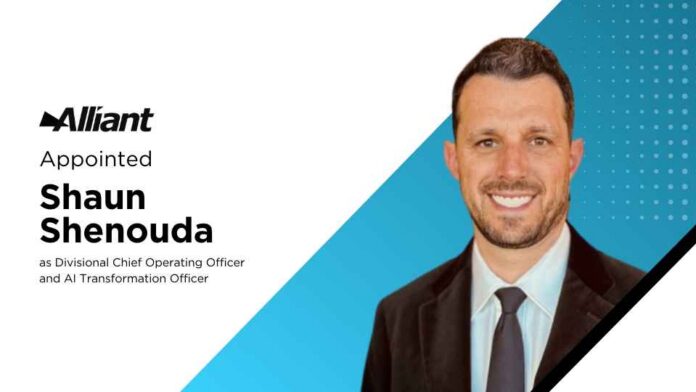

Alliant Underwriting Solutions (AUS), the program administrator division of Alliant Insurance Services, has appointed Shaun Shenouda as Divisional Chief Operating Officer and AI Transformation Officer. The appointment places artificial intelligence, automation, and operational execution under a dedicated executive leadership role as the insurance business looks to strengthen its operating model and support future growth.
Alliant Puts AI Transformation at the Center of Insurance Operations
Alliant Underwriting Solutions (AUS) has appointed Shaun Shenouda as Divisional Chief Operating Officer and AI Transformation Officer, adding a dedicated executive mandate for artificial intelligence, automation, and operational performance.
The appointment brings technology transformation and business execution together within AUS, the program administrator division of Alliant Insurance Services. Shenouda will oversee operational strategy while leading initiatives intended to expand the division’s use of AI and automation.
According to the company announcement, his responsibilities will include identifying and prioritizing AI initiatives, allocating resources, driving innovation, and translating strategic objectives into coordinated business programs. He will also be accountable for operating leverage and enterprise execution, with an emphasis on measurable financial outcomes.
The role signals a broader shift in how organizations are approaching AI adoption. Rather than treating artificial intelligence as an isolated technology investment, businesses are increasingly placing implementation responsibility within senior operational leadership.
From AI experimentation to operational accountability
For insurance businesses, AI transformation involves more than introducing generative AI assistants or automating administrative tasks. The technology can potentially influence underwriting workflows, document processing, claims administration, risk assessment, customer servicing, and internal decision-making.
These applications depend on reliable data, integration with existing systems, appropriate governance, and employees who understand how to work alongside automated processes.
Shenouda’s combined COO and AI Transformation Officer responsibilities suggest that AUS intends to connect technology initiatives with operational priorities. This is significant because organizations often struggle to convert successful AI pilots into sustainable enterprise-wide improvements.
The appointment does not identify specific AI platforms, implementation timelines, investment figures, or technology partners. It therefore remains unclear whether AUS will develop internal AI capabilities, adopt third-party enterprise software, or combine both approaches.
However, assigning an executive responsibility for prioritization, resource allocation, and financial outcomes establishes a clearer accountability structure for future transformation initiatives.
Why executive AI leadership matters
The challenge of scaling AI is becoming increasingly visible across industries.
A September 2026 Gartner survey found that only 22% of organizations had successfully scaled AI across multiple business units or adopted an AI-first approach. The research also found that 85% of functional leaders planned to increase AI spending in 2026.
Gartner
The figures highlight a growing gap between investment intentions and enterprise execution. Businesses are spending more on AI, but integrating the technology into established operating models remains difficult.
McKinsey’s 2026 State of AI research offers another indication of this transition. Forty-four percent of surveyed organizations reported scaling AI across their enterprises, compared with 38% a year earlier. However, the proportion reporting enterprise-level financial impact remained relatively unchanged.
For insurance administrators and service providers, this distinction matters. Automating individual tasks may improve efficiency, but sustainable value requires changes to processes, employee responsibilities, technology infrastructure, and performance measurement.
A senior executive overseeing both operations and AI transformation can help coordinate these areas rather than allowing technology projects to operate independently of business objectives.
Insurance technology enters a new phase
The insurance industry is increasingly exploring AI for operational efficiency and improved risk management. Document-intensive processes, policy administration, portfolio analysis, and customer interactions offer potential opportunities for automation.
McKinsey’s research on AI in insurance identifies enterprise-wide integration and strategic execution as important factors in capturing value from the technology.
The competitive environment also includes technology providers such as Microsoft, Google Cloud, Amazon Web Services, Salesforce, and NVIDIA, whose cloud infrastructure, enterprise AI services, and computing platforms support broader industry adoption.
For organizations such as AUS, the relevant question is not simply which AI technology to purchase. It is how to integrate suitable capabilities into existing insurance operations while maintaining oversight, data security, and service quality.
That distinction becomes particularly important in insurance, where automated decisions can affect financial exposure, contractual obligations, and customer outcomes.
Leadership continuity alongside transformation
Shenouda will retain his position as president of SES Risk Solutions, an AUS company providing property and casualty insurance for portfolios of single-family residential rental properties and properties held in trust by financial institutions.
Maintaining that responsibility alongside his new divisional position could provide continuity between business operations and the wider transformation agenda. His experience within SES Risk Solutions may also give him direct exposure to the operational requirements of specialized insurance portfolios.
The company has not disclosed whether the new appointment will involve changes to SES Risk Solutions’ technology infrastructure or specific AI deployments.
Shenouda holds a master’s degree in global finance from Pepperdine University’s Graziadio Business School.
What the appointment means for the future of work
Although the announcement is primarily an insurance leadership development, it also reflects a wider workforce technology trend: AI transformation is becoming an organizational responsibility rather than exclusively an IT function.
For HR and workforce leaders, this creates new priorities around AI literacy, employee reskilling, workforce planning, job redesign, and cross-functional collaboration.
Automation can change the distribution of work across departments, but its impact depends on how organizations prepare employees for new responsibilities. HR teams may increasingly need to collaborate with operations and technology executives to identify skills gaps and establish appropriate training programs.
For AUS, Shenouda’s appointment establishes an executive structure for connecting operational strategy with AI-driven change. Whether that translates into measurable productivity improvements, cost efficiencies, or new capabilities will depend on the initiatives the company implements and the results it delivers.
The announcement is therefore less about a specific AI product launch and more about a leadership decision that places technology-enabled operational transformation within the division’s senior management agenda.
Market Landscape
The appointment reflects three broader developments across insurance technology and enterprise AI:
-
Executive ownership of AI: Organizations are assigning senior leaders responsibility for AI implementation, governance, and measurable business outcomes.
-
Insurance automation: Underwriting support, document processing, risk analysis, and customer servicing are emerging as important areas for AI adoption.
-
Workforce transformation: AI implementation is increasing demand for digital skills, employee training, process redesign, and collaboration between HR, IT, and operations.
The market challenge is moving from AI experimentation to scalable implementation. Gartner’s finding that only 22% of organizations have successfully scaled AI illustrates the execution gap.
For HRTech providers, this creates opportunities in workforce analytics, learning management systems, skills intelligence, employee experience platforms, and AI-enabled workforce planning.
Top Insights
-
Alliant Underwriting Solutions appoints Shaun Shenouda to oversee operational strategy and enterprise-wide AI transformation.
-
The new executive role combines operational leadership, AI adoption, automation priorities, and measurable financial accountability.
-
Shenouda will retain his presidency at SES Risk Solutions, maintaining leadership continuity across the business.
-
Enterprise AI adoption increasingly requires executive ownership, workforce readiness, governance, and integration with existing business processes.
-
The appointment highlights growing demand for leaders who can connect technology investments with operational and organizational outcomes.
Join thousands of HR leaders who rely on HRTechEdge for the latest in workforce technology, AI-driven HR solutions, and strategic insights

Business Wire, a Berkshire Hathaway company, is the global leader in press release distribution and regulatory disclosure. Public relations, investor relations, public policy and marketing professionals rely on Business Wire for secure and accurate distribution of market-moving news and multimedia. Founded in 1961, Business Wire is a trusted source for news organizations, journalists, investment professionals and regulatory authorities, delivering news directly into editorial systems and leading online news sources via its multi-patented NX network. Business Wire’s global newsrooms are available to meet the needs of communications professionals and news media worldwide.




