
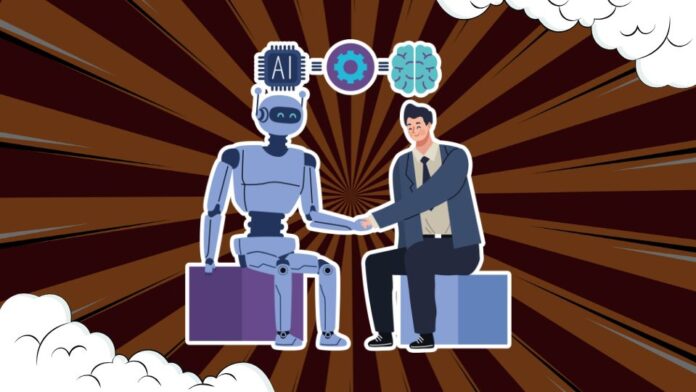

As companies move from AI experimentation toward increasingly AI-enabled workplaces, a September 2026 Digital@UNGA Affiliate Session at New York’s Museum of Modern Art will examine a parallel question: how should organizations develop the human capabilities needed to work effectively with intelligent systems? The Power of Words® will use the event to explore emotional intelligence, judgment, resilience and human connection as organizational capabilities rather than conventional soft skills.
The workplace conversation around artificial intelligence has largely focused on what machines can do. Increasingly, HR leaders are confronting a different question: what capabilities do employees and managers need as AI takes on more tasks, influences decisions and changes how people interact with work?
That question will be at the center of an official Digital@UNGA Affiliate Session hosted by The Power of Words® on Sept. 24, 2026, at the Celeste Bartos Theater at The Museum of Modern Art in New York City.
Titled “Human Intelligence in the Age of Artificial Intelligence,” the session will bring together leaders from technology, business, education, digital wellbeing and social-impact organizations. The official session is scheduled for 9:00 to 10:30 a.m. ET, followed by additional discussions and audience engagement through 12:30 p.m.
The event’s premise is that investment in AI infrastructure needs to be accompanied by investment in what the organizers describe as “human architecture.”
That concept has implications for HR departments navigating an increasingly AI-enabled workforce. Organizations are adopting AI for recruitment, customer service, knowledge work, analytics and automation, but the resulting workplace changes can also increase the importance of skills such as judgment, communication, emotional regulation and ethical decision-making.
The Power of Words founder and CEO Deborah Sawaf describes this as “dual intelligence”: aligning artificial intelligence with distinctly human capabilities including empathy, resilience, responsibility and connection.
The concept is not positioned as an alternative to AI. Instead, it asks organizations to treat human capabilities as part of the infrastructure required to deploy AI responsibly.
The event will also introduce Relational Emotional Development, or RED EQ™, a framework developed by The Power of Words® for translating emotional intelligence into repeatable behaviors. The methodology focuses on recognizing emotions, communicating needs, responding intentionally and strengthening relationships.
For HR leaders, that approach intersects with several established workforce priorities.
Employee experience, for example, has traditionally encompassed engagement, workplace culture, communication and wellbeing. AI is expanding that agenda. Employees may now work alongside AI systems, receive AI-generated recommendations, use automated management tools or experience changes in job responsibilities as organizations automate processes.
Those changes can create productivity opportunities but also introduce uncertainty around autonomy, trust and decision-making.
Managers face a similar challenge. AI tools can provide information and recommendations, but managers remain responsible for communicating organizational decisions, resolving interpersonal conflicts and understanding employee concerns.
That means leadership development may need to incorporate AI literacy alongside distinctly human skills.
The issue is particularly relevant as organizations experiment with agentic AI. Unlike conventional software that waits for explicit instructions, AI agents can increasingly execute multi-step tasks and interact with enterprise systems. As those systems become more capable, the boundaries between employee responsibilities and automated work can become less obvious.
HR teams consequently have a role in defining how humans remain accountable when AI participates in workflows.
The Power of Words session will examine that relationship through discussions around AI leadership, digital wellbeing, loneliness, education and human connection. The agenda also includes the idea of moving from “compete” to “connect” within teams and institutions.
Digital wellbeing is another emerging HR concern. Employees increasingly operate through digital communication tools, AI assistants and hybrid work environments, potentially reducing opportunities for informal human interaction. Technology can improve collaboration while simultaneously changing how employees experience connection and belonging.
The challenge for HR leaders is not necessarily to reduce technology use, but to design workplaces in which technology supports rather than undermines healthy human relationships.
That principle extends beyond corporate environments. The event’s speakers and participants are expected to represent government, education, business, media and social-impact organizations. Confirmed participants include Shelley Zalis, founder and CEO of The Female Quotient; Dr. Melisa S. Valle of SYNC/Ithra; Dr. C. Raj Kumar, founding vice-chancellor of O.P. Jindal Global University; Fernando Garibay; Juliet Scott-Croxford; leadership strategist Joelle Jarvis; and human performance lead Dr. Justin Thomas. A representative of Bangladesh’s Ministry of Foreign Affairs is also listed among the participants.
The cross-sector composition reflects an increasingly common view that AI workforce transformation cannot be addressed exclusively by technology teams.
HR organizations are particularly positioned to connect AI adoption with employee development. That can involve redesigning learning programs, updating leadership competencies, establishing responsible-AI policies and helping employees understand how their roles may evolve.
McKinsey’s 2026 HR Monitor, which surveyed about 1,300 HR professionals and 5,500 employees across 10 countries, found that agentic HR operating models are emerging, but large-scale adoption remains limited. Fragmented technology environments and capability gaps were among the barriers to scaling new approaches.
The finding reinforces a broader point: adopting AI is partly a technology challenge, but organizational capability determines how effectively that technology becomes embedded in everyday work.
The competitive HRTech market is already moving in that direction. Vendors across HR software, employee experience, learning and workforce analytics are adding AI capabilities, while organizations are developing internal AI governance and workforce strategies.
The next differentiator may therefore be less about whether an organization has access to AI and more about whether its people can use the technology with appropriate judgment.
The Power of Words’ event frames that challenge through emotional and relational development. Its Band Bond Initiative and Two-Hand Principle are presented as practical examples of using visible cues to encourage connection and support.
Whether those specific approaches gain wider adoption remains to be seen. But the underlying question is increasingly relevant to HR leaders: if AI changes how work is performed, organizations must also reconsider how employees lead, communicate, learn and collaborate.
The emerging AI workplace will not be defined solely by machine intelligence. Its effectiveness will also depend on whether organizations deliberately develop the human capabilities needed to direct that intelligence.
Market Landscape
AI is moving deeper into HR, from recruiting and employee support to workforce analytics and increasingly autonomous agents. That expansion is creating demand for AI governance, employee training and leadership capabilities that extend beyond technical literacy.
The emerging HRTech opportunity is to connect AI adoption with employee experience, learning, wellbeing and organizational culture.
For HR leaders, emotional intelligence and human judgment are increasingly relevant to AI transformation because employees and managers must interpret automated recommendations, manage change and maintain accountability for consequential decisions.
Top Insights
- AI adoption is increasing the importance of human judgment, emotional intelligence and leadership rather than eliminating the need for distinctly human workplace capabilities.
- HR teams increasingly need to connect AI deployment with employee experience, leadership development, digital wellbeing and responsible technology governance.
- Relational Emotional Development is presented as a framework for translating emotional awareness into repeatable communication and relationship-building behaviors.
- Agentic AI could increase the need for clear human accountability as autonomous systems begin executing multi-step workplace tasks.
- McKinsey’s 2026 HR Monitor found agentic HR models emerging while fragmented technology and capability gaps continue to limit large-scale adoption.
Join thousands of HR leaders who rely on HRTechEdge for the latest in workforce technology, AI-driven HR solutions, and strategic insights





