
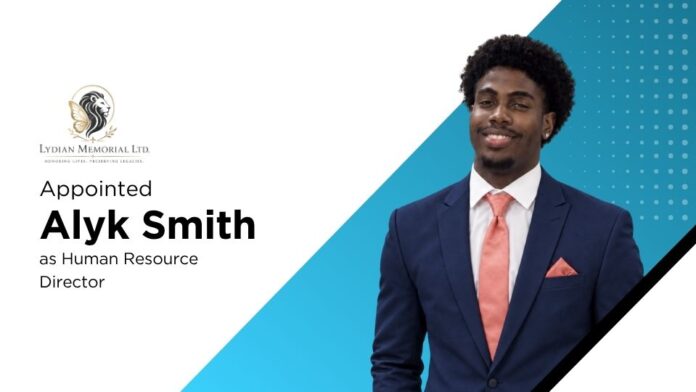

Lydian Memorial has appointed Alyk Smith as Human Resource Director as the Jamaica-based company expands its workforce, production capabilities and service offerings. The appointment puts formal HR systems, employee training, workplace safety and organizational development at the center of the company’s next growth phase.
For growing manufacturers, adding employees is only one part of scaling a business. Companies also need the HR systems, training processes and workplace standards required to turn a larger workforce into a dependable operating organization.
Lydian Memorial is addressing that challenge with the appointment of Alyk Smith as Human Resource Director.
The Jamaica-based company, which operates across memorial products, engraving, manufacturing and custom signage, says Smith will oversee its human resources functions as the organization expands its workforce and production capabilities.
His responsibilities span the core HR lifecycle, including recruitment, onboarding, employee relations, training, performance management, policy administration, personnel records and organizational development.
The appointment is significant because it moves HR from an administrative function toward a more structured component of the company’s growth strategy.
As organizations expand, informal processes that work with a small team can become difficult to manage. Job responsibilities need to be documented, hiring procedures standardized and employees given consistent expectations. Training also becomes more important when new workers are introduced to manufacturing equipment, production processes and workplace safety requirements.
Smith will help build those systems at Lydian Memorial.
His remit includes developing recruitment and hiring procedures, creating job descriptions, coordinating interviews and offers, managing onboarding and maintaining confidential personnel records. He will also administer workplace policies and the employee handbook while supporting performance reviews, improvement plans, attendance and disciplinary procedures.
For employees, the objective is greater clarity around how the organization operates and what is expected of them.
For leadership, structured HR processes can provide better visibility into workforce needs, employee performance and organizational development as the company adds products, expands production and enters additional markets.
Training is another major component of the role.
Lydian Memorial’s manufacturing operations involve laser and CNC equipment, engraving and finishing processes, material handling and installation work. Smith will coordinate with operations and production leaders to ensure employees receive appropriate instruction before undertaking those responsibilities.
Training areas are expected to include equipment safety, personal protective equipment, granite lifting and material handling, emergency procedures, quality control, customer service, confidentiality and workplace conduct.
That combination illustrates how modern HR functions increasingly overlap with operations.
In manufacturing environments, employee development is not limited to conventional professional skills. Training can directly affect workplace safety, product consistency and operational efficiency. HR teams therefore need to work closely with production managers to understand which competencies employees require and how those skills should be documented and refreshed.
This is also where HR technology can become relevant.
Learning-management systems can track required training and refresher courses, while HR information systems can centralize employee records, performance information and organizational policies. Applicant tracking systems can standardize recruitment, while workforce analytics can help companies identify hiring requirements, turnover patterns and skills gaps.
Lydian Memorial’s announcement does not indicate that it is deploying a specific HR technology platform. However, the processes Smith has been tasked with establishing represent many of the workflows that modern HRTech platforms are designed to manage.
The appointment also comes at a time when skills-based workforce management is gaining attention across industries. Rather than treating employees solely according to job titles, organizations can map specific skills, certifications and training requirements to roles.
For a manufacturing company, that could mean knowing which employees are qualified to operate particular equipment, which workers have completed safety training and where additional development is needed.
Employee relations will form another part of Smith’s remit. Lydian Memorial says he will provide processes for employees to raise concerns, report workplace issues and seek guidance. The company also plans to emphasize respectful communication, professional conduct and accountability.
Those mechanisms become particularly important as organizations grow. A larger workforce introduces more interpersonal and managerial complexity, making consistency in workplace policies increasingly important.
Smith will also support compensation, benefits, recognition and retention initiatives. These functions connect workforce experience with the company’s ability to retain institutional knowledge as it grows.
Retention can be particularly valuable in manufacturing because experienced employees may carry knowledge of equipment, production processes, quality standards and customer requirements that is difficult to replace immediately.
The broader labor market reinforces the importance of this approach. The U.S. Bureau of Labor Statistics projects employment in production occupations to decline overall from 2024 to 2034, but it also projects about 909,100 openings annually across production occupations due largely to replacement needs. The figure illustrates why employers can face substantial workforce-management requirements even in occupational categories where aggregate employment is not growing.
For Lydian Memorial, workforce planning will need to account for its own expansion rather than relying solely on broader labor-market trends. Smith will advise executive leadership on staffing and organizational requirements as the company develops new products, expands manufacturing and pursues additional markets.
The appointment also creates a clearer division of responsibilities within the company’s leadership structure. Smith will focus on people, policies, training and workplace culture, while other executives oversee operations, production development, marketing and corporate strategy.
That separation can help a growing organization establish accountability across functions while giving HR a direct role in strategic workforce planning.
For HRTech providers, smaller and mid-sized manufacturers represent an opportunity to bring structured workforce management to businesses that may previously have relied on manual processes. The demand spans recruiting and onboarding through learning, safety compliance, performance management and employee engagement.
Lydian Memorial’s move illustrates the starting point of that journey: before an organization can effectively scale its workforce, it needs a framework for defining jobs, training people, measuring performance and maintaining consistent workplace standards.
The Human Resource Director role therefore represents more than a new leadership position. It signals an effort to build the people infrastructure required to support physical production, employee development and business growth at the same time.
Market Landscape
Growing manufacturers are increasingly treating HR infrastructure as part of operational scalability. Recruitment, onboarding, learning, safety training, performance management and employee records all become more complex as headcount increases.
HRTech platforms can connect these processes through HRIS, applicant tracking, learning management, workforce analytics and performance-management systems.
For manufacturing organizations, the opportunity extends into skills-based workforce management, where employee capabilities and completed training can be connected to specific equipment, production processes and safety requirements.
Top Insights
- Lydian Memorial’s new HR leadership role connects recruitment, training, safety, performance management and organizational development to its expansion strategy.
- Manufacturing growth requires HR systems that can document employee skills, training completion, workplace expectations and operational responsibilities.
- Structured onboarding and equipment-safety training can help organizations reduce preventable risks while improving consistency across expanding production teams.
- HR technology can centralize employee records, recruitment, learning, performance management and workforce analytics as companies move beyond informal processes.
- BLS projects about 909,100 annual openings across production occupations from 2024 to 2034, largely reflecting replacement needs.
Join thousands of HR leaders who rely on HRTechEdge for the latest in workforce technology, AI-driven HR solutions, and strategic insights





