
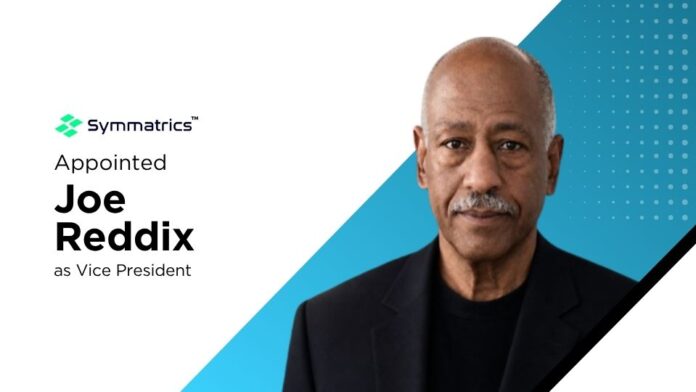

The federal cybersecurity market is confronting a workforce problem alongside a technology problem: agencies need to modernize identity, access and infrastructure while managing increasingly complex machine-driven systems. Symmatrics has appointed Joe Reddix as vice president of Federal Sector, giving the cybersecurity company a senior executive focused on government growth, systems integration and adoption of its quantum-secure security architecture. The move also places workforce expertise at the center of a broader push to prepare government systems for AI and post-quantum threats.
Symmatrics Brings Federal Workforce Expertise to Its Quantum-Security Push
Symmatrics is adding a veteran government technology executive as it attempts to turn its quantum-security proposition into deployments across the federal government.
The company announced the appointment of Joe Reddix as vice president of Federal Sector, where he will lead federal strategy and growth initiatives. The company says his priorities will include pilot deployments at Fort Meade, partnerships with major systems integrators and acquisition pathways intended to speed adoption by federal agencies.
The appointment is significant less for the executive move itself than for the market Symmatrics is targeting.
Federal agencies are being asked to modernize systems while defending increasingly distributed digital environments. AI introduces new forms of machine-to-machine activity, while the eventual arrival of cryptographically relevant quantum computing is forcing organizations to reconsider how long-standing encryption and identity technologies will hold up.
For HR and workforce-technology leaders, that creates an unusual intersection. Cybersecurity modernization increasingly depends on specialized talent, systems-integration expertise and the ability to manage identities belonging not just to employees, but also to applications, devices and automated systems.
Reddix joins Symmatrics from The Reddix Group, where he served as president. Before founding the company, he held leadership and project-management roles at General Dynamics and BAE Systems. Symmatrics says his previous work included supporting the Department of Defense and Intelligence Community, as well as projects involving artificial intelligence, machine learning and microservices architectures.
That background fits the company’s stated strategy.
Symmatrics describes its technology as a quantum-secure symmetric-key trust layer intended to reduce dependence on conventional public-key infrastructure. The company says its architecture combines symmetric-key encryption, continuous credential renewal and a zero-PKI identity model.
Those are substantial technical claims, and they should be viewed as company positioning rather than independently established industry consensus. In particular, Symmatrics’ description of its architecture as “mathematically unbreakable” and its claim that it can eliminate credential-based cybercrime require technical validation in specific deployment environments.
The underlying problem, however, is well established.
Identity infrastructure is becoming more complicated as organizations deploy cloud services, automation and AI. Gartner reported in 2025 that an IAM survey of 335 leaders found IAM teams were responsible for only 44% of an organization’s machine identities. The research firm warned that unmanaged machine accounts and credentials can materially expand the attack surface.
That matters for federal agencies because automated systems can require access to the same infrastructure that human workers use.
From Workforce Identity to Machine Identity
Traditional identity and access management has largely been built around people: employees receive accounts, permissions are assigned according to their roles and access is revoked when circumstances change.
Machine identity management complicates that model.
Applications, workloads, devices, APIs and AI agents can all require credentials or authorization. Their lifecycles can also be much faster than those of human employees.
Gartner has consequently positioned machine identity and access management as an increasingly important component of enterprise IAM. Its 2025 research describes machine-to-machine interactions as ubiquitous and a significant risk surface.
The federal workforce challenge adds another dimension.
The U.S. Government Accountability Office reported in 2025 that most of 23 agencies it reviewed could not accurately determine the size and cost of their cyber workforce. Agencies reported at least 63,934 federal cybersecurity-related staff and 4,151 contractor staff, representing at least $14.6 billion in annual costs, but GAO said those figures were incomplete and unreliable.
The implication for federal technology vendors is straightforward: sophisticated security architectures still require people who can integrate, operate and govern them.
Reddix’s systems-integration background therefore becomes part of Symmatrics’ value proposition. The company says it wants to work with prime contractors and integrate systems across cyber, intelligence, communications and coalition environments rather than position its technology as a standalone replacement for every existing security system.
That distinction could matter in government procurement.
Federal agencies rarely replace infrastructure in isolation. New security technologies must fit existing identity systems, applications, networks, acquisition processes and compliance requirements. Integration can become as important as the underlying cryptography.
Competing With the Existing Security Stack
Symmatrics also enters a market dominated by established identity, encryption and cybersecurity ecosystems.
Microsoft, IBM, Cisco, Thales, Entrust, CyberArk and other vendors already provide pieces of identity, authentication, privileged access, encryption and security infrastructure. Gartner’s 2025 access-management research evaluated vendors including Microsoft, Okta, CyberArk, Entrust, IBM, Ping Identity and Thales, illustrating the breadth of the existing market.
Symmatrics’ differentiation is therefore not simply that it offers stronger encryption. Its pitch is that a different trust architecture can reduce reliance on conventional PKI and continuously refresh credentials.
Whether that approach can scale economically and operationally across federal environments will depend on interoperability, certification, key-management logistics, acquisition requirements and independent security validation.
The company’s planned Fort Meade pilots could become an important early test.
For HR and workforce-technology teams, the broader lesson is that cybersecurity skills are becoming part of workforce infrastructure. Government agencies need personnel who understand identity, cloud architecture, AI systems, cryptography and systems integration simultaneously.
That demand is emerging while agencies are already dealing with workforce constraints. GAO reported in July 2026 that federal cybersecurity workforce development programs have struggled to achieve broad participation, with only eight employees completing rotational assignments under the Federal Rotational Cyber Workforce Program over its lifetime.
Symmatrics’ Reddix appointment consequently represents two parallel trends: a cybersecurity company expanding its federal go-to-market operation and a government technology market increasingly dependent on specialized talent capable of integrating emerging security technologies.
For enterprise and government buyers, the eventual test will not be the strength of a technology’s marketing claim. It will be whether the architecture can operate alongside existing infrastructure, withstand independent scrutiny and provide measurable security improvements without creating a new layer of operational complexity.
Market Landscape
The federal identity and cybersecurity market is shifting from human-centric access control toward human and non-human identity governance.
Three forces are driving the change:
AI and automation: AI agents, software workloads and automated processes increasingly need controlled access to applications and data.
Post-quantum preparation: Organizations are assessing how existing cryptographic systems will need to evolve as quantum computing advances.
Cybersecurity workforce constraints: Agencies need specialized professionals capable of implementing and governing increasingly complex infrastructure.
The competitive environment includes established IAM and security providers such as Microsoft, CyberArk, IBM, Entrust, Okta and Thales, alongside specialist companies targeting machine identity, zero trust and post-quantum security.
For federal technology buyers, Symmatrics’ proposed differentiation is architectural: replacing or reducing dependence on traditional PKI through a symmetric-key trust model.
That makes interoperability and deployment economics critical questions. A new security layer must work across legacy systems, cloud infrastructure, government applications and contractor environments if it is to become federal infrastructure rather than a narrowly deployed security product.
The workforce implications are equally important. GAO’s findings suggest federal agencies still have difficulty measuring their cyber workforce capacity, while Gartner’s research indicates that machine identities are increasingly outside the direct control of traditional IAM teams.
The result is a market where security architecture and workforce capability are becoming inseparable.
Top Insights
- Symmatrics appointed Joe Reddix to lead federal growth, bringing systems-integration experience to its push for quantum-secure identity and cybersecurity infrastructure.
- Machine identities are expanding the security workforce challenge, with Gartner finding IAM teams directly responsible for only 44% of organizational machine identities.
- Federal agencies face persistent cyber talent constraints, making systems integration and specialized cybersecurity expertise increasingly important to modernization programs.
- Symmatrics is challenging traditional PKI architecture, but its quantum-security and zero-PKI claims will need independent technical validation and successful federal deployments.
- AI and post-quantum security are converging, forcing government technology teams to rethink identity, encryption, infrastructure and workforce capabilities simultaneously.
Join thousands of HR leaders who rely on HRTechEdge for the latest in workforce technology, AI-driven HR solutions, and strategic insights





