
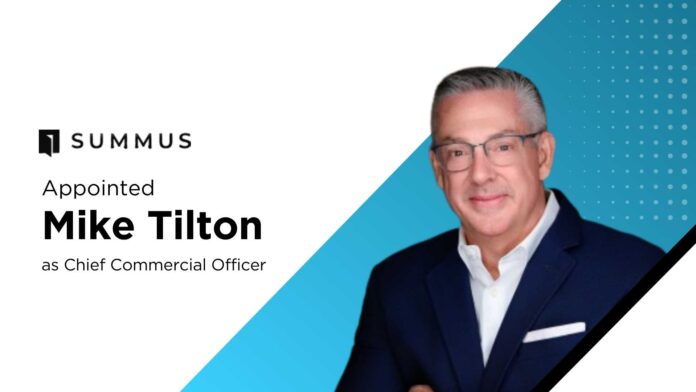

As healthcare employers and insurers face rising medical costs and increasing complexity in specialty care management, digital health platforms are racing to position themselves as centralized care coordination infrastructure rather than standalone point solutions.
Summus, a physician-led clinical navigation and specialty care platform, announced the appointment of healthcare executive Michael P. Tilton as Chief Commercial Officer, signaling the company’s next phase of growth as it expands partnerships with employers and health plans.
The executive hire comes at a time when self-insured employers, benefits consultants, and insurers are reassessing healthcare delivery models amid persistent inflation in medical spending and growing dissatisfaction with fragmented care ecosystems.
Tilton joins Summus after serving in senior leadership roles across several of the largest organizations in U.S. healthcare, including Humana, Blue Cross Blue Shield of Arizona, UnitedHealth Group, and Cigna.
At Summus, he will oversee go-to-market strategy across employer and health plan channels as the company scales its physician-led platform designed to support high-cost and medically complex members throughout their care journeys.
Employers Are Seeking Fewer Healthcare Point Solutions
The appointment reflects a broader shift occurring across employer-sponsored healthcare.
Over the past decade, employers adopted dozens of specialized digital health solutions targeting areas such as mental health, chronic disease management, care navigation, telehealth, and benefits engagement. But many organizations are now moving toward platform consolidation strategies aimed at reducing operational complexity and improving measurable health outcomes.
Healthcare costs continue rising sharply.
According to projections from PwC and Mercer, employer-sponsored healthcare costs are expected to increase approximately 8% to 9% annually in 2026, driven largely by specialty care utilization, chronic disease prevalence, and rising pharmacy expenses.
Specialty care remains one of the largest drivers of healthcare spending, particularly among high-risk patient populations who often navigate disconnected provider systems, multiple diagnoses, and inconsistent care coordination.
That environment has created demand for clinically guided navigation platforms capable of supporting patients longitudinally across multiple healthcare interactions.
Summus positions itself within that category by combining physician-led clinical guidance with digital care navigation infrastructure.
Unlike many virtual care startups focused narrowly on telemedicine or wellness engagement, the company emphasizes ongoing specialist access, expert second opinions, and coordinated support for medically complex members.
“Employers and health plans are under enormous pressure to manage the highest-cost, most complex members without compromising member experience,” Tilton said in the announcement.
Healthcare Navigation Is Becoming a Strategic HR Technology Category
The rise of clinical navigation platforms reflects the convergence of healthcare technology, employee benefits strategy, and workforce experience management.
Large employers increasingly view healthcare navigation not simply as a medical service, but as part of broader employee experience and retention initiatives.
The complexity of the U.S. healthcare system often creates operational burdens for employees navigating specialty care decisions, insurance approvals, provider networks, and treatment pathways.
Research from McKinsey & Company has found that employees frequently struggle to access appropriate specialty care quickly, contributing to delayed treatment, increased costs, and lower satisfaction with employer-sponsored health plans.
As a result, employers are seeking healthcare platforms that combine clinical expertise, digital accessibility, and measurable cost management outcomes.
That trend has fueled growth across healthcare navigation and digital advocacy categories, where companies compete to become centralized healthcare engagement layers between members, providers, and insurers.
Competitors in the broader market include Included Health, Accolade, Transcarent, Quantum Health, and navigation offerings embedded within larger payer ecosystems.
The market is also attracting attention from enterprise technology providers and AI-driven healthtech companies seeking to automate aspects of care coordination, member engagement, and clinical triage.
Leadership Experience Signals Enterprise Expansion Plans
Tilton’s background suggests Summus is preparing for deeper expansion within enterprise payer and employer markets.
At Humana, he managed specialty and retiree solutions businesses representing more than $12.7 billion in annual revenue. His experience also spans commercial insurance operations, underwriting, payer strategy, provider contracting, and healthcare go-to-market execution.
That experience may prove particularly valuable as healthtech vendors face increasing scrutiny from employers demanding measurable return on investment and integrated healthcare ecosystems.
Many employers are no longer willing to adopt isolated healthcare applications without clear operational and financial impact.
Instead, buyers increasingly prioritize platforms capable of integrating into broader benefits strategies while reducing fragmentation across employee healthcare experiences.
Summus’ positioning as a physician-led platform may also differentiate it in a crowded digital health market where many competitors rely heavily on AI-driven workflows or nonclinical navigation models.
Healthcare organizations are increasingly balancing automation with clinician oversight, particularly in high-acuity care management where trust and medical expertise remain critical.
AI and Care Navigation Are Beginning to Converge
While Summus emphasizes physician-led care, the broader healthcare technology sector is rapidly incorporating AI into navigation and clinical support systems.
Platforms across the industry are integrating AI-powered triage, predictive analytics, care recommendations, and member engagement tools designed to identify rising-risk patients earlier and optimize healthcare utilization patterns.
Technology giants including Microsoft, Google, Amazon, and Salesforce are all expanding healthcare AI investments focused on operational efficiency, clinical workflow support, and patient engagement infrastructure.
The challenge for healthcare navigation providers will likely center on balancing automation with clinical trust.
As healthcare systems grow more data-driven, physician-guided platforms may hold an advantage in complex care scenarios where patients and employers require both digital efficiency and medical credibility.
For employers and insurers, the larger objective remains controlling healthcare costs without reducing care quality or employee satisfaction.
That pressure is likely to continue driving investment toward integrated care navigation platforms capable of unifying fragmented healthcare experiences under a single operational model.
Market Landscape
The healthcare navigation and digital care coordination market is expanding rapidly as employers and insurers seek solutions that improve member outcomes while reducing specialty care costs. According to McKinsey & Company and Gartner healthcare research, organizations are consolidating healthcare point solutions into broader integrated care platforms focused on navigation, clinical guidance, and longitudinal member engagement.
Digital health vendors increasingly compete on measurable cost reduction, care coordination effectiveness, physician access, and member experience outcomes. At the same time, AI-driven healthcare infrastructure is reshaping clinical workflows, predictive risk management, and patient support systems across the healthcare ecosystem.
Top Insights
- Summus appointed veteran healthcare executive Michael P. Tilton as Chief Commercial Officer to accelerate growth across employer and health plan markets.
- Employers are increasingly consolidating fragmented healthcare point solutions into integrated care navigation platforms focused on high-cost and medically complex members.
- Specialty care costs and rising healthcare inflation are driving enterprise demand for physician-led healthcare coordination and longitudinal clinical support models.
- Healthcare navigation platforms are evolving into strategic workforce experience tools that combine clinical expertise, digital accessibility, and measurable cost management outcomes.
- AI-powered healthcare infrastructure is accelerating across the industry, though physician-led models remain critical for trust and oversight in complex care management.
Join thousands of HR leaders who rely on HRTechEdge for the latest in workforce technology, AI-driven HR solutions, and strategic insights






