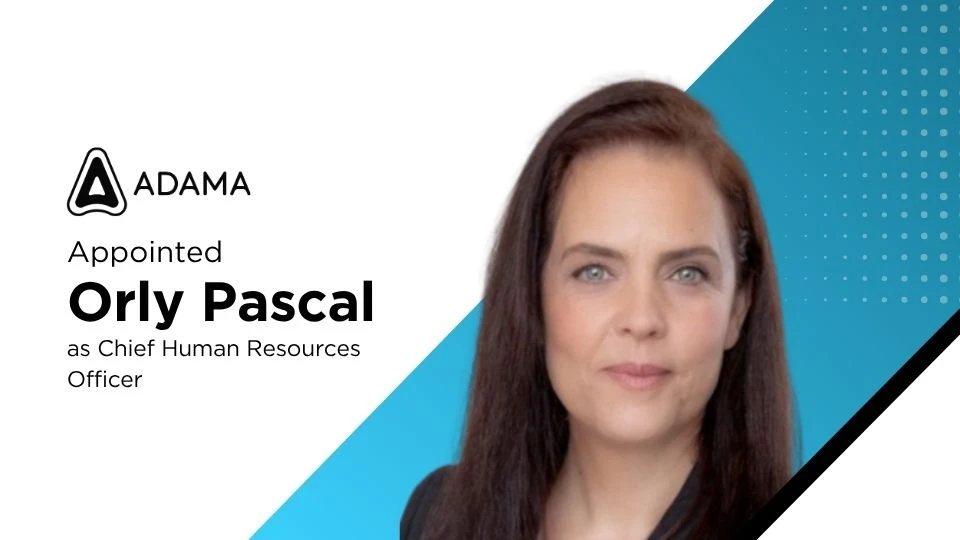
ADAMA is putting its human resources function closer to the center of its global transformation agenda, appointing Orly Pascal as chief human resources officer at a time when large enterprises are redesigning jobs, leadership structures and workforce capabilities around AI and changing operating models.
ADAMA Ltd. has appointed Orly Pascal as Chief Human Resources Officer (CHRO), adding her to the company’s Global Leadership Team effective August 12, 2026. Pascal will oversee the global HR organization, with responsibility for people strategy, organizational development and workforce capabilities across ADAMA’s international operations.
The appointment is notable less as a routine executive reshuffle than as a signal of where workforce strategy is heading inside large, geographically dispersed companies. HR leaders are increasingly being asked to help redesign how organizations operate, rather than simply manage recruitment, compensation and employee programs.
That shift is particularly relevant for ADAMA. The crop protection company operates across a complex international ecosystem spanning manufacturing, research and development, commercial operations and regional markets. Its 2025 ESG report lists more than 7,000 employees worldwide, $4.05 billion in sales and direct commercial presence in 20 key markets.
Pascal brings more than two decades of HR leadership experience. Before joining ADAMA, she was EVP and deputy to the CEO at Phoenix Financial, Israel’s largest insurance and financial services group, according to the company. Earlier, she served as VP HR at Cellcom and held several senior HR positions at Teva Pharmaceutical, including roles covering international markets, global support functions, regional HR and HR strategy and integration.
That background gives Pascal experience across industries where organizational complexity, regulatory requirements and international workforce management are significant operational issues.
At ADAMA, her mandate includes organizational transformation, succession planning and talent development. Those priorities increasingly overlap with technology decisions. As companies deploy AI, workforce analytics, automation and digital collaboration tools, HR teams are becoming responsible for determining which skills the organization needs, how roles should evolve and how employees move into new positions.
Gartner’s 2026 HR research illustrates the scale of the change. The research firm says AI transformation is the leading HR priority for CHROs, alongside workforce redesign for the human-machine era. Gartner also reported that 40% of organizations surveyed had eliminated outdated roles to align with changing business needs, while nearly half had redesigned teams to become more cross-functional or agile.
For ADAMA, that context matters because workforce transformation cannot be separated neatly from operational transformation. The company has already signaled a broader focus on changing its manufacturing organization: in May, ADAMA appointed Hongsheng Liu as EVP AI Production, describing the role as part of its next phase of manufacturing transformation.
Pascal’s arrival therefore creates a potentially important connection between operational change and the talent infrastructure needed to support it.
Why the CHRO role is changing
Traditional HR software has largely centered on systems of record: employee data, payroll, recruiting, benefits and performance management. The newer HR technology market is moving toward systems that can help organizations understand workforce skills, forecast talent requirements and automate parts of employee and manager workflows.
Platforms from companies such as Microsoft, Salesforce, Workday and SAP increasingly sit alongside specialized talent intelligence, employee experience and workforce analytics products. Meanwhile, generative AI is introducing another layer, with vendors developing AI assistants and agents capable of handling HR queries, drafting communications, supporting recruiting workflows and surfacing workforce insights.
The challenge for enterprise HR leaders is not simply buying these tools. It is integrating them into operating models without losing governance, employee trust or accountability.
Gartner says 92% of HR leaders had taken steps to implement AI during the six months preceding its March 2026 research. It also estimates that AI could augment all HR tasks and perform up to half of current HR activities by 2030.
That makes organizational design and leadership development strategic technology concerns.
Pascal’s experience in transformation and HR strategy could position her to address precisely that intersection. Her remit will involve building leadership capabilities and developing talent pipelines while ADAMA continues to operate across different markets, functions and labor environments.
There is also a broader lesson for enterprise buyers of HR technology. A sophisticated workforce analytics platform or AI-enabled HR suite does not automatically produce a more capable organization. The value depends on whether HR leaders can translate workforce data into decisions about skills, structures, succession and deployment.
McKinsey research reinforces that point: organizations are increasingly redesigning workflows and retraining employees as they introduce generative AI, while companies that treat talent management as a strategic capability can capture substantially greater economic value.
For HR technology vendors, appointments such as Pascal’s also highlight a changing buyer. The CHRO is becoming an increasingly important stakeholder in enterprise transformation alongside the CIO, COO and business-unit leadership.
ADAMA has not announced a new HR technology platform as part of Pascal’s appointment, so it would be premature to assume a specific software strategy. What is clear is that the company is placing its global people function under an executive with a mandate spanning organizational effectiveness, leadership and workforce capability.
That distinction matters. The next phase of HR technology will be judged less by how much administrative work it can automate and more by whether it helps enterprises redesign work effectively.
For a global manufacturer such as ADAMA, the question is ultimately practical: can technology, leadership and workforce planning move together quickly enough to support the company’s next stage of growth?
Pascal’s appointment puts that question firmly within the CHRO’s remit.
Market Landscape
The HRTech market is moving from systems of record toward systems of intelligence and action. Core HR, payroll and recruiting platforms remain foundational, but enterprise buyers are increasingly evaluating workforce analytics, skills intelligence, employee experience platforms and AI-enabled HR automation as connected components of a broader operating model.
The competitive landscape includes large enterprise ecosystems such as Microsoft, SAP, Salesforce and Oracle, alongside specialist HR platforms such as Workday and talent-focused technology providers. The differentiator is increasingly less about whether a vendor offers AI and more about how securely and effectively that AI connects employee data, workflows, skills and business planning.
The timing of ADAMA’s appointment reflects that transition. Gartner says 50% of current HR activities could be performed by AI or AI agents by 2030, while McKinsey found that 76% of employees reported using AI at work in 2025, up sharply from 30% in 2023.
For enterprise HR teams, the implication is straightforward: AI adoption is becoming a workforce-design issue, not merely a software procurement decision.
Top Insights
- ADAMA appointed Orly Pascal as CHRO to lead global people strategy, organizational development and workforce capabilities across its international operations and functions.
- Pascal’s transformation and succession-planning background arrives as HR leaders increasingly manage AI-driven workforce redesign, skills planning and organizational restructuring.
- ADAMA’s manufacturing transformation agenda increases the importance of aligning operational technology investments with leadership development, talent pipelines and employee capabilities.
- Enterprise HR technology is shifting beyond payroll and employee records toward AI assistants, workforce analytics, skills intelligence and automated decision-support workflows.
- The appointment highlights a broader industry trend: CHROs are becoming strategic transformation leaders alongside CIOs and COOs as AI changes how organizations structure work.
Join thousands of HR leaders who rely on HRTechEdge for the latest in workforce technology, AI-driven HR solutions, and strategic insights