
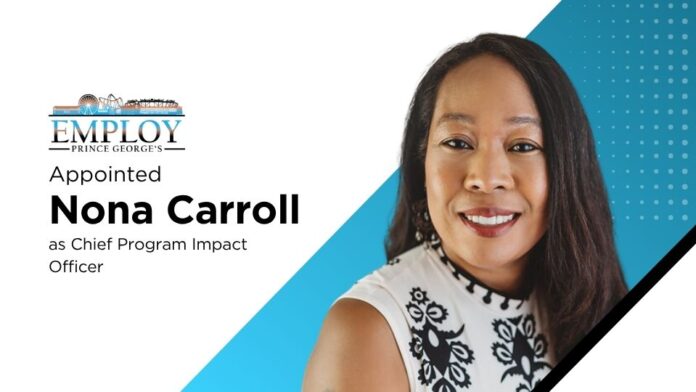

Employ Prince George’s is adding new leadership to its workforce-development operation as employers and communities face a more complicated skills and talent environment. The Maryland workforce organization has appointed Nona Carroll as Chief Program Impact Officer, effective August 10, 2026, giving her responsibility for program performance, workforce partnerships and initiatives connecting Prince George’s County residents with education, training and employment.
Workforce development is increasingly becoming an ecosystem exercise. Employers need skilled workers, education providers need stronger connections to job opportunities, and communities need career pathways that translate training into sustainable employment.
Employ Prince George’s (EPG) is responding to that challenge with a leadership change aimed at strengthening those connections.
The organization has appointed Nona Carroll as Chief Program Impact Officer, effective August 10. Carroll will oversee workforce-development program performance and help advance partnerships connecting Prince George’s County residents with education, training and employment opportunities.
Her appointment comes with more than 15 years of leadership experience across nonprofit, education and corporate organizations.
Most recently, Carroll served as Chief of Talent Ecosystem at Baltimore’s Promise, where she worked on workforce initiatives designed to strengthen career pathways for young people across Maryland. She previously held senior roles at the Maryland Business Roundtable for Education, including interim CEO, chief strategy officer and deputy director and chief program officer. Earlier in her career, she worked at investment management firm T. Rowe Price.
The career path is notable because it spans several of the institutions now being asked to collaborate more closely on workforce development: employers, education organizations, nonprofits and public-sector stakeholders.
For HR leaders, that model reflects a broader shift away from treating talent development as an isolated corporate function.
Employers increasingly need external partnerships to build pipelines for difficult-to-fill roles, while workforce organizations are expected to understand the specific skills businesses require. That makes coordination between training providers, economic-development organizations and employers increasingly important.
Carroll’s role at EPG will focus on that intersection.
According to the organization, she will provide strategic leadership for its workforce programs, oversee program performance, advance organizational priorities and strengthen partnerships supporting both residents and local employers.
The emphasis on program performance is particularly relevant as workforce-development organizations face greater pressure to demonstrate measurable outcomes.
Traditional measures such as enrollment and program completion provide only part of the picture. Employers and public-sector funders increasingly want to know whether programs lead to employment, wage growth, career progression and sustained participation in the labor market.
That is pushing workforce organizations toward more data-driven operating models.
Skills assessments, labor-market analytics, digital credentialing and workforce intelligence platforms can help identify which occupations are expanding, what capabilities employers require and where training investments are likely to have the greatest effect.
The technology layer is increasingly important because local labor markets can differ substantially from national trends.
A workforce program designed around national demand may not address the specific skills shortages affecting employers in Prince George’s County. Local workforce organizations therefore need mechanisms to translate employer demand into training programs and then connect qualified candidates back to those employers.
This is also where the HR technology ecosystem increasingly overlaps with workforce development.
Applicant tracking systems and recruiting platforms traditionally focus on candidates already looking for work. Skills-based workforce systems extend the process further upstream, helping organizations identify potential talent before candidates enter the traditional hiring funnel.
Learning and development platforms, meanwhile, can help workers acquire skills while workforce analytics can give employers visibility into internal and external talent supply.
The result is a more connected model of talent acquisition and development.
Carroll brings experience in building that type of cross-sector infrastructure. During her career, she has led statewide initiatives serving tens of thousands of students each year and helped secure multimillion-dollar investments intended to expand workforce opportunities, according to EPG.
She also currently serves as secretary and chair of the Justice, Diversity, Equity & Inclusion Committee at Maryland Nonprofits and sits on the Pillar 3 Advisory Committee for the Blueprint for Maryland’s Future Accountability & Implementation Board.
Those roles provide exposure to policy, education and community-based workforce issues beyond a single employer or training provider.
For Prince George’s County employers, the practical question will be whether that experience can translate into stronger pipelines for the occupations businesses need to fill.
For residents, the objective is different but connected: making education and training opportunities easier to navigate and more directly connected to viable careers.
That dual mandate is becoming increasingly common for workforce-development organizations.
The U.S. labor market has moved away from the extraordinary hiring conditions of the early post-pandemic period. Employers are becoming more selective, while many workers are looking for career mobility rather than simply another job. At the same time, artificial intelligence and automation are changing the skills required for existing roles.
These pressures increase the value of organizations that can connect employers, education providers and workers around real-time labor-market needs.
Carroll’s appointment therefore represents more than an executive personnel change. It reflects a broader evolution in workforce development toward measurable outcomes, cross-sector partnerships and skills-based career pathways.
For HR technology providers, that evolution creates a larger addressable ecosystem. The systems connecting employers with candidates are increasingly being complemented by platforms that connect workers with training, credentials and career opportunities before they become traditional job applicants.
Market Landscape
The workforce-development market is increasingly converging with HR technology, skills intelligence and talent acquisition.
Platforms from Workday, LinkedIn, Microsoft, Oracle and SAP increasingly incorporate skills data, learning capabilities, workforce planning or talent intelligence into broader enterprise ecosystems. At the same time, specialized providers are developing tools for skills assessment, credentialing, career mobility and labor-market analysis.
Government and nonprofit workforce organizations occupy a different position in this ecosystem. Their role often involves coordinating multiple stakeholders rather than simply supplying software or recruiting services.
That makes data interoperability and shared labor-market intelligence increasingly important. A training provider may know what courses a worker completed, while an employer knows which skills it needs and a workforce agency knows which populations require support. Connecting those datasets can make workforce programs more responsive.
The growing emphasis on skills-based hiring also changes how employers evaluate candidates. Instead of relying exclusively on degrees, job titles or previous employers, organizations can increasingly assess specific competencies.
For workforce-development organizations, that creates an opportunity to make training credentials more directly useful to employers.
The long-term challenge will be proving that these systems produce measurable outcomes: stronger employment rates, better wages, shorter hiring cycles and improved retention.
Top Insights
- Employ Prince George’s appointed Nona Carroll chief program impact officer, adding workforce-development expertise to its executive leadership team.
- Carroll’s experience spans nonprofits, education and business, positioning her to strengthen partnerships connecting workers, training providers and employers.
- The appointment highlights the growing importance of ecosystem-based workforce development as employers face changing skills requirements and talent shortages.
- Skills intelligence, workforce analytics and digital credentials could increasingly connect community training programs with employer hiring requirements.
- For HR leaders, stronger workforce partnerships can create talent pipelines before candidates enter conventional recruiting channels, particularly for hard-to-fill roles.
Join thousands of HR leaders who rely on HRTechEdge for the latest in workforce technology, AI-driven HR solutions, and strategic insights





