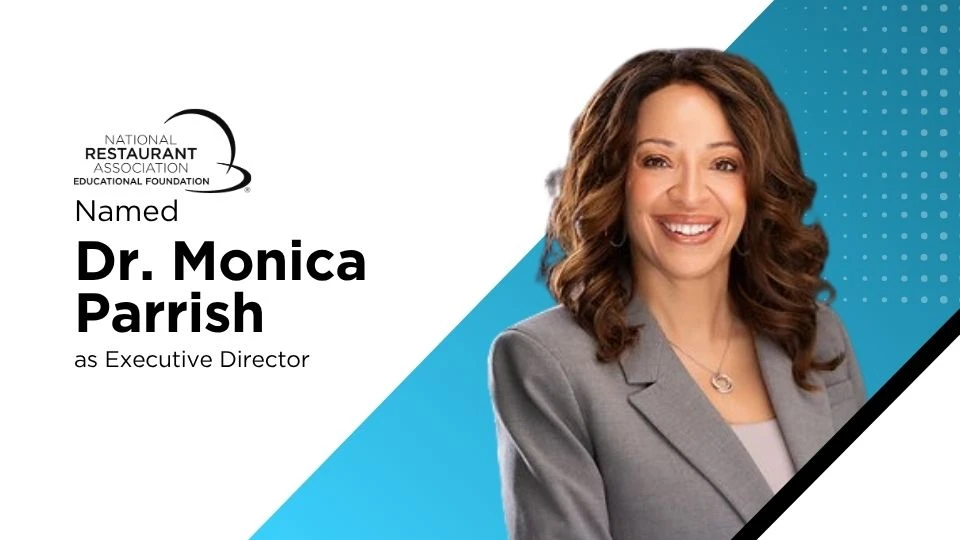
The National Restaurant Association Educational Foundation is putting workforce development at the center of its next leadership chapter, naming Monica Parrish Trent, PhD, as its new Executive Director. Her appointment brings more than two decades of experience spanning higher education, community colleges, workforce strategy and nonprofit leadership to an organization focused on preparing workers for careers across the restaurant, foodservice and hospitality sectors.
The leadership change comes as employers across the service economy face a more complicated workforce environment. Restaurants remain a major source of entry-level employment and career mobility, but employers increasingly need workers with clearly defined skills, credentials and pathways to advancement.
Trent’s background sits directly at that intersection.
Before joining the National Restaurant Association Educational Foundation (NRAEF), Trent served as Chief Program and Network Officer at Achieving the Dream (ATD), a national nonprofit working with more than 300 community colleges. In that role, she oversaw national program and workforce strategy across a distributed network of educational institutions.
Her career spans more than 25 years and includes teaching and leadership positions at multi-campus community colleges before moving into national nonprofit executive roles. That experience is particularly relevant to the Foundation’s model, which relies on partnerships among educators, employers, community organizations and other workforce stakeholders.
Rather than treating workforce development as a standalone training function, the Foundation operates across several stages of the employment journey. Its programs include ProStart, a high-school career and technical education initiative; Restaurant Ready/HOPES, which works with community organizations on skills training and employment; programs supporting military personnel transitioning into civilian careers; scholarships; and apprenticeship programs through the Restaurant & Hospitality Leadership Center.
Trent’s appointment could give the organization an opportunity to strengthen the connections between those programs.
“Monica is an exceptional leader who cares deeply about the power and opportunity in getting people into the right job,” said Michelle Korsmo, CEO of the National Restaurant Association Educational Foundation. Korsmo highlighted Trent’s ability to develop partnerships and translate organizational missions into programs that can reach young people entering the workforce.
That emphasis on translating education into employment reflects a broader shift in HR technology and workforce strategy. Employers are increasingly looking beyond traditional hiring pipelines toward skills-based approaches that identify what workers can do, what credentials they hold and what additional capabilities they need to progress.
For hospitality employers, the issue is particularly important. Training programs have to work for people entering the industry for the first time while also supporting existing employees who want to move into supervisory, management or specialized roles.
Trent said her own experience working in restaurants as a student influenced her view of the sector. She described restaurants and hospitality as industries capable of creating opportunities for people with varied backgrounds, while emphasizing the potential for an initial job to develop into a longer-term career.
That career-pathway approach puts the NRAEF’s work adjacent to several major trends in HR technology, including skills-based hiring, digital learning, workforce analytics and credentialing.
Technology providers such as Workday, SAP, Oracle and Microsoft are increasingly building skills data and workforce intelligence into enterprise HR platforms. Meanwhile, learning and talent platforms are attempting to connect employee skills with training recommendations, internal mobility and career opportunities.
The NRAEF’s model is different. It is not an enterprise HR software provider. Instead, it operates as a workforce development and education organization connecting people with training, credentials and employment opportunities. Its role therefore sits upstream of many HR technology systems, potentially helping create the talent pipelines those platforms are designed to manage.
The distinction matters for employers. Recruiting technology can make it easier to identify candidates, but it cannot by itself solve gaps in foundational skills, work experience or access to career pathways. Workforce organizations such as the NRAEF can help address those gaps before candidates enter an employer’s talent ecosystem.
Trent’s experience managing partnerships across hundreds of community colleges could prove significant in that context. Distributed workforce networks are difficult to scale because educational institutions, employers and community organizations often operate with different objectives and resources.
Her challenge will be turning those relationships into programs that produce measurable outcomes for both workers and employers.
For HR leaders, that means watching not only how many people participate in training programs, but whether participants earn recognized credentials, secure employment and progress into higher-value roles. Those measures increasingly shape how organizations evaluate workforce investments.
The Foundation’s leadership transition therefore represents more than a personnel announcement. It places a workforce-development executive with experience connecting education and employers at the helm of an organization whose programs increasingly intersect with the skills economy.
As restaurants and hospitality companies navigate changing labor requirements, automation and evolving employee expectations, the ability to build clearer pathways from education to employment could become an increasingly important part of the industry’s workforce strategy.
Market Landscape
The appointment arrives during a broader transformation in how employers approach talent development.
The traditional model—recruit, onboard and train for a specific role—is increasingly being supplemented by skills-based workforce management, where employers identify capabilities, map them to jobs and use training to close skill gaps.
For the restaurant and hospitality sector, that model has particular relevance because workers can enter with limited industry experience and progress through multiple roles. Programs combining classroom education, apprenticeships and employer partnerships can create a more structured route from first job to career.
The competitive landscape is also changing. HR platforms from Workday, SAP, Oracle and Microsoft increasingly incorporate skills intelligence, analytics, learning and talent-management capabilities. LinkedIn and other professional platforms also use skills data to connect workers, employers and learning opportunities.
The NRAEF occupies a different position in this ecosystem. Its core proposition is workforce preparation rather than enterprise HR software. Its partnerships with schools, community organizations and employers can therefore complement the HR systems companies already use.
For enterprise and multi-location restaurant operators, the practical question is whether workforce-development programs can produce candidates with demonstrable skills and credentials that map directly to operational requirements.
That makes measurable career progression—not simply training participation—a key indicator to watch.
Top Insights
- NRAEF appointed Monica Parrish Trent, PhD, as Executive Director, bringing extensive workforce-development experience to its restaurant and hospitality talent strategy.
- Trent’s Achieving the Dream experience connects community colleges, employers and workforce partners, potentially strengthening NRAEF’s career pathway and training ecosystem.
- The Foundation’s programs span high-school education, apprenticeships, scholarships, military transitions and community-based workforce training for restaurant industry careers.
- The appointment reflects a broader HR trend toward skills-based hiring, credentialing and structured career pathways rather than relying solely on traditional recruitment.
- Restaurant employers could benefit from stronger links between education, workforce programs, employee skills and measurable career advancement opportunities.
Join thousands of HR leaders who rely on HRTechEdge for the latest in workforce technology, AI-driven HR solutions, and strategic insights